

You are parked outside the house ten minutes early, going over a CMA you printed this morning, and you already know how the next hour usually goes. You walk in warm, you know the comps, the seller nods along, and at the end they say the thing every agent dreads: “We’re talking to a couple of other people, we’ll let you know.” Most of the time they never do, and the listing goes to someone who was not smarter than you. They were just better prepared for the room.
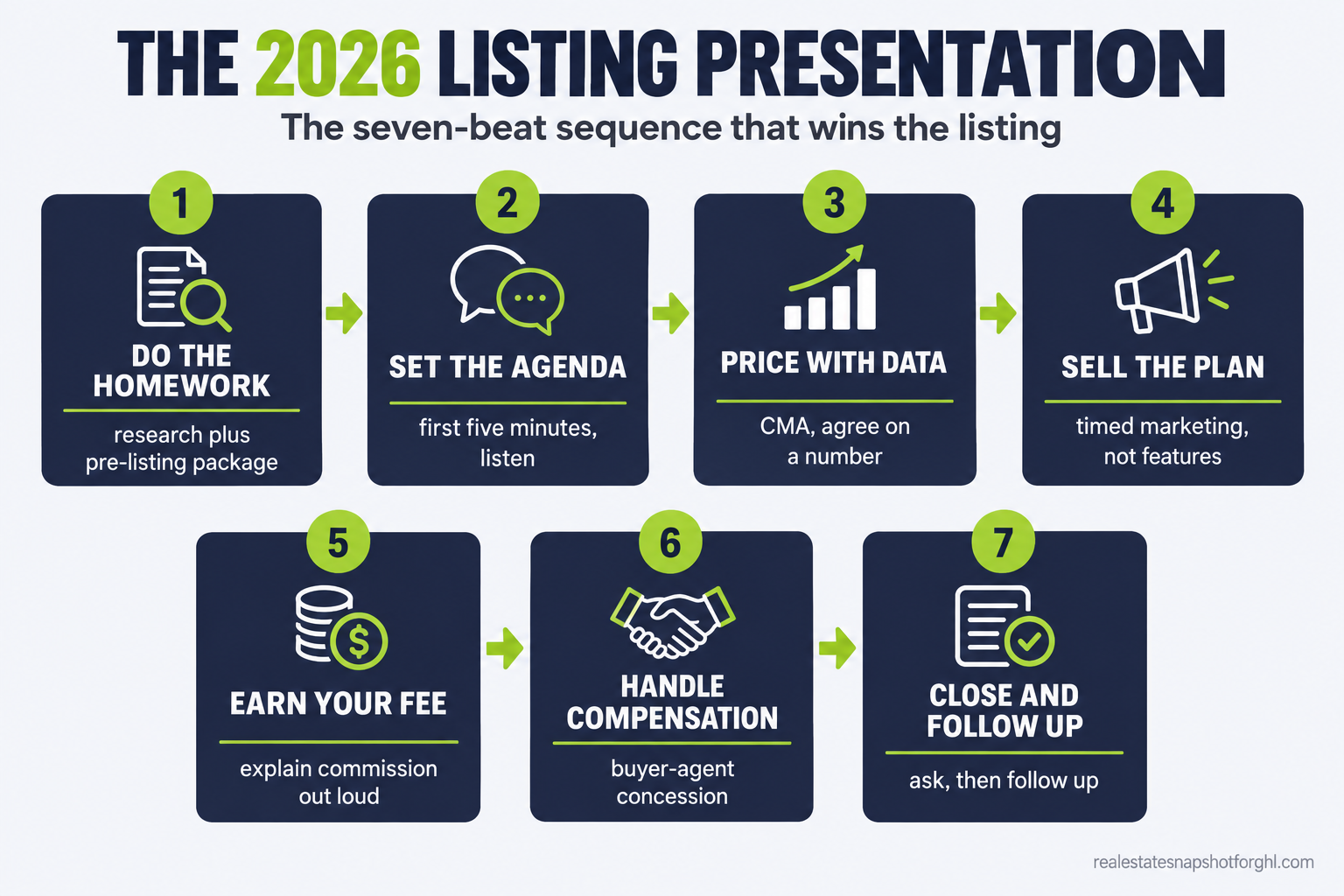
The listing presentation that wins is not a slide deck. It is a sequence: do the homework before you knock, set the agenda in the first five minutes, price with data instead of hope, sell the plan instead of the features, earn your fee out loud, handle the compensation question cleanly, and ask for the signature before you leave. Here is that sequence, section by section, with the scripts you can steal and the exact spots where agents lose the room.
Table of contents
- Why the listing appointment is yours to lose
- What a weak listing presentation costs you
- Stage 1: Do the homework before you knock
- Stage 2: Set the agenda in the first five minutes
- Stage 3: Price with data, not hope
- Stage 4: Sell the plan, not the features
- Stage 5: Earn your fee out loud
- Stage 6: Handle the buyer-compensation question
- Stage 7: Ask for the signature, then follow up
- Three ways to run it: solo, team, brokerage
- Where the compliance line sits
- Objections
- Frequently asked questions
Why the listing appointment is yours to lose
Start with the number that should change how you prepare. About 81% of sellers contact only one agent before they sign, and among sellers aged 26 to 34 it is 86% (NAR 2025 Generational Trends, via BAM). You are rarely in a bake-off. You are the one agent in the room, and the seller is deciding whether to hire you or wait.
That flips the job. You are not beating a rival, you are giving a nervous seller the confidence to move, and most of that confidence is built before the kitchen table, because 66% of sellers came through a referral or a past relationship (NAR 2025 Profile). The sphere-of-influence system that fed you this appointment is what feeds you the next one.
Share of home sellers who contacted only one agent before listing, by age group (NAR 2025 Generational Trends, via BAM). Most of the time you are the only agent in the room.
What a weak listing presentation costs you
A bad appointment does not just cost you one listing. It costs you the price on the one you do win, because in 2026 pricing is where the money is made or lost. Realtor.com’s June 2026 analysis found homes under contract by week four sell about 1.8% above the market average, while homes sitting 18 weeks or more sell 1.3% below it, and price cuts now peak around week six versus week three back in 2021 (Realtor.com, via Barchart).
On a median home of $429,100 (NAR, August 2026), the spread between a fast sale and a stale one is roughly $13,000, before the carrying costs and the two price drops that drain a seller’s trust. If your presentation cannot get a seller to the right number on day one, you have lost most of what a good agent is worth.
Final sale price versus the market average, by time on market (Realtor.com, June 2026). The pricing conversation is the single highest-leverage thing you do all year. With existing-home sales running below 4 million a year, down 2.0% in August (NAR, August 2026), every appointment matters more, and confidence is the product you are selling.
The order of the seven stages matters: lead with price before you have earned trust and you lose the room, and save the fee for the end and it feels like a reveal. Each stage below has the script and the failure mode. Steal what fits your market.
Stage 1: Do the homework before you knock
The appointment is won or lost before you arrive. Pull the full property history, not just the Zestimate: prior sales, permits, days on market last time, any price cuts. Pull three to five true comparables and know why each is comparable, and look the seller up so you know the connection if they came from your sphere.
Then send a pre-listing package the day you book, so they open the door already half-sold: a one-page bio with real reviews, a short marketing outline, a sample net sheet, and the documents you will need signed. It does the credibility work so the appointment can be about them.
The script (appointment confirmation text, sent on booking):
“Hi [Name], Priya here, looking forward to Thursday at 4. I’ll bring a pricing analysis built for [address] and a plan to get it sold, and I just emailed a short pre-listing packet. Quick question: is there anyone else part of the decision who should be there?”
Where this breaks: the confirmation gets forgotten in a busy week, so the seller shows up cold and you spend the first twenty minutes proving you are competent. Agents who automate the booking, the packet, and the reminder, the same way our contract-to-close communication system works on the back end of a deal, walk into a warmer room every time.
Stage 2: Set the agenda in the first five minutes
Do not open with your resume. Sellers decide early whether they trust you, so the first five minutes are for listening. Ask what they love about the home and the real reason and timeline behind the move, because that reason is the whole negotiation later. Then set the agenda out loud so they know the hour has a shape:
“Here’s how I’d like to use our time: hear what you’re trying to do and by when, walk through what the market’s doing for homes like yours, land on a number together, then show you how I get it sold and what I charge. If it feels right at the end, we’ll start the paperwork. If not, no hard feelings. Sound fair?”
Where this breaks: nerves make agents fill silence with features. You list your awards and the seller tunes out, because nothing you said is about their house. The fix is a question, then your mouth closed. The reputation that sells them is already built, since 35% of sellers name it as the deciding factor (NAR 2025 Profile), so a steady review pipeline does this work before you arrive.
Stage 3: Price with data, not hope
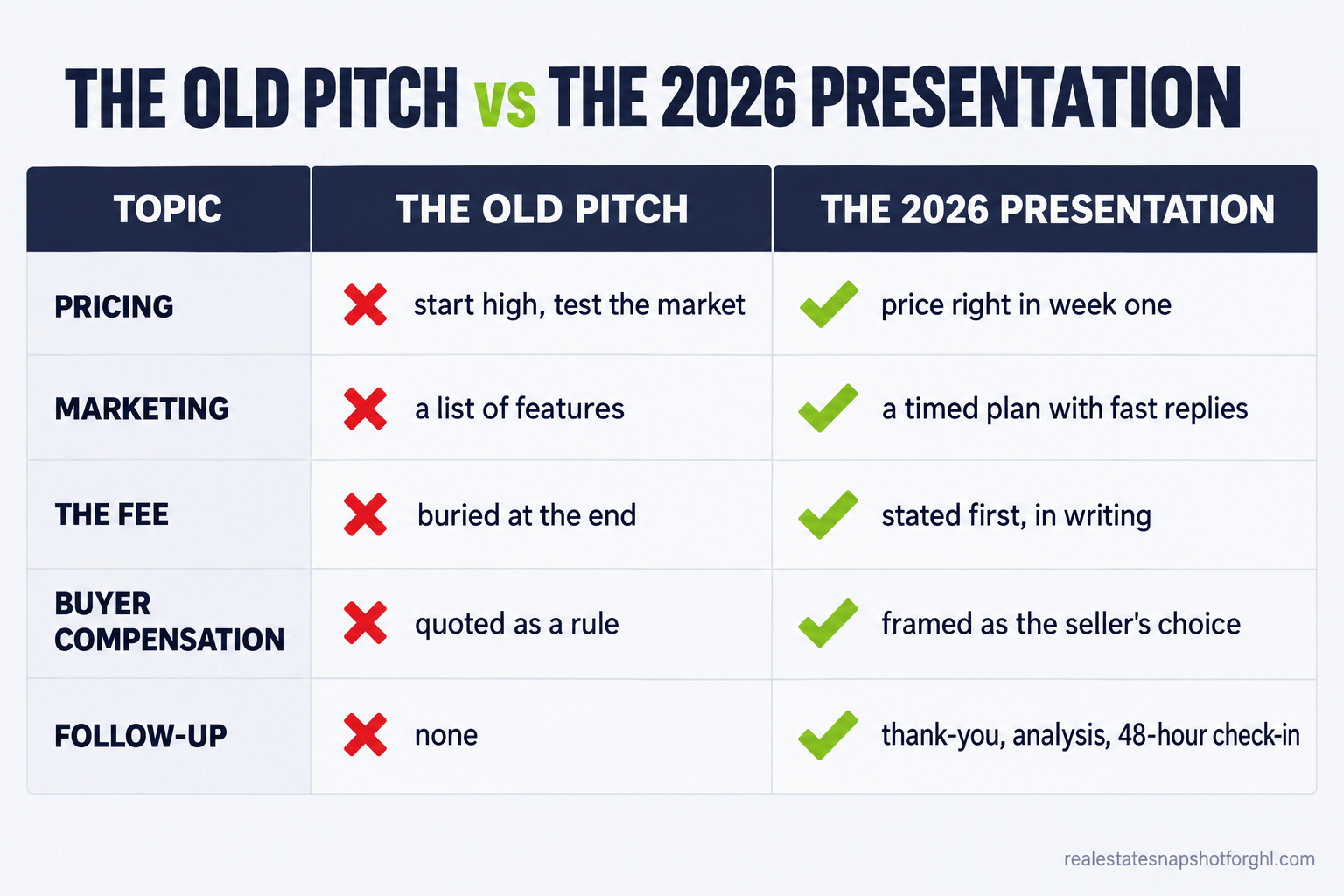
This is the highest-stakes part of the hour. Do not tell them a number. Walk them through the data until they arrive at it themselves, so it is their decision, not an opinion they can argue with. Put the three to five comps on the table: the active listings they compete against, the recent solds that set the ceiling, anything that fell out of contract. Then connect it to the week-four data, where the market pays a premium for homes priced right and punishes the ones that chase it down.
The reframe when the seller wants to overprice:
“I’d love for it to be worth that. But homes that sell in the first few weeks go for a little above average, and homes that sit past four months sell for less than if we’d priced right on day one. Start high to test it and we’re the test, and buyers read a price cut as ‘something’s wrong.’ I’d rather price where the buyers already are and let the competition work for you.”
Where this breaks: you cave to keep the listing. You take the overpriced number to avoid an awkward moment, and three weeks later you are begging for a price cut from a seller who now trusts you less. Taking an overpriced listing is not winning it; it is signing up for the price-cut conversation twice. Name the risk on day one.
Stage 4: Sell the plan, not the features
Sellers do not buy a feature list. They buy the feeling that someone has a system and nothing will slip. So do not recite that you do professional photos and email blasts. Show the sequence and the timing, because the timing is the proof you have done this before. Walk them through the first fourteen days: photos and copy by day two, live on the MLS and major portals by day three, your sphere notified the same day, an open house the first weekend, a buyer-agent push in parallel, every inquiry answered in minutes. If you have a prebuilt listing website and IDX presence, show it, because it makes the plan concrete.
Where this breaks: the plan is real on paper and fake in practice. You promise fast follow-up, then a portal lead sits for six hours while you are at a closing. Speed-to-lead is the one promise a seller can test, and a slow reply undoes the whole presentation. The agents who keep it are not more disciplined; they have the response automated, so a lead is answered in under a minute whether they are at a showing or asleep.
Stage 5: Earn your fee out loud
The fee conversation is no longer something you bury at the end and hope they skip. Since the 2024 settlement, your commission goes in writing and is explicitly negotiable, so sellers know they can ask (NAR). Say it first, with confidence, before they pull it out of you. Anchor it to outcomes, not effort: nobody pays for your hours, they pay for the net number that lands in their account and the problems that never happen. The gap between a well-run sale and a stale one is far bigger than the fee itself.
The fee script:
“My fee is [X]%, and here’s what it buys: the right price on day one, which the data says is worth more than my whole commission; every buyer lead answered in minutes so we don’t lose early offers; and me handling the forty things that go wrong before closing. It’s all negotiable, but I’d rather earn it than discount it, because a discounted agent usually costs you more at the closing table.”
Where this breaks: you apologize for your fee with your body language, and the seller smells it. The agents who hold their rate explain their value in one breath, the same muscle you need for the buyer-side commission conversation. To know your real take-home on the fee you defend, run it through a commission calculator first.
Stage 6: Handle the buyer-compensation question
This is the new stage, and it trips up agents who have not scripted it. Sellers now ask: “Do I have to pay the buyer’s agent?” The honest answer is that it is their choice, and your job is to frame it as a strategy decision, not a rule. Offers of buyer-broker compensation can no longer be posted in the MLS, but a seller may still offer a concession through other channels, and many do because it widens the buyer pool (NAR). Offering can bring more buyers and stronger offers, especially from first-time buyers tight on cash; not offering keeps more in the seller’s pocket but may narrow the field.
The script:
“It’s your call, not a requirement. You can offer to cover some or all of the buyer’s agent fee, or not. Offering often brings more buyers, which can mean a higher sale price that more than covers it. Not offering keeps that money with you but can thin the pool. We’ll look at who’s buying in your range and decide what nets you the most, and I’ll put it in writing.”
Where this breaks: the agent states it as a rule (“you have to offer 2.5%”) or dodges the question. Both erode trust. Know the mechanics, present the options, and let the seller own the decision with your guidance.
Stage 7: Ask for the signature, then follow up
Plenty of agents run a strong hour and never actually ask. Once you have agreement on price, plan, and fee, assume the close and move to the paperwork as the natural next step, not a separate pitch.
“This all feels right to me. If it does to you, let’s get it listed. I’ve got the agreement here, we’ll fill it in together, and I can have photos booked for [day] and go live by [day]. Want to get started?”
If they want to think about it, that is fine, but do not leave without a next step on the calendar and permission to follow up. Then actually follow up, because this wins the listings you did not close on the spot: a thank-you that evening, the pricing analysis the next morning, a short check-in at 48 hours. Most agents send nothing, which is exactly why a reliable follow-up sequence, pointed at sellers, wins the genuinely undecided ones.
Where this breaks: no ask, no follow-up, and a week later the seller has quietly listed with the agent who did send a note. You were not beaten on skill. You were beaten on follow-through, and steps 1 and 7 are a systems problem, not a willpower problem.
Three ways to run it: solo, team, brokerage
Solo agent, 20 to 40 listings a year. You are the whole system, so prep and follow-up slip when you get busy. Automate three things and leave the rest manual: the confirmation, the pre-listing packet, and the 48-hour follow-up. Keep the CMA and the conversation human, because that is where you win.
Small team, 2 to 5 agents. Consistency is the problem. One agent runs a tight presentation, another wings it, and your brand shifts with whoever shows up. Standardize the scripts and the package so every appointment looks like one company, and route new seller leads to whoever responds fastest. Lead routing for small teams makes this hold together.
Brokerage or large team. Your presentation becomes a training and recruiting asset: the scripts are onboarding, the follow-up is a tracked workflow, the package is a branded template nobody rebuilds. At this scale an inconsistent appointment costs you dozens of listings. The fix is a shared back end that runs the prep and follow-up identically for everyone.
Where the compliance line sits
The listing side has its own rules, and they changed with the settlement. Your listing agreement states the commission, and it must make clear that commission is set by you and the seller, not by law, and is fully negotiable (NAR). Do not quote a “standard” rate as if it were fixed. Offers of buyer-broker compensation cannot be published in the MLS, though a seller may still offer a concession through other channels. The Clear Cooperation Policy still applies: once you publicly market a listing, you generally have one business day to submit it to the MLS, with the delayed-marketing options under Policy Statement 8.5 if the seller wants to hold off (NAR).
Advertising rules vary by state on how prominently your team name, brokerage name, and license number must appear. And any SMS follow-up you automate, including the confirmation and 48-hour text above, has to respect consent and quiet-hours rules, covered in our SMS compliance guide. None of this is legal advice; confirm your state and local MLS rules with your broker.
Objections
“I already have a listing presentation.” Most agents have slides, not a sequence. The question is whether stages 1 and 7, the prep and the follow-up, happen every time without you thinking about it. That is where listings leak, and a prettier deck does not fix it.
“Sellers just pick on price and commission anyway.” The data says otherwise. Reputation is the top deciding factor at 35%, well ahead of fee (NAR 2025 Profile). Sellers discount agents who cannot explain their value, which is a presentation problem, not a market one.
“Isn’t a script too rigid? Sellers can tell.” A script is a floor, not a cage. You deliver it in your own words, but you never fumble the fee or the compensation question because you are not improvising the hard parts.
“Do I really need software for a listing appointment?” For the hour, no. For the confirmation before and the follow-up after, yes, if you want them to happen every time. The appointment is human; the prep and follow-through are where automation earns its keep, because those are the steps that vanish in a busy week.
The listing you lost last month was probably a follow-up you never sent
Think back to the last appointment you did not close. Odds are it was not your CMA or your fee. It was the note you meant to send that evening and did not, the packet that never went out, the lead you answered six hours late. The seller did not choose a better agent. They chose the one who stayed in front of them.
The presentation is yours to give, and it should stay human. But the prep that makes you walk into a warm room and the follow-up that wins the undecided ones should not depend on you remembering in a busy week. That is what the Real Estate Snapshot installs inside your GoHighLevel account: confirmations and pre-listing packets that send themselves, speed-to-lead replies in under a minute, review requests, and seller follow-up that runs whether you are at a closing or asleep. You bring the hour; the system makes sure no follow-up slips.
Frequently asked questions
How long should a real estate listing presentation be?
Plan for 45 to 60 minutes, but treat it as a sequence, not a runtime. The prep before and the follow-up after matter as much as the hour itself.
What should a 2026 listing presentation include?
Seven beats: pre-appointment research and a pre-listing package, an agenda you set out loud, a data-driven pricing conversation, a timed marketing plan, a clear fee explanation in writing, a clean answer on buyer-agent compensation, and an ask followed by real follow-up.
How do I justify my commission to a seller now?
Say it first and anchor it to outcomes: the right price on day one, fast lead response, and handling the problems between contract and close. State plainly that commission is negotiable and set by you and the seller, not by law, then explain why you would rather earn it than discount it.
Should I send a pre-listing package before the appointment?
Yes. A short package sent when you book, with your bio and real reviews, a marketing outline, a sample net sheet, and the documents you will need, means the seller opens the door already half-sold.
How do I handle a seller who wants to overprice?
Walk them through the comps and the week-four data: homes priced right sell for a premium, and homes that chase the market down sell for less after price cuts that read as 'something's wrong.' An overpriced listing just means the price-cut conversation twice.
What do I tell a seller about paying the buyer's agent?
That it is their choice, not a requirement. Offers of buyer-broker compensation can no longer be posted in the MLS, but a seller may still offer a concession through other channels. Offering can widen the buyer pool and lift offers; not offering keeps more in their pocket but may narrow the field.