

It is a Tuesday in November and your phone has been quiet since Friday. The portal leads still trickle in, but they are “just looking.” The seller you listed six weeks ago wants to know why there are no offers. Your buyer from October went dark the day rates ticked up. You open your CRM, see forty contacts you have not touched in a month, and close the laptop. That feeling, that the market has stalled and taken your income with it, is the most dangerous thing in a slow market. Not the rates. The freeze it puts on you.
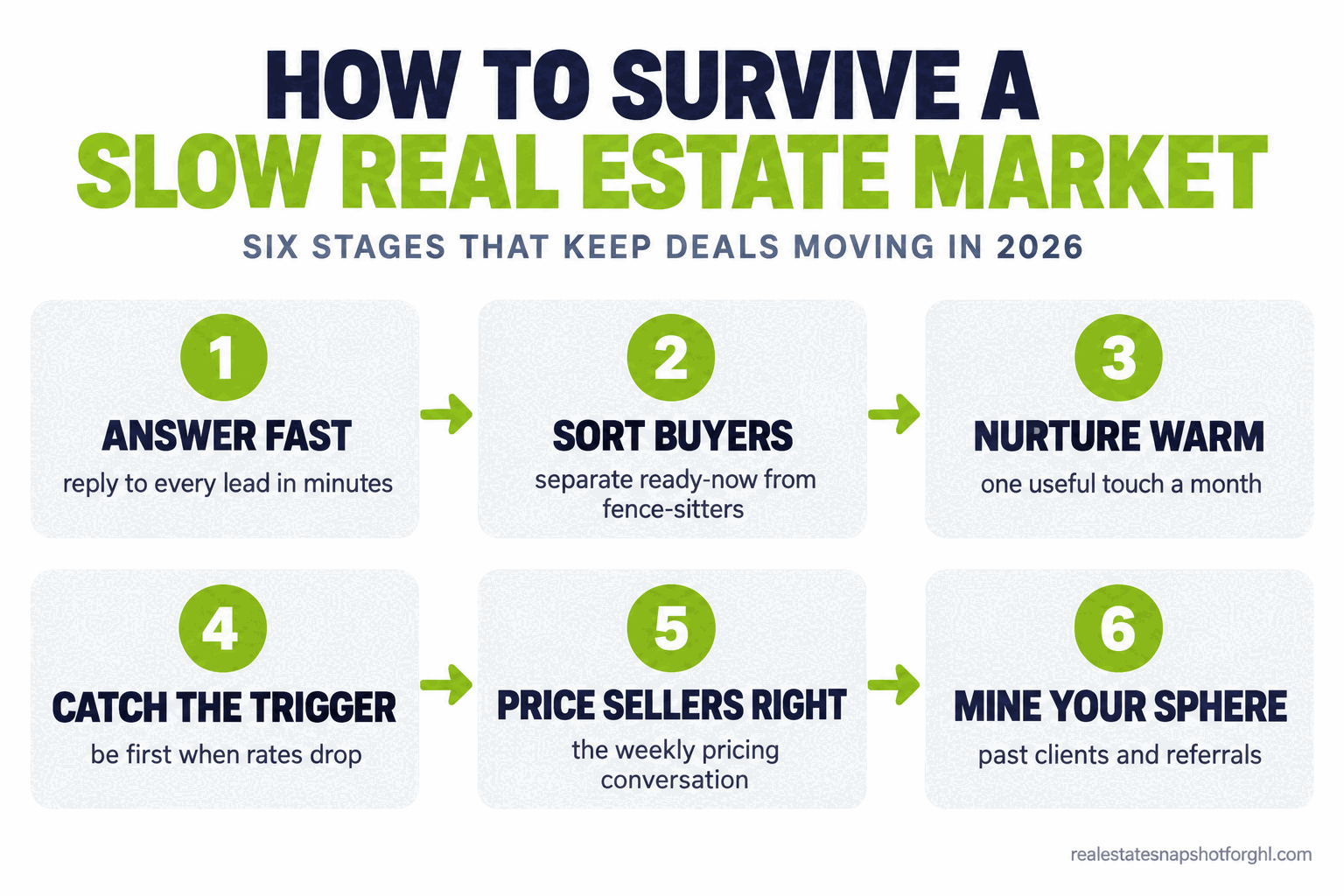
A slow market does not kill agents. Doing less kills agents. The ones who come out the other side run a tighter system on fewer leads, because every lead now has to count for more. This is that system: six stages, the message copy for each, and the exact ways it breaks.
Table of contents
- What a slow market actually costs you
- The six-stage slow-market system
- Stage 1: Answer every lead like it is your last
- Stage 2: Separate the ready-now from the fence-sitters
- Stage 3: Keep the fence-sitters warm
- Stage 4: Catch the trigger that moves them
- Stage 5: Work the sellers you already have
- Stage 6: Mine the business you already earned
- Steal this: the slow-market scripts
- Where your hours pay off: hot market vs slow market
- Run the system for a solo agent, a team, and a brokerage
- The compliance you cannot skip
- Objections
- Frequently asked questions
What a slow market actually costs you
Start with the number that should stop the panic. Existing-home sales rose 1.5% from August to a 3.99 million annual pace in September 2026, down only 2.2% from a year earlier, and the median price hit $417,500, up 1.3% year over year, the 39th straight month of annual gains (NAR). This is not a crash. It is a slow grind where fewer homes change hands at prices that are still rising, which means fumbling any one deal costs more.
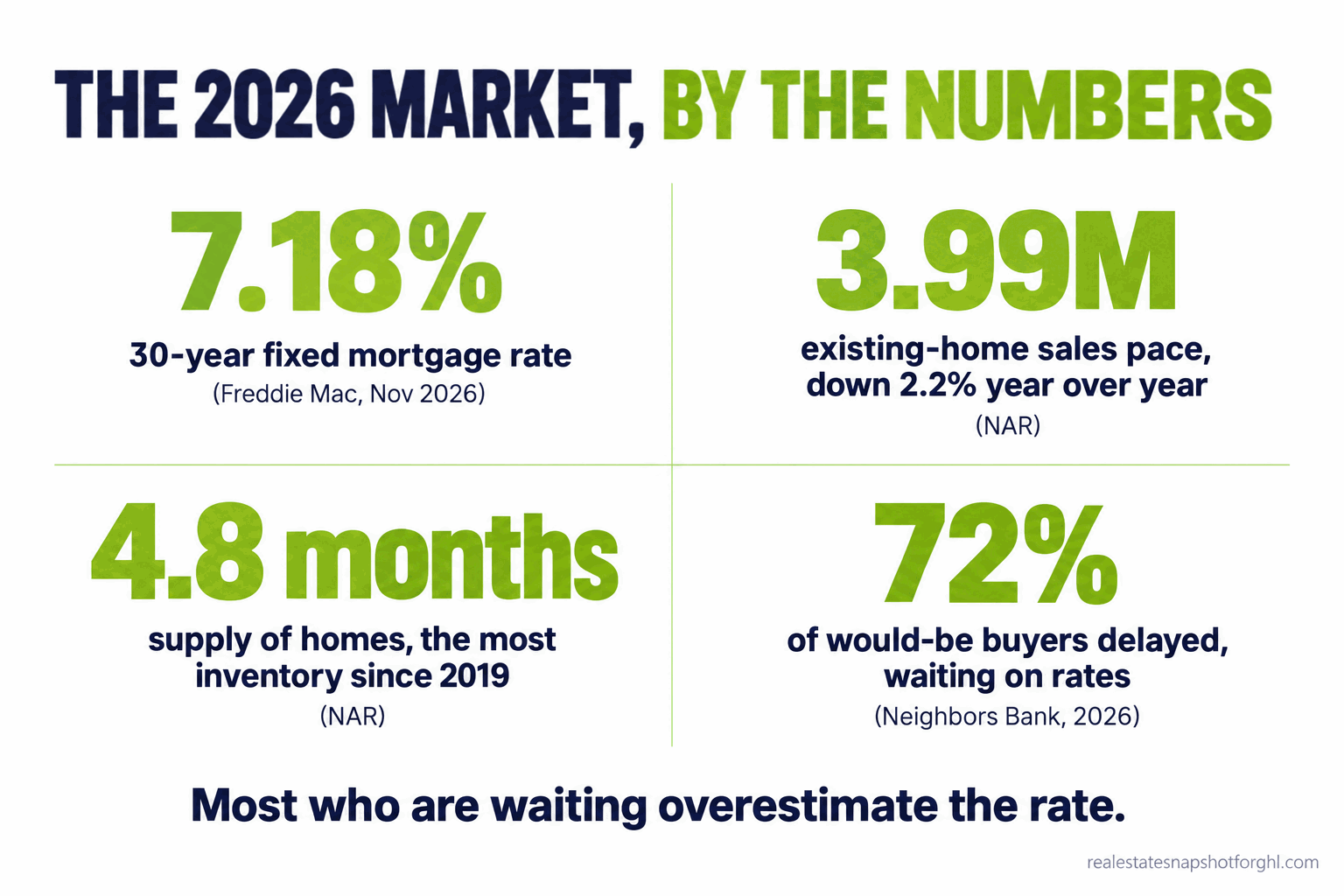
Then the rate story everyone is frozen by. The average 30-year fixed hit 7.18% in the November 5, 2026 Freddie Mac survey, its third straight weekly decline from 7.32% two weeks earlier, but still about a point above the 6.22% of a year ago (AP via WCAX; Freddie Mac PMMS). Rates near 7% do price some buyers out. But here is the part that changes how you work: most of your buyers do not know what the rate actually is.
30-year fixed mortgage rate, weekly Freddie Mac average (percent). Source: AP via WCAX, Nov 5 2026 and Freddie Mac PMMS.
In a July 2026 survey of 1,000 potential buyers, 72% had delayed their search waiting for rates, only 35% could name the current rate, and 45% guessed too high (Neighbors Bank). Read that twice. Your pipeline is not empty because the deals do not exist. It is empty because most people in it are waiting on a number they have wrong, and nobody is talking to them.
So the cost of a slow market is not the rate. It is the leads you stop working because you assume they will not move. At a 2.5% buy-side fee on the median price, one closed buyer is worth roughly $10,400. Let three fence-sitters drift to another agent over a quiet winter and that is more than $30,000 gone, to a market you blamed instead of worked.
The six-stage slow-market system
The deals in a slow market go to whoever stays in the conversation longest with the fewest people. The six stages below do that, each with one job:
- Answer every lead fast so zero can leak at the front door.
- Separate ready-now buyers from fence-sitters and spend your human hours where they convert.
- Keep the fence-sitters warm, the patient nurture most agents quit and the entire edge now.
- Catch the trigger the day a rate drop or life change flips the switch.
- Work the sellers you have with the pricing conversation that now does the selling.
- Mine the business you earned, the cheapest pipeline you own.
Skip stage three and you are back to buying leads you cannot afford, the trap most agents fall into in a slow year.
Stage 1: Answer every lead like it is your last
The job: respond in minutes, sound human, and book a real conversation before the lead cools.
In a hot market you could miss a few inquiries because ten more were behind them. That cushion is gone. The first agent to respond usually wins the conversation, and speed beats polish (speed-to-lead for realtors). You do not need more leads to close more deals. You need to stop losing the ones you already paid for at Zillow, your website, or a sign call.
How it breaks: you are at a showing, the lead comes in, and you get to it that evening, after they filled out three other forms and the fastest agent already called. Wire up a missed-inquiry auto-response that sounds like you, then follow with a real reply the moment you are free (missed-call text-back). The automation holds the door open; you still walk through it.
Stage 2: Separate the ready-now from the fence-sitters
The job: find the few buyers who will transact in the next 90 days, and stop treating everyone the same.
Ask three things early: what is your timeline, do you have to move or want to move, and are you pre-approved. A renter whose lease ends in February and who is pre-approved is a ready-now buyer. Someone browsing “for when rates drop” with no deadline is a fence-sitter. Both are worth keeping, but only one gets your Saturday. The slow market did not make everyone a tire-kicker; it buried a few real buyers under a lot of waiters (real estate buyer nurture system).
How it breaks: you either chase every lead with equal energy and burn out, or write everyone off as “not serious right now” and nurture no one. Both lose. Sort them: showings this week for the ready-now, a light touch every few weeks for the fence-sitter.
Stage 3: Keep the fence-sitters warm
The job: stay usefully in the conversation with the waiting buyers for months, so you are the agent they call when they finally move.
This is the stage that separates agents who survive from agents who get crushed, and almost everyone skips it. Most follow up twice, hear “we’re waiting,” and give up. But that buyer’s lease ends, their rent rises, or they get tired of waiting. Send one useful message a month and you are the agent they call. Go silent in December and you are a stranger again by spring.
Warm does not mean “are you ready yet” every week. That is pressure. Warm means useful: a new listing that fits, a plain note when rates move, their real monthly payment at today’s rate versus the 5% they are dreaming of. You are correcting the number keeping them frozen. No human running six deals remembers a monthly touch to thirty quiet buyers, so the sequences fire on schedule and you step in when someone replies (real estate follow-up sequences).
How it breaks: you go dark the moment a buyer says they are waiting, because it does not feel like progress. Six months later they buy with whoever was in their inbox. Silence is the most expensive thing you can do in a slow market: the deal is not gone, it is delayed, and whoever stays visible gets it.
Stage 4: Catch the trigger that moves them
The job: be the first message a fence-sitter sees the moment something changes, whether a rate dip, a new listing, or a life event.
Waiting buyers do not move on a schedule. They move on a trigger: rates fall a quarter point and the payment feels doable, a perfect listing hits the market, a job offer turns “someday” into “sixty days.” Set up two kinds. Market-driven: when the weekly rate drops meaningfully, a short note goes to every waiting buyer with what their target home now costs per month. Listing-driven: when a home matching their saved criteria comes on, they hear from you the same day (listing-alert drip campaigns).
How it breaks: rates drop for three straight weeks, like they just did into November 2026, and you send nothing because you were busy. Another agent did, and your fence-sitter is now their buyer. The trigger is the payoff of all that patient nurture. Miss it and the nurture was wasted.
Stage 5: Work the sellers you already have
The job: have the honest pricing conversation early and often, because in a slower market the price is the marketing.
Inventory is climbing. There were 1.60 million homes for sale in September 2026, up 4.6% from a year earlier, the most since 2019, with homes taking a median of 33 days to sell (NAR). NAR’s chief economist put it plainly: “Higher inventory and lengthening days on market give buyers improved negotiating power.” The overpriced listing that would have sold anyway in 2021 now just sits, training buyers to wait for a cut. Your job is no longer “get the listing.” It is “keep the seller realistic,” with honest comps at the appointment and a weekly note on showings, feedback, and where the listing stands (the listing presentation that wins the listing).
How it breaks: you take an overpriced listing to win it, go quiet, and surface a month later asking for a $40,000 cut with no evidence trail. The seller feels ambushed and blames you, not the market. Build the pricing conversation into a weekly rhythm from day one and the adjustment becomes obvious instead of insulting.
Stage 6: Mine the business you already earned
The job: turn past clients and your sphere into the referrals and repeat deals that cost nothing and convert highest.
When new leads get expensive and scarce, the pipeline you already own gets more valuable. Past clients are the warmest contacts you have, and most agents ignore them for years. A slow market is when you finally build the habit: a systematic touch program for everyone who already knows you (sphere of influence playbook). If your database has gone cold, do not fix two years of silence with one blast. Run a quiet reactivation that reopens the door before you ever ask for anything (real estate database reactivation).
How it breaks: you treat your sphere as a holiday-card list and “remind” them you sell real estate once a year. They use the agent who texted them something useful last month. Referrals are a habit, and a slow market either proves you built it or exposes that you never did.
Steal this: the slow-market scripts
Keep the structure, adjust the wording to sound like you, and route the automated pieces through your CRM so they never get skipped.
Five messages, sent at the right moment, keep a quiet database alive through a quiet market.
Where your hours pay off: hot market vs slow market
The same hours that printed money in a hot market are often wasted in a slow one. The work does not stop, it moves.
Where to spend your time when the market shifts
| Hot market | Slow market (2026) | |
|---|---|---|
| Where buyers stall | Competing offers, no inventory | Frozen on rates, on a number they have wrong |
| Main buyer job | Win the bidding war fast | Patient monthly nurture until a trigger fires |
| Main seller job | List it, it sells | Price it right, keep the seller realistic weekly |
| Cheapest pipeline | Easy to ignore your sphere | Past clients and referrals become essential |
| Biggest risk | Dropping balls on volume | Going quiet because it feels like no progress |
If your calendar still looks like a hot-market calendar, that is the problem. Shift the hours.
Run the system for a solo agent, a team, and a brokerage
The same six stages, three very different builds.
The solo agent. A slow market tempts you to cut spending by cutting activity, which is backwards. Automate the three touches a human forgets first: the fast first reply, the fence-sitter monthly nurture, and the rate-drop alert. Keep the qualifying call and seller pricing conversation human. Your real risk is emotional, letting a quiet week become a quiet month of doing nothing (residential agent system).
The 2 to 5 person team. Now the risk is inconsistency, where one agent works the sphere and another lets every fence-sitter rot. Standardize the nurture as shared sequences, route new inquiries to the fastest responder, and run one shared pipeline. You cannot afford to find out in March that a teammate stopped following up in December.
The brokerage. At scale, a slow market is where thin agents quit and strong ones take share. Give every agent the same playbook, scripts, and automated nurture, and track two numbers per agent: speed-to-lead and how much of their database they touched this month.
The compliance you cannot skip
None of the scripts above override your state law, your broker’s forms, or federal marketing rules.
Texting and calling those buyers is regulated. Every automated message here is still governed by TCPA consent rules, and for SMS by A2P 10DLC registration. Get real consent, honor every opt-out immediately, and register your campaigns before you send a single drip (is texting real estate leads legal).
The buyer paperwork still applies. You still need a written, signed buyer representation agreement before touring a home, with your compensation stated in writing (NAR settlement FAQs). A slow market is not an excuse to skip it to keep a nervous buyer happy (how to explain the buyer agency agreement).
Agency law is not the same in two states. Florida bans dual agency and uses a transaction-broker model. Colorado restricts designated and dual agency. California permits disclosed dual agency with its own disclosure burden. Confirm the relationship type and the exact forms with your broker before you reuse anything here.
Objections
“Isn’t this just a fancy way of saying wait it out?” The opposite. Waiting it out is doing nothing and hoping rates save you. This is working a smaller pipeline harder. The agents who wait it out have no pipeline when the market turns. The ones who nurtured through the slow stretch walk into the recovery already busy.
“I can’t afford to buy more leads right now.” Good, because that is not the move. The win is converting the leads and contacts you already have. Your sphere, your past clients, and the fence-sitters already in your CRM are free, and working them converts higher than any portal. If you are weighing what your current tools cost versus what they do, our breakdown of what real estate CRM software actually costs in 2026 is worth a read.
“My past clients aren’t moving either, so what’s the point?” They are not moving today. But lives keep changing regardless of rates: jobs, families, downsizes, relocations. Staying in touch is about being the obvious call when one of those lands, and past clients refer other people long before they move again themselves.
“Do I need to be technical to run all this?” No. The human parts, the qualifying call and the pricing conversation, are pure agent skill. The automated parts get set up once and run without you. A done-for-you system means you are having conversations during the day while the follow-up handles itself, not building workflows at midnight.
Frequently asked questions
How do you sell real estate in a slow market?
You run a tighter system on fewer leads. Answer every inquiry fast, qualify hard to find the few ready-now buyers, nurture the fence-sitters with useful monthly touches, be first when a trigger like a rate drop fires, keep your sellers priced realistically, and work your past-client database for referrals. Follow-through beats spend, because the deals go to whoever stays in the conversation longest.
Is the 2026 real estate market actually slow or is it crashing?
Slow, not crashing. Existing-home sales ran at a 3.99 million annual pace in September 2026, down only 2.2% year over year, and the median price was still up 1.3% to $417,500, per NAR. Transactions are down and homes take longer to sell, but prices are holding and deals are still closing.
Should I tell buyers to wait for lower mortgage rates?
No. Give them the real number and the real monthly payment, then let them decide. Surveys show most waiting buyers overestimate rates: in one 2026 survey only 35% could name the current rate and 45% guessed too high. Many 'waiting' buyers move once their own circumstances change, not because rates hit a magic figure.
How often should I follow up with a buyer who says they're waiting?
Roughly once a month, and every touch should be useful rather than an 'are you ready yet' nudge. Send a matching new listing, a plain note when rates move, or their real monthly payment at today's rate. The goal is to stay the agent they remember without pressure, so you are first in line when a trigger finally moves them.
What should I do with my sellers when homes aren't selling?
Have the pricing conversation early and keep it going weekly. Inventory is at its highest since 2019 and homes take a median of 33 days to sell, so overpriced listings sit and train buyers to wait for cuts. Send a weekly update with showings, feedback, and comparable sales, so a price adjustment is a case you built over weeks instead of an ambush.