

It is 9:15 on a Tuesday morning. You pull the overnight expired list, forty fresh numbers, and start dialing from the top, the way your coach taught you. Number six picks up, hears “Hi, I noticed your home came off the market,” and says the four words that can cost you a year of commission: “How did you get this number, I’m on the Do Not Call list.” You hang up and keep going. You just broke federal law, and you have thirty-four more chances before lunch.
Here is the short answer. You can legally cold call expired listings and FSBOs, but only if the number is not on the National Do Not Call Registry, or you fit an exemption. You have to scrub every number before you dial, honor your own internal do-not-call list, call only between 8 a.m. and 9 p.m. in the prospect’s local time, and never use a prerecorded or AI-generated voice without written consent. Get it wrong and each call can carry statutory damages of $500 to $1,500, and Do Not Call violations can run up to $53,088 per call (FTC). This is the part of prospecting nobody at the office teaches, written so you can keep calling the way you always have without becoming a defendant.
Table of contents
- Is it actually legal to cold call expired listings and FSBOs?
- What it costs you when you get it wrong
- Rule 1: The Do Not Call Registry and the 31-day scrub
- Rule 2: The established business relationship windows
- Rule 3: Your own internal do-not-call list
- Rule 4: Calling hours and identifying yourself
- Rule 5: The AI dialer and prerecorded-voice trap
- Scripts and copy you can steal
- Solo agent, small team, and brokerage
- State laws that go beyond the federal rules
- Your objections, answered
- Frequently asked questions
Is it actually legal to cold call expired listings and FSBOs?
Yes. No law says an agent cannot call an expired or FSBO owner. What the law regulates is who you call, how you dial, and when.
The line that trips up most agents is the difference between a friendly chat and a solicitation. When you call a FSBO hoping to walk away with a listing agreement, that is a telephone solicitation. NAR puts it plainly: agents cannot call people on the Do Not Call Registry to entice them to buy or sell a home (REDX). A number posted on a yard sign or a public listing is not permission. Public data is not consent.
That matters more every year, because the pool has shrunk. For-sale-by-owner sales fell to a record low of 5% of all home sales in NAR’s 2025 survey, and 91% of sellers used an agent, the highest share on record (NAR). The ones who exist get hammered by every agent in town, so they are quick to reach for the Do Not Call defense. “Cold” is legal. “Random” is not.
What it costs you when you get it wrong
Agents treat Do Not Call like a parking ticket. These numbers are built to hurt.
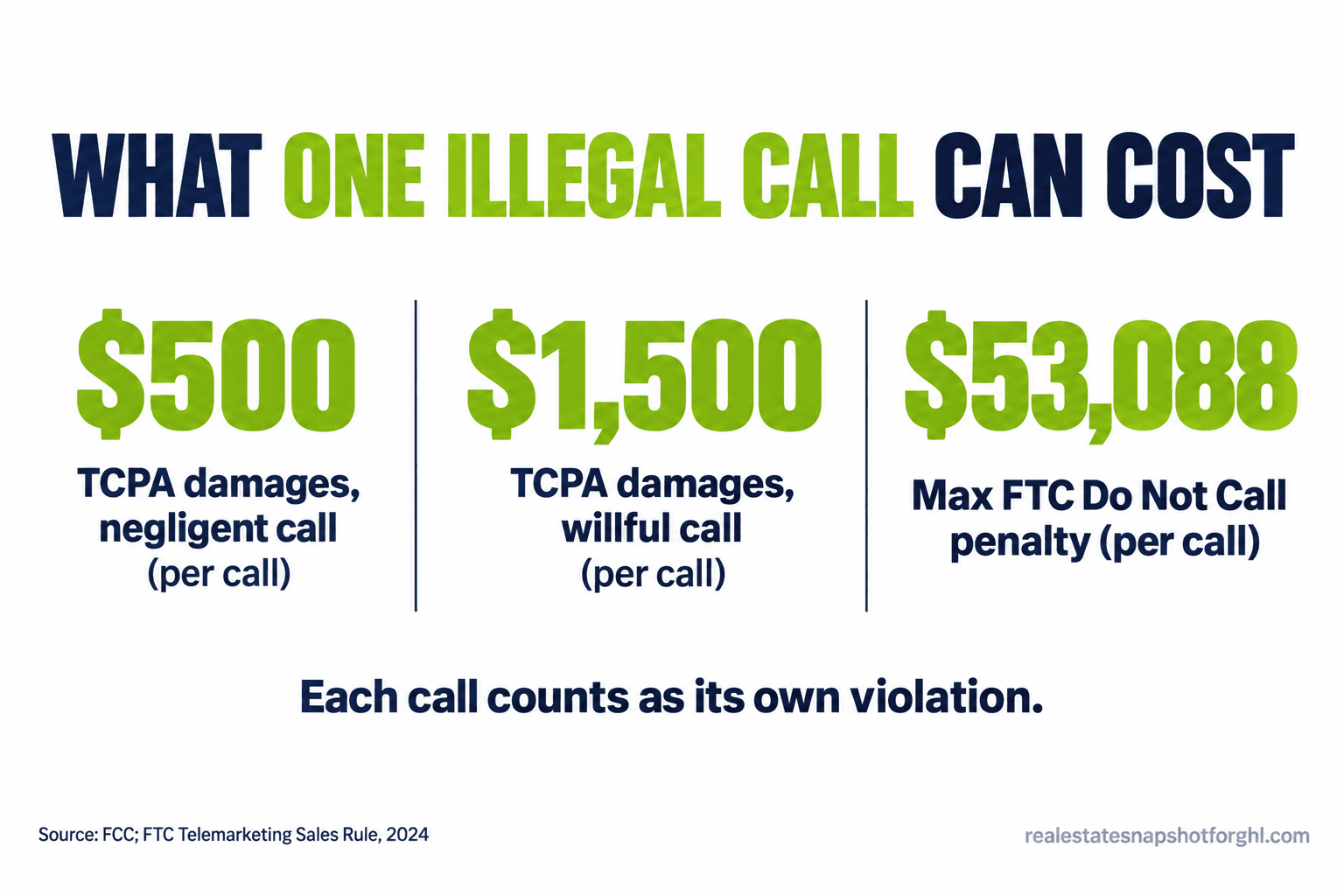
Two systems can bite you. The TCPA lets the person you called sue you directly for $500 per negligent call and up to $1,500 per willful call (FCC). On top of that, the FTC can bring civil penalties up to $53,088 per Do Not Call violation, each call counting on its own (FTC).
A solo agent who dials five registered numbers before lunch is not looking at one fine. They are looking at five, each standing alone, which is why one afternoon of lazy dialing can cost more than a year of closings.
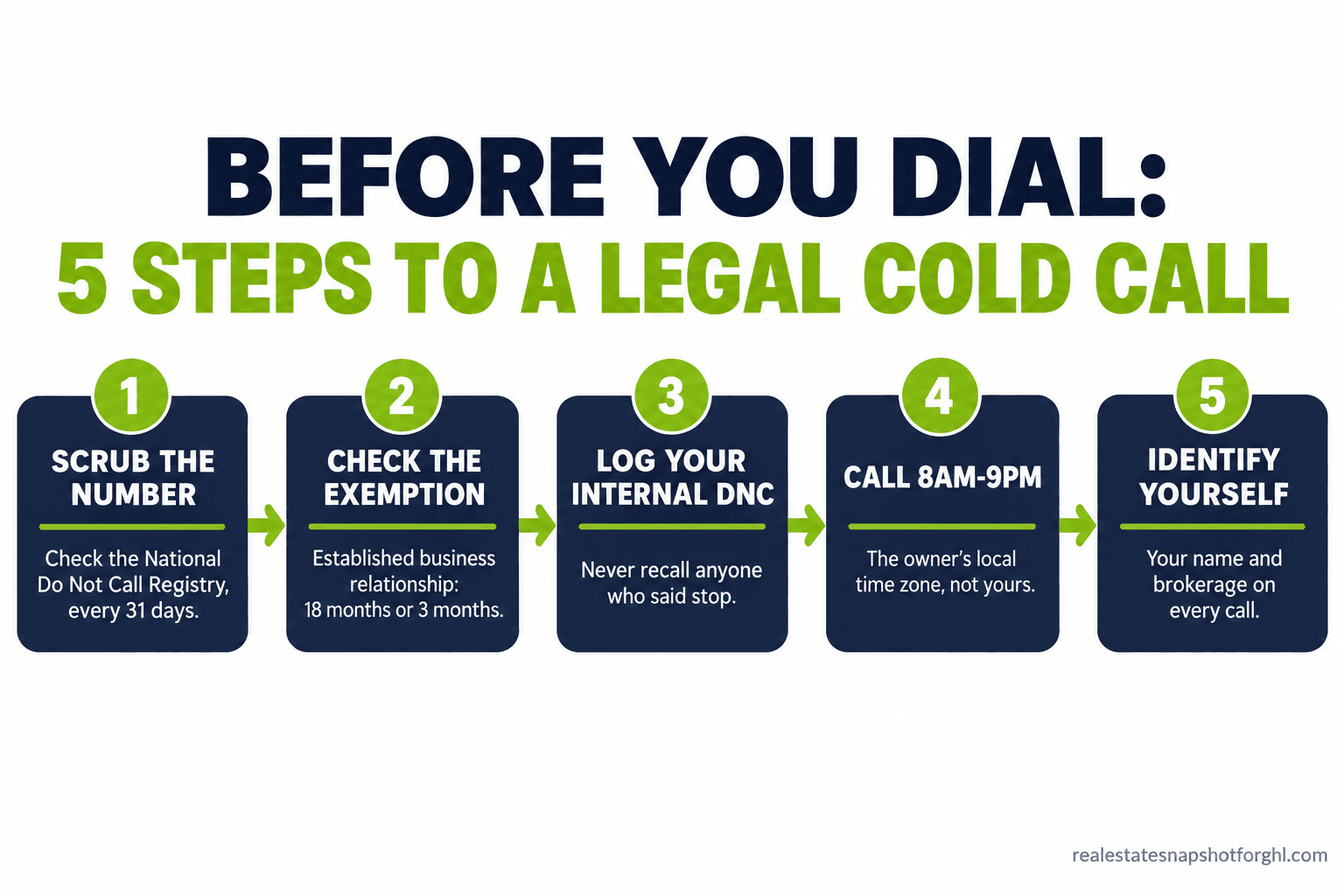
Strip away the legal language and compliant cold calling comes down to five rules, each with a setup and a way it breaks.
Rule 1: The Do Not Call Registry and the 31-day scrub
The registry lists numbers whose owners do not want telemarketing calls. If a number is on it and you have no exemption, you cannot make a solicitation call to it.
Two details catch agents out. First, this is not one-and-done. The FTC requires that you scrub your list at least every 31 days, and the safe harbor that protects you from an accidental call requires that you checked that number no more than 31 days before dialing (FTC). A list scrubbed in March is worthless in May. Second, free one-off checks at DoNotCall.gov do not scale to a daily pull, so most agents scrub through a dialer.
Set it up: use a tool that scrubs on the way in, so a flagged number never reaches your queue, and keep each scrub date as safe-harbor evidence.
Rule 2: The established business relationship windows
The registry has exemptions, and the one you lean on most is the established business relationship, or EBR, the legal version of “we already know each other.” There are two windows (FTC):
- Transaction window: 18 months. If someone bought or sold with you, the clock runs 18 months from the last payment or transaction. Inside that window you can call even if they are on the registry.
- Inquiry window: 3 months. If someone contacted you to ask about your services, say a home-valuation form or an open-house sign-in, you get 3 months from that inquiry.
Months you can legally call a registered number without fresh consent, by relationship type. Source: FTC Telemarketing Sales Rule Q&A.
Here is the uncomfortable part for expired and FSBO work. A brand-new expired that was listed with another brokerage is not your EBR, and neither is a FSBO you found this morning. The exemption does not help with true cold prospects. It helps with your own past clients and old leads, so reviving a cold database is safer ground than chasing strangers. See reviving expired listings.
Rule 3: Your own internal do-not-call list
Separate from the national registry, you must keep your own list of people who told you to stop calling. It applies even to numbers not on the national registry and even to people inside your EBR window (FTC). If anyone, past client or stranger, says “take me off your list,” you record it and never call that number for a solicitation again.
Set it up: one tag, say dnc-internal, that pulls the contact out of every calling workflow the moment it is applied and also blocks any text or email. Make it permanent and loud, not a note buried where nobody reads it.
Rule 4: Calling hours and identifying yourself
Two smaller rules, both litigated when ignored.
Hours. No solicitation calls before 8 a.m. or after 9 p.m. in the called party’s local time, not yours (FTC). An agent in Denver calling Boston at 7:30 is dialing 9:30 the owner’s time, already over the line. A dialer that respects the area code’s time zone handles this; a phone and a spreadsheet does not.
Identification. On every call, promptly say who you are, which business you are calling for, and that it is a solicitation if asked. No spoofed caller ID, and get your brokerage name in, since many states have rules on brokerage and license-number prominence.
Rule 5: The AI dialer and prerecorded-voice trap
This is the newest rule and the one most likely to catch a tech-forward agent in 2026. The TCPA has always required prior express written consent before a telemarketing call that uses an artificial or prerecorded voice, and in February 2024 the FCC ruled that AI-generated voices count as “artificial” under the TCPA (FCC via Hunton).
So the AI caller that dials your expired list in a human-sounding voice is making artificial-voice calls, and to a cold prospect you have no written consent, so they are not legal solicitations. A generic marketing opt-in does not cover AI.
That does not make AI useless. Point it at leads who already raised their hand, showing confirmations, review requests after a closing, or inbound calls, as we cover in AI voice agents for real estate. For cold outreach to expireds and FSBOs, the voice on the line has to be a human.
Scripts and copy you can steal
Compliance is also about the moment a wrong word creates a record against you. Lift this directly.
The opening (identify yourself, every time):
“Hi, is this [Name]? This is Priya with [Your Brokerage] here in [City]. I saw your listing on [Street] came off the market and wanted to reach out directly. Do you have a quick minute?”
When they say they are on the Do Not Call list:
“Thank you for letting me know, and I’m sorry to have bothered you. I’m adding your number to our do-not-call list right now so you won’t hear from our office again. I hope the sale goes well for you.”
Then actually do it: mark the contact dnc-internal before your next call. The sentence plus the action shows you honored the request immediately, which is your best protection.
When a FSBO asks how you got the number:
“Your listing is public, so I found it the same way a buyer would. If you’d rather I not call again, just say the word and I’ll take you off my list for good.”
Your pre-call checklist, taped to the monitor:
- Scrubbed against the national registry in the last 31 days? (date: ____)
- Not on my internal do-not-call list?
- Inside 8 a.m. to 9 p.m. in their time zone?
- A live human is dialing, no AI or prerecorded voice?
- Brokerage name ready in my opener?
All five yes, dial; any no, fix it first. Five seconds of checking beats five figures of exposure.
Solo agent, small team, and brokerage
The rules are the same for everyone. Enforcing them is not.
The solo agent. The risk is a stale list and a sticky-note internal DNC. Make compliance a habit: scrub inside your dialer every morning before you touch the phone, keep one dnc-internal tag, and never let an AI tool call a number you did not get consent from.
The 2-to-5-person team. Now the danger is coordination. Two agents working the same expired pool can both call a number one of them already got a stop request on, and that is a willful violation. You need a shared CRM where the internal do-not-call list is one list, visible to everyone, that pulls a contact out of every queue the instant it is marked, plus one owner of the registry scrub.
The small brokerage. Here the exposure is institutional, because the fines attach to the business. You need written policy, a single scrubbing process, time-zone-aware dialing enforced by the system, and audit trails of every scrub and stop request. Manual compliance across a dozen agents is a lawsuit waiting for a slow month, which is where done-for-you automation earns its cost.
State laws that go beyond the federal rules
Federal rules are the floor, not the ceiling. A growing number of states have their own telemarketing statutes, the mini-TCPAs, stricter in ways that change how you prospect there. A few specifics worth knowing (Convoso; JustCall):
- Florida. The Florida Telephone Solicitation Act drove a wave of litigation over automated calls and texts; 2023 amendments narrowed it to unsolicited sales calls, but it is still one of the most aggressive states for telemarketing suits.
- Oklahoma. Its Telephone Solicitation Act is modeled closely on Florida’s and caps you at three calls per number per 24 hours on the same subject, which matters if your dial plan hits the same owner repeatedly.
- Washington. Its law has its own consent and disclosure requirements and its own damages for texts.
The takeaway: where your prospect lives can change the rules, not just where you sit. If you prospect across state lines, your system needs to apply the strictest rule that touches the call.
Your objections, answered
“Everyone cold calls expireds, why would I get in trouble?”
Because enforcement does not depend on a regulator catching you. It depends on one annoyed homeowner who knows they are on the list and decides to file, and plaintiff-side TCPA work is a cottage industry. Be the agent in your market who scrubs and logs, so you are not the easy case.
“I use REDX or a dialer that scrubs for me. Am I covered?”
Mostly, for the national registry. But a scrubbing tool does not keep your internal do-not-call list, stop you calling at the wrong hour in another time zone, or bless an AI voice on cold numbers. It handles one of the five rules; the other four are on you and your CRM.
“Can I just text them instead?”
Texting has its own, arguably stricter, rulebook, including A2P 10DLC registration and the same consent and opt-out rules. A cold text to a FSBO is not a loophole, as we cover in the real estate texting compliance guide.
“Do I need to be technical to stay compliant?”
No, but you need a system that is. The failure mode is almost always manual: a stale list, a sticky-note DNC, a batch dial at the wrong hour. Work inside a setup where the scrub, the internal list, the calling window, and the consent log are enforced for you.
Frequently asked questions
Is it legal to cold call expired listings?
Yes, if the number is not on the National Do Not Call Registry, or you have an exemption like an established business relationship. Scrub it within the last 31 days, call only between 8 a.m. and 9 p.m. in the owner's time zone, use a live human voice, and honor any request to stop. A number being public is not permission to call it (FTC).
What is the established business relationship exemption?
It lets you call a registered number because you already have a relationship: 18 months from your last transaction with that person, and 3 months from an inquiry they made about your services. It covers your own past clients and leads, not a stranger whose listing just expired with another brokerage, and it ends the moment they ask to be on your do-not-call list (FTC).
Can I use an AI dialer to call expired listings?
Not for cold outreach. Since February 2024 the FCC treats AI-generated voices as artificial under the TCPA, so an AI caller making solicitation calls needs prior express written consent you will not have for a cold prospect. Point AI callers at opted-in leads, showing confirmations, or inbound calls, and keep a human on cold prospecting (FCC via Hunton).
How much can a Do Not Call violation actually cost?
Private TCPA damages run $500 per negligent call and up to $1,500 per willful call, and the person you called can sue you directly. Separately, the FTC can seek civil penalties of up to $53,088 per Do Not Call violation, with each call counting on its own (FTC).
How often do I have to scrub against the registry?
At least every 31 days, and ideally on the day you call. The FTC safe harbor requires that you checked the number no more than 31 days before dialing and that you keep records of the scrub (FTC).
It is Tuesday morning again. Same forty expireds, same coffee. Except now the list was scrubbed an hour ago, the out-of-state numbers are held until 8 a.m. where they live, your internal list quietly pulled the three people who asked you to stop, and the AI assistant is confirming showings instead of cold-dialing strangers. You call number six, a live human to a clean number, and book the appointment instead of bracing for a complaint. That is the whole difference. Not calling less. Calling clean.
If you are also working the listing side, pair this with the seller lead system and the speed-to-lead playbook.