
It is a Tuesday night and you are boosting a just-listed post from your phone. Nice photo, sharp caption, a price, “DM me.” By morning it has 40 comments. It also breaks three advertising rules at once: no brokerage name, no license number, and a team name your broker never registered. Nobody notices for months. Then a competing agent screenshots it, sends it to the state commission, and you are explaining yourself to a board instead of showing houses.
Here is the short version. In almost every state, any ad you run has to show your brokerage’s licensed name, your own name cannot imply you are the brokerage, and a team name usually has to be registered and kept smaller than the brokerage name. Several states also require your license number on first-contact materials, and federal Fair Housing law governs what you can say and who you can target. Get those four things right and you can market as hard as you want. Miss them and the penalties run from an ethics fine to five-figure Fair Housing damages and, at worst, a suspended license.
This is the operator’s map of what has to be on your ads in 2026, how the rules differ across California, Texas, and Florida, the copy you can paste into your templates, and where agents get caught.
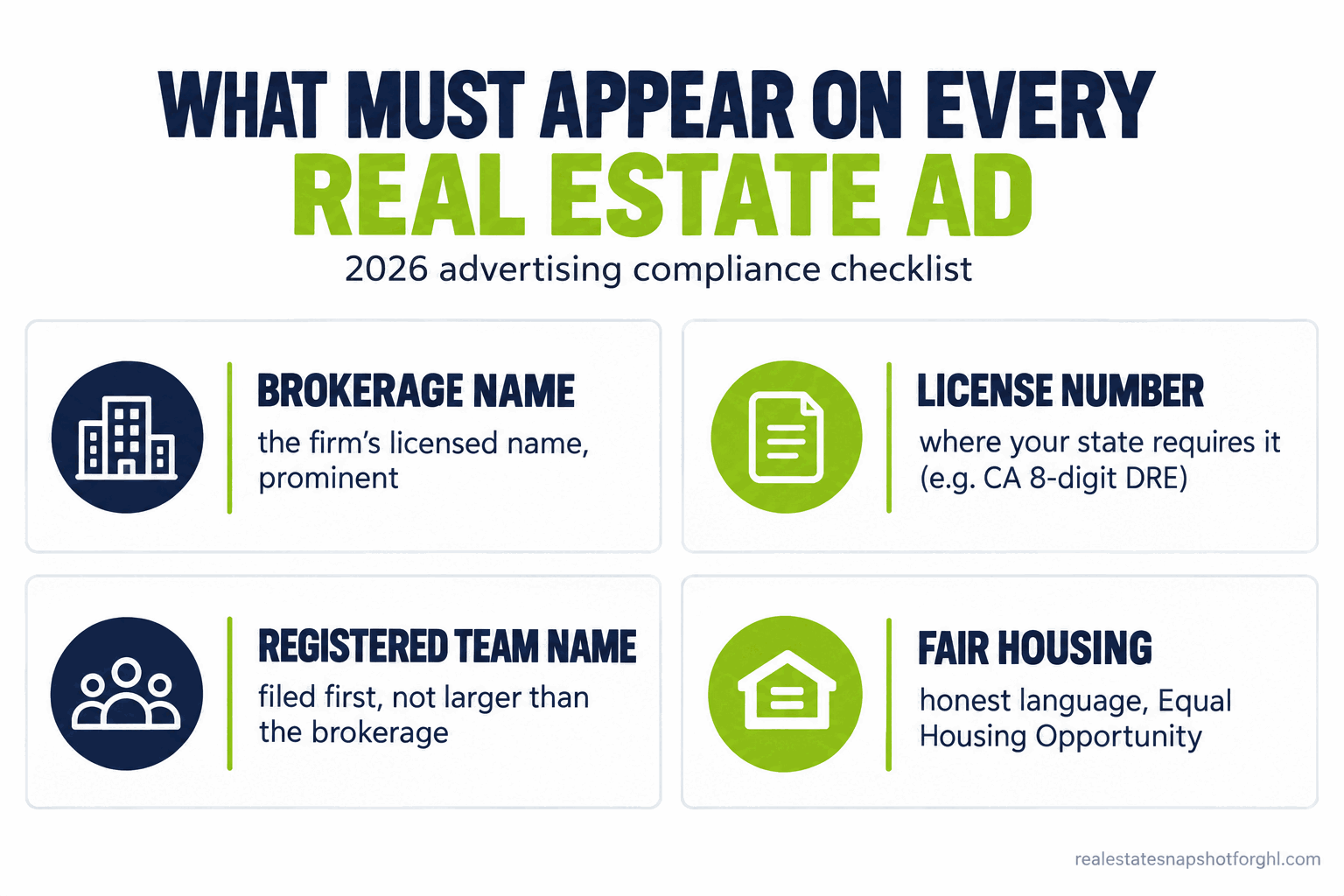
Table of contents
- Why this matters more in a frozen 2026 market
- What a bad ad actually costs you
- Your brokerage name
- Your license number
- Team names are not free text
- Fair Housing governs words and targeting
- What the 2024 settlement changed
- Social media is where most agents get caught
- State quick-reference and three operator profiles
- Steal this: the disclosure block and checklist
- Objections
- FAQ
Why this matters more in a frozen 2026 market
Slow markets make agents advertise harder. Existing-home sales fell to a 3.75 million annual pace in October 2026, down 8.8% from a year earlier and the lowest since 2010, while first-time buyers slipped to 29% of sales from 32% a year ago (NAR). Every agent is fighting for the same shrinking pool of attention.
Source: National Association of REALTORS, Existing-Home Sales, October 2026 (released November 12, 2026).
That competition is when the shortcuts creep in. The brokerage name gets dropped from a caption, the team name hits a yard sign before anyone registered it, a “luxury family neighborhood” line sneaks into a listing. Every one is reportable, and your competitors watch your feed as closely as your clients do.
First-time buyers as a percentage of existing-home sales, the group most protected by Fair Housing law. Source: NAR Existing-Home Sales, October 2026. The pool you market to is tighter, so the discipline matters more, not less.
What a bad ad actually costs you
The penalties stack from three directions.
Your state commission. State boards discipline advertising violations directly, from a warning letter to fines, mandatory education, and license suspension. California’s DRE has revoked a broker’s license for advertising licensed services without the license number (KTS Law). In Texas, both the agent and the sponsoring broker get disciplined for the same bad ad (TREC).
The REALTOR Code of Ethics. If you are a REALTOR, Article 12 requires a true picture in your advertising and that your status as a licensee is readily apparent. NAR’s sanctioning guidelines describe a newly licensed agent who advertised a listed property without disclosing licensee status, was found in violation, fined $1,000, and sent to a full-day ethics course (NAR). A “For Sale” sign counts as an ad, so this is not just paid media.
Federal Fair Housing law. HUD’s 2025 inflation adjustment set the maximum civil penalty at $26,262 for a first violation, rising to as much as $131,308 for repeat violations (Federal Register). Those apply to discriminatory advertising, not just discriminatory sales.
So one careless ad runs from a $1,000 ethics fine to five-figure federal penalties and a license in jeopardy. Bad trade for a caption that saved ten seconds. Four requirements repeat across states, and the rest of this guide takes them one at a time. The mistakes happen when you type an ad from scratch at 9pm instead of from a template.
Your brokerage name
This is the closest thing to a universal rule. You hold your license under a broker, and the public has to know it, so almost every state requires the brokerage’s licensed name on your advertising, and your own brand cannot suggest you are the brokerage.
Florida is explicit: the licensed name of the firm must appear in all real estate advertisements, and on internet ads it has to sit adjacent to the point of contact (Florida Realtors; Rule 61J2-10.025). Texas goes further on prominence: the broker’s name has to appear in at least half the size of the largest piece of contact information for any agent or team in the ad (TREC).
Where it breaks: social bios that name your team but not your brokerage, yard-sign riders that drop the broker, and listing syndication that strips the brokerage line between tools. Treat the brokerage name as a required field in every template.
Your license number
Some states require your license number, and California is the one everyone cites. Under Business and Professions Code 10140.6 and DRE Regulation 2773, you have to put your eight-digit DRE number on “first point of contact” solicitation materials, and the list is broad: business cards, stationery, flyers, mailings, websites you control, even online videos (CA DRE). It has to be readable, no smaller than the smallest type in the piece.
Other states take a lighter touch. Texas limits what its regulator can require around license numbers, so its emphasis is the broker’s name instead. The practical rule: find out whether your state requires the number, and when in doubt, include it. A license number has never gotten an agent in trouble for being present. Leaving it off has.
Team names are not free text
Agents love a team name. Regulators treat it as a controlled category, because one that reads like a brokerage confuses the public about who is responsible for the deal.
Texas is the clearest case. A team name must be registered with TREC by the sponsoring broker before it appears in any advertising, it has to end in “team” or “group,” and it cannot contain words like “brokerage,” “company,” or “associates” that make it sound like its own firm (TREC). Florida comes at it from size: a team name cannot be presented as a separate brokerage or printed larger than the registered brokerage name (Florida Realtors).
Where it breaks: a team launches with signage, cards, and an Instagram handle on day one, and files the registration on day thirty. Every ad in that gap is non-compliant. Register first, then order the signs.
Fair Housing governs words and targeting
Everything above is about identity. Fair Housing is about content, and it has the biggest teeth. The federal Fair Housing Act makes it illegal to publish any advertisement that indicates a preference, limitation, or discrimination based on race, color, religion, sex, disability, familial status, or national origin (NAR). States and cities add protected classes on top.
In plain terms, cut the describing-the-buyer habit out of your copy. “Perfect for a young family,” “great for empty nesters,” and “walkable to the church” all describe who should live there instead of what the property is, and all can be read as steering. Describe the house: beds, baths, square footage, the kitchen, the lot.
The second half of Fair Housing is targeting. Because of past discrimination cases, Meta restricts how housing ads can be targeted by age, gender, ZIP code, and detailed interests through its Special Ad Category. Run them without flagging that category and you create a discrimination record. We cover the platform mechanics in running Fair Housing compliant Facebook ads.
The Equal Housing Opportunity logo or slogan is worth a word. For most private listings it is not strictly mandatory, but HUD treats its presence as evidence of good-faith compliance if a complaint is filed (NAR). It costs nothing. Include it.
What the 2024 settlement changed
If you are reusing listing templates from before 2024, read them, because one common line is now a violation. Since August 17, 2024, offers of compensation to buyer brokers can no longer be communicated through the MLS, and an MLS cannot even carry a yes-or-no compensation field (Zillow). Sellers can still agree to pay a buyer’s agent, but off-MLS.
So old “co-op commission 2.5%” or “buyer agent compensation offered” boilerplate in your MLS remarks has to come out, and you cannot build a workaround that aggregates those offers from MLS data. The rules were upheld on appeal in 2026. The related change is on the buyer side: a written buyer-representation agreement is required before you tour homes, which we cover in explaining the buyer agency agreement without losing the client. The advertising takeaway is narrow: scrub compensation offers out of your listings.
Social media is where most agents get caught
Your designed flyer probably has the brokerage name, because a designer built it once and got it right. Your feed is where things fall apart, because you post fast and the rules are less obvious.
The question regulators disagree on is whether the brokerage name has to be on every post or can live on your profile. Nebraska says there is no “one click away” allowance and the name should appear on the first public-facing page of a post (NREC). Texas treats posts like any other advertising (TREC). Two more traps: reposting another agent’s listing can require written permission from the listing brokerage, and your “sold” or “number one” claims have to be true. Until you confirm your state’s stance, put the brokerage name on both your profile and a sign-off on posts that advertise a property or your services. Redundant is cheap. A complaint is not.
State quick-reference and three operator profiles
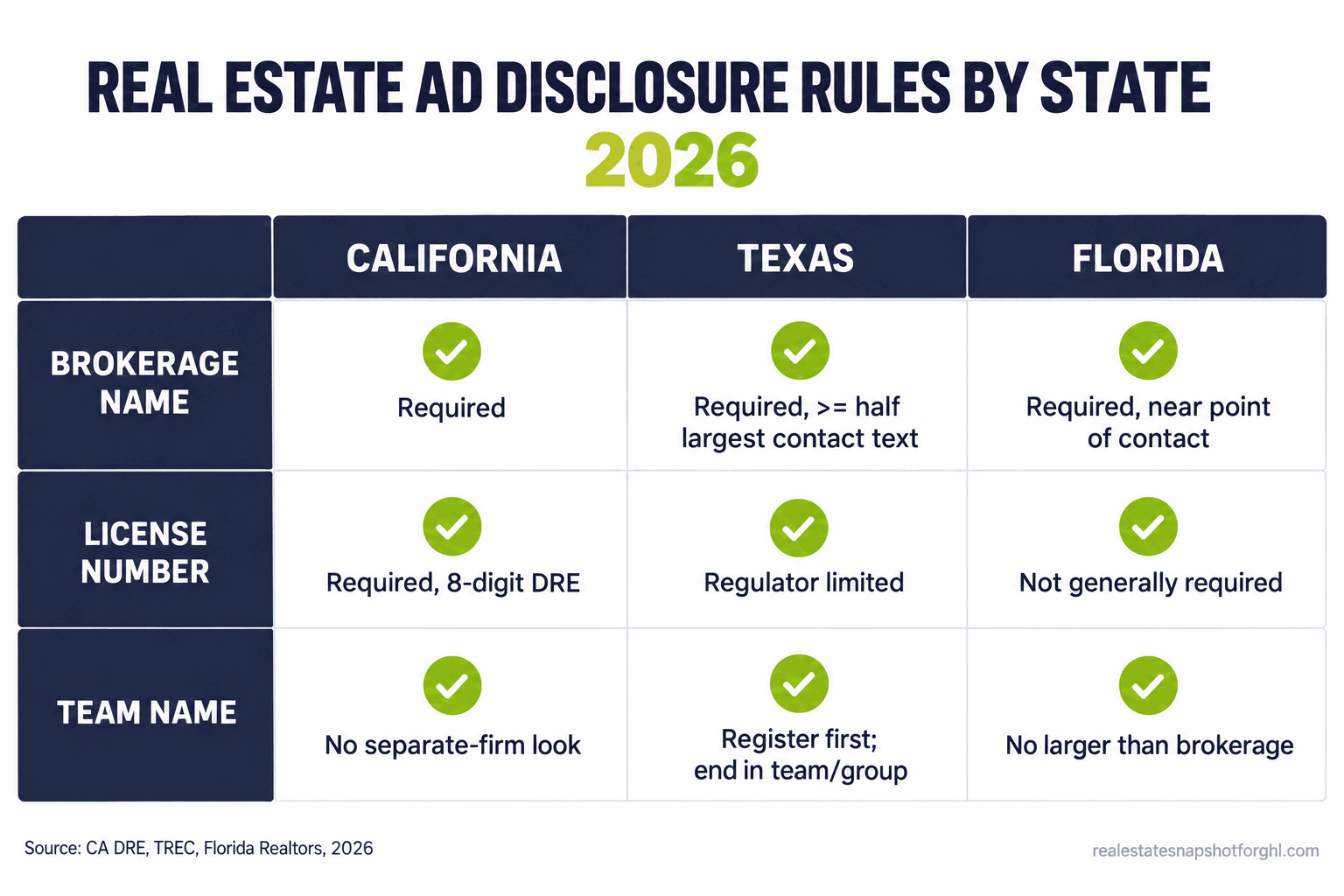
A starting map; confirm your own state’s current rule text.
| State | Brokerage name | License number | Team name rule |
|---|---|---|---|
| California | Required | Required, 8-digit DRE, readable | Must not imply a separate firm |
| Texas | Required, >= half the largest contact text | Regulator limited on requiring it | Register first; end in “team”/“group” |
| Florida | Required in all ads, near point of contact | Not generally required | Cannot be larger than brokerage name |
| General default | Assume required | Include if any doubt | Register and keep subordinate |
The same rules land differently depending on your setup.
The solo agent. Your biggest exposure is the license number and brokerage name on fast, self-made content: captions, graphics, text blasts, video. No coordinator checks your work, so the rules have to live in your templates, not your memory. Your brand is you, which makes the “readily apparent you are a licensee” rule easy to trip when you post like an influencer.
The small team, two to five agents. Your risk is the team name and consistency across people. One agent uses the registered name, another shortens it on their signs, a third drops the brokerage line. You need one approved template kit, and the team name registered and sized correctly before anyone prints.
The brokerage or larger team. Now it is a supervision problem. The broker is on the hook for every agent’s advertising, so the question becomes “can I prove all 20 are compliant.” That means locked templates, a written advertising policy, and automation that stamps the disclosures onto outbound marketing so no agent can strip them. One bad post is the broker’s exposure, multiplied by headcount.
Steal this: the disclosure block and checklist
Adapt to your state and broker, then stop writing from scratch.
You decide once. After that the compliant version is the fast version, because it is already in the template. The same logic drives our listing presentation template, where the compliant fee language is built into the script.
Objections
“Nobody checks a random agent’s Instagram.” Your clients do not. Your competitors do, and so do fair-housing testers. Most commission complaints start with another agent or a consumer screenshotting something and reporting it, not a regulator browsing feeds. Assume your boosted posts are watched by people who would enjoy filing the complaint.
“My broker handles compliance, not me.” Your broker is liable, which is not the same as your broker doing the work. In Texas both you and your sponsoring broker get disciplined for the same bad ad. A broker who finds you posting without the brokerage name is more likely to tighten your leash than take the fall quietly.
“The rules differ in every state, so I will never get it right.” The identity rules rhyme even when details differ: name the brokerage, do not pretend to be the brokerage, register the team name, tell the truth. Fair Housing is federal and the same everywhere. Learn your state’s two or three specifics once, bake them into templates, and the variation stops being a daily decision. Cross state lines and a done-for-you system with disclosures built in earns its keep.
Advertising is one piece of staying inside the lines. For the channels with their own rulebooks, see A2P 10DLC and TCPA texting compliance, cold calling expired listings and FSBOs legally, and RESPA Section 8 and lender co-marketing, where agents most often break federal law without realizing it.
Finish the story
Back to that Tuesday-night boosted post. The version that protects you is not harder to make: same photo, same caption, same price. It just ends with one line that lives in your template, so you never typed it: your name, your brokerage’s licensed name, your license number, and “Equal Housing Opportunity.” It still pulls 40 comments. When a competitor screenshots it, there is nothing to send to the board. That is the whole game: build the right defaults in once, so the fast way and the safe way are the same way.
Frequently asked questions
Do I have to put my brokerage name on every social media post?
It depends on your state. Nebraska requires the brokerage name on the first public-facing page of a post and rejects a 'one click away' profile link; others allow the name to live on your profile. Because the rule varies and the penalty does not, put the brokerage name on both your profile and a sign-off on any post advertising a property or your services.
Does my real estate license number have to be in my ads?
In some states, yes. California requires your eight-digit DRE number on first-point-of-contact materials, including business cards, flyers, websites, and online videos, in a readable type size. Texas focuses on the broker's name instead. If your state is unclear, include the number anyway. Omitting it has led to discipline.
What language is banned in a real estate listing under Fair Housing?
Anything that describes the ideal occupant rather than the property. Phrases like 'perfect for a young family' or 'walkable to the church' can be read as a preference based on familial status, age, or religion, which the Fair Housing Act prohibits in advertising. Describe the house and let buyers decide if it fits.
Can I still advertise the buyer agent commission in the MLS?
No. Since August 17, 2024, offers of compensation to buyer brokers can no longer be communicated through the MLS, and an MLS cannot carry even a yes-or-no compensation field. Sellers can still agree to pay a buyer's agent off-MLS. Remove any co-op commission language from your listing remarks.
How much can a Fair Housing advertising violation cost?
HUD's 2025 inflation adjustment set the maximum civil penalty at $26,262 for a first violation and as much as $131,308 for repeat violations, and those apply to discriminatory advertising, not just transactions. State commission and REALTOR Code of Ethics sanctions can apply on top.
Sources
- NAR: Existing-Home Sales, October 2026
- NAR: Code of Ethics, Article 12
- NAR: Create Advertisements With Fair Housing in Mind
- HUD civil penalty adjustment: Federal Register FR-6513-F-01 (2025)
- California DRE: Regulation 2773; KTS Law summary
- TREC: Advertising name types under Rule 535.154; required advertising information; Social Media and Advertising
- Florida Realtors: REALTOR Advertising Rules; Rule 61J2-10.025
- Nebraska Real Estate Commission: Social Media Compliance
- Zillow: 8 Agent Takeaways From the NAR Settlement