

It is a Tuesday and your favorite loan officer buys you lunch. Halfway through the sandwich comes the offer that sounds like a gift: “Let me cover half your Zillow co-marketing. You keep the leads, I get to be your preferred lender.” You are a solo agent watching every dollar in a slow market, and free lead spend feels like found money. Say yes the wrong way and you have both just committed a federal crime that carries a fine and up to a year in prison.
That is the trap at the center of RESPA Section 8, the one federal law where friendly favors between agents, lenders, and title companies quietly turn into kickbacks. Most agents who break it never meant to. Here is the plain-English version: what Section 8 bans, which everyday arrangements are fine, which are a violation dressed up as a marketing deal, and the exact language and scripts to stay clean.
Table of contents
- What RESPA Section 8 actually says
- What a violation really costs you
- The six arrangements agents get wrong
- Legal vs illegal, side by side
- What it looks like when the CFPB comes
- Three scenarios: solo agent, small team, brokerage
- Steal this: the disclosure language and scripts
- Objections
- Frequently asked questions
What RESPA Section 8 actually says
RESPA is the Real Estate Settlement Procedures Act. Section 8 is the anti-kickback part, at 12 U.S.C. 2607, implemented in Regulation X at 12 CFR 1024.14. Three pieces matter.
Section 8(a): no referral fees. You cannot give or accept a fee, kickback, or thing of value under any agreement that settlement business will be referred to someone. A lender cannot pay you for sending a borrower, no matter what you call it.
Section 8(b): no unearned fees. You cannot split a settlement charge with someone who did no work for it. A title company cannot carve off part of its fee and hand it to you for doing nothing.
Section 8(c): what is allowed. Payments for goods or services actually furnished at fair market value are fine, as is normal employee pay and disclosed affiliated arrangements.
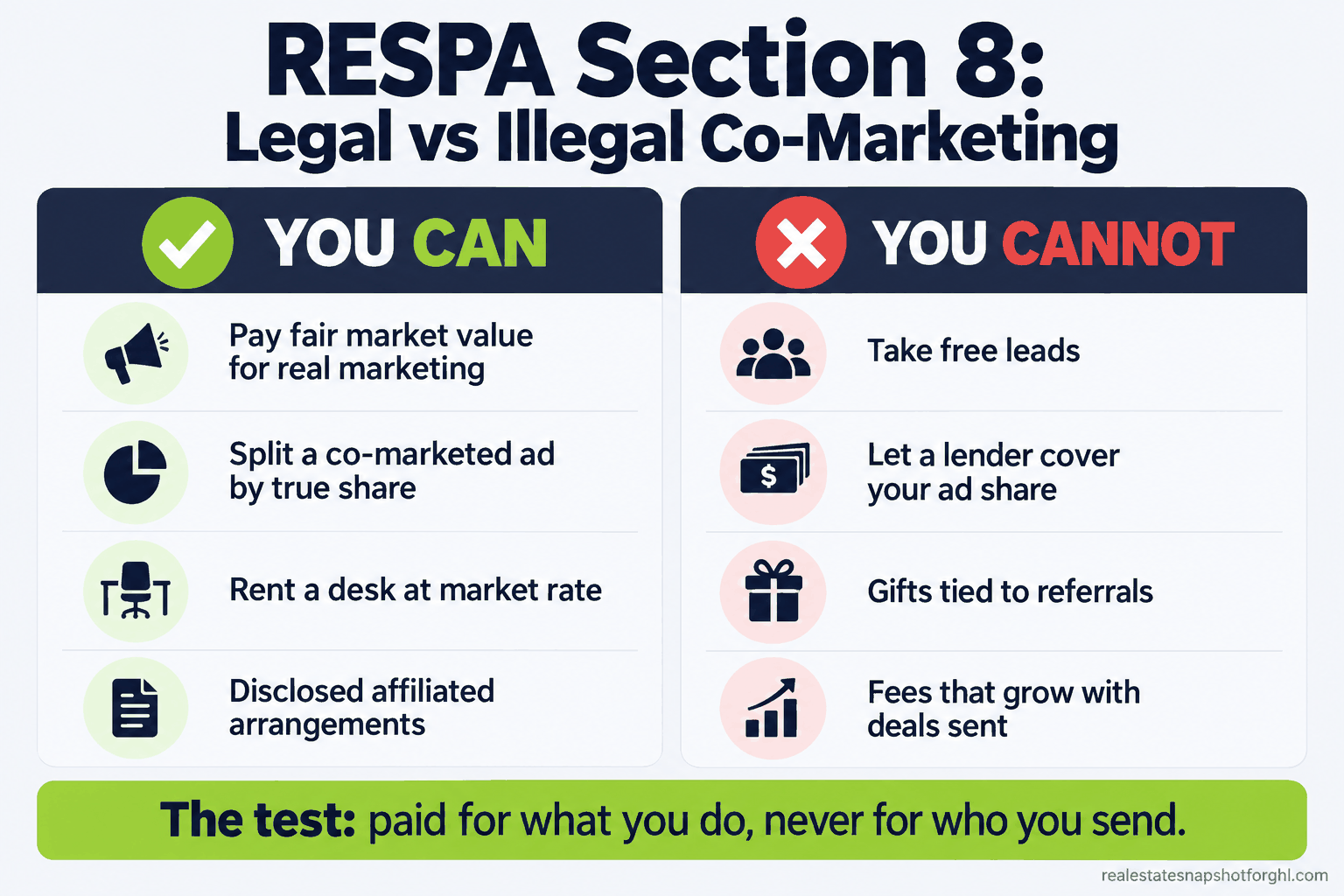
The phrase that traps people is “thing of value,” and the rule reads it broadly. Not just cash: discounts, free or below-market services, leads at no cost, trips, dinners, “special” banking terms. The law does not require money to change hands, so a free CRM seat or a stack of leads counts. The whole thing in one sentence: you can be paid for what you do, never for who you send.
What a violation really costs you
RESPA Section 8 is not a slap on the wrist. Under 12 U.S.C. 2607(d), a criminal violation carries a fine up to $10,000 and up to one year in prison, per violation. The consumer also gets a private right of action for three times the amount they paid, plus costs and fees. And the CFPB brings enforcement actions with penalties in the millions, naming the agents and brokers who took the money, not just the lenders who paid.
Put it against your market. The median existing-home price was $429,100 in August 2026, with sales down to a 3.98 million annual pace, off 2.0% (NAR). In a thinner market, “let me help with your ad spend” gets more tempting. One referred closing is thousands of dollars, which is why the law treats it as a thing of value.
The six arrangements agents get wrong
Almost nobody sets out to break RESPA. They fall into one of six normal-looking arrangements and get the structure wrong.
1. Marketing Services Agreements (MSAs)
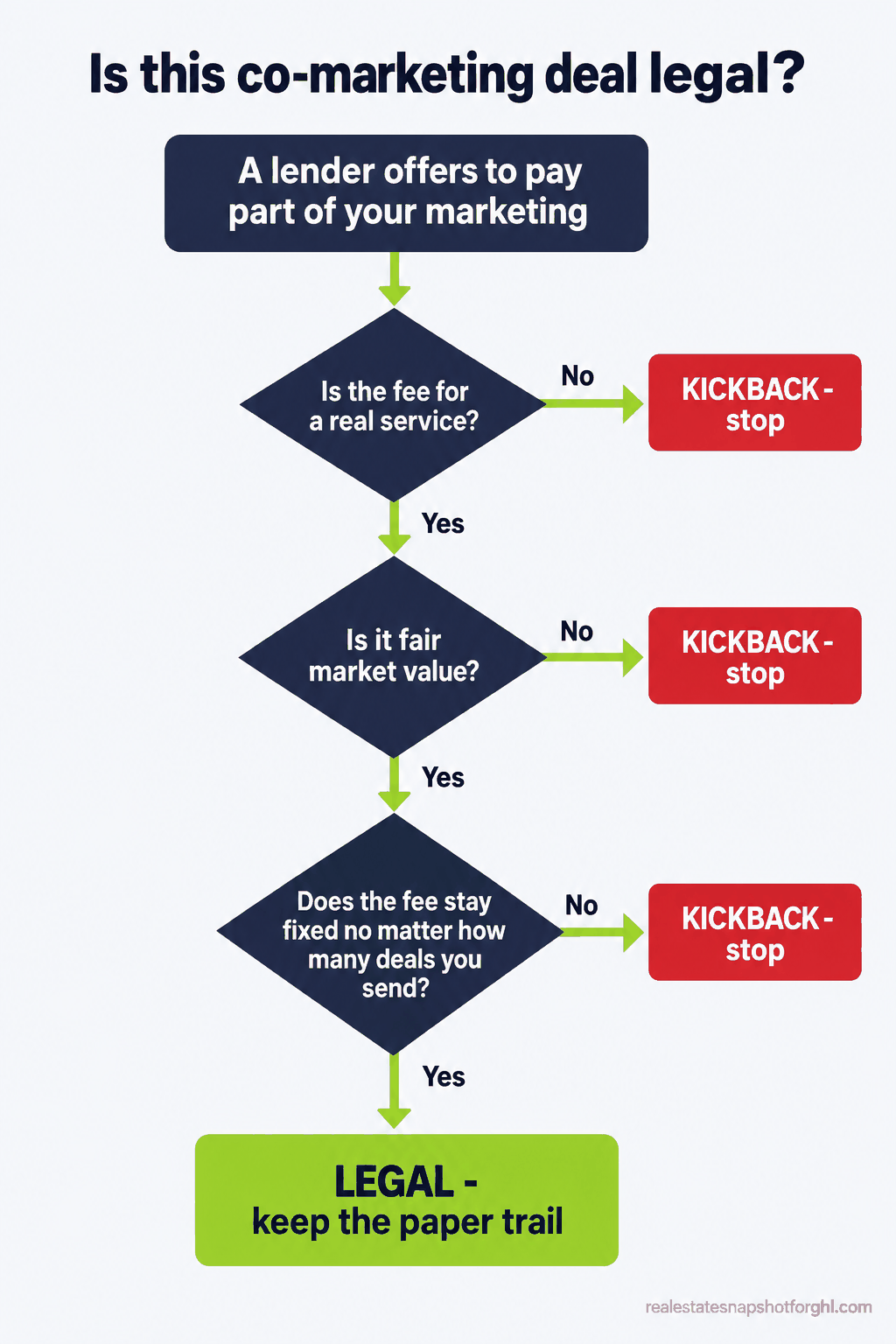
A lender pays you a monthly fee to market their brand: logo on your materials, a mention in your emails, a sign at your open houses. That is legal when the fee is for marketing actually performed and reasonably related to fair market value, which the CFPB confirmed in its October 2020 RESPA FAQs. It breaks the moment the fee tracks your closing volume, nobody documents the services, or you get paid the same whether you run one email or ten. The CFPB treats any payment above market value as payment for referrals.
2. Portal co-marketing (Zillow and the rest)
You and a lender share a Zillow or Realtor.com ad, your face and their logo on one placement, and the lender pays only its true proportional share. It breaks when the lender pays more so you pay less, because that gap is a thing of value for being the preferred lender on your leads. The CFPB probed Zillow’s program and closed it in 2018 without action, but that was about Zillow’s structure, not a license for a loan officer to cover your half.
3. Desk rental and office space
You rent desk space to a loan officer or title rep at fixed, fair market rent, priced the way you would for any tenant. It breaks when the “rent” is far above or below market and tracks referral volume, like a loan officer paying $2,000 for a desk worth $400 because the extra $1,600 buys your buyers. Sham desk deals were part of the Prospect Mortgage case. Price the space like a landlord, not a pipeline partner.
4. Gifts, events, and co-branded swag
The title company sponsors your client party; the lender brings the taco truck and pays for co-branded flyers. On their own, occasional gifts and promotion are generally fine. It breaks when there is an understanding that referrals flow back in exchange, especially when the perks are recurring. Freedom Mortgage was penalized in 2023 for exactly this: a one-off closing gift is not a kickback, but a standing arrangement that keeps flowing as long as the deals do is.
5. Affiliated Business Arrangements (in-house title or mortgage)
Your brokerage owns a piece of a title or mortgage shop and refers clients to it. This is allowed under 12 CFR 1024.15 only if all three hold: a written disclosure at or before the referral, no requirement that the client use that provider, and no money to you beyond a bona fide return on your ownership interest. It breaks when the disclosure is missing, clients feel required to use the in-house shop, or the “ownership return” is a disguised per-referral payout. RealtySouth paid $500,000 in 2014 for steering buyers to its affiliate without adequate disclosure; Meridian Title paid up to $1.25 million in 2017.
6. Lead-gen platforms that are really pay-per-referral
A platform or lender feeds you leads with pricing tied to closings, or steers consumers toward whoever pays most. It breaks when the platform ranks lenders by payment, which the CFPB’s 2023 advisory opinion on digital comparison-shopping called a referral. If the “lead fee” rises with closings, it is a referral fee in a costume; buying your own leads instead, as our CRM cost breakdown shows, keeps you clear.
Legal vs illegal, side by side
| The arrangement | Legal version | Illegal version |
|---|---|---|
| Marketing fee / MSA | Flat fee for marketing actually done, at fair market value | Fee that scales with deals, or with no real services tracked |
| Portal co-marketing | Lender pays its true proportional share | Lender covers your share so you pay less |
| Desk / office rent | Market-rate rent, fixed, like any tenant | Above or below market, tracking referral volume |
| Gifts and events | Occasional, not tied to referrals | Recurring sponsorship in exchange for business |
| In-house title / mortgage | Written disclosure, no required use, return on ownership only | No disclosure, required use, or per-referral payouts |
| Leads | Flat, fair price for real advertising | Free leads, or a fee that rises with closings |
What it looks like when the CFPB comes
The cases are the clearest teacher. They also show regulators pursue the agents and brokers who took the money, not just the lenders.
CFPB RESPA Section 8 penalties, in millions of US dollars. Sources: CFPB Prospect Mortgage, 2017; ALTA on Freedom Mortgage, 2023; CFPB RealtySouth, 2014.
Prospect Mortgage, 2017. The big one: $3.5 million for sham MSAs, desk rental deals, and lead agreements with more than 100 brokerages to buy referrals. The brokers did not walk away clean. RE/MAX Gold Coast paid a $50,000 penalty, and Keller Williams Mid-Willamette paid $145,000 in disgorgement plus a $35,000 penalty. The agent who accepts the arrangement is liable too.
Freedom Mortgage, 2023. The first public Section 8 enforcement in years, which signaled the rules were not dead letters: $1.75 million for giving 40-plus brokerages cash, subscriptions, and catered parties for referrals. A brokerage that accepted, Realty Connect USA, paid its own $200,000 penalty.
RealtySouth, 2014 ($500,000) and Meridian Title, 2017 (up to $1.25 million) are the affiliated-arrangement failures in the wild: steering to an in-house or executive-owned provider without adequate disclosure. Lighthouse Title (Michigan), 2014 ($200,000) is the MSA failure again, with payments that tracked referral volume, not real service.
In the PHH case, a court vacated the CFPB’s $109 million order in 2016 and held that payments do not violate Section 8 if they stay within reasonable market value. That line is your safe harbor, and it is why the game comes down to whether the money matches the work.
Three scenarios: solo agent, small team, brokerage
The right move changes with your size.
The solo agent. Your risk is co-marketing and gifts. The safe rule is the simplest: pay your own marketing in full, and let lenders pay only their honest share of a genuinely shared ad. You have no compliance department, so your defense is a clean paper trail and the discipline to say no to “free.” A warm database and steady follow-up out-earn any subsidized ad at zero federal risk, which is what database reactivation is for.
The small team (2 to 10). Now MSAs and desk rentals show up. These can be fine, but the burden is on you to prove fair market value and actually perform the services. Price the deal against what an outside vendor would charge, track the work, and keep the fee fixed regardless of deals. If you cannot answer “what is this fee buying, in hours and deliverables,” do not sign.
The brokerage. Your exposure is affiliated arrangements and the culture around them. If you own a title or mortgage affiliate, the three conditions are the whole defense: written disclosure every time, genuine freedom to go elsewhere, and payouts that are only a return on real ownership. Train every agent that “you have to use our title company” is a sentence that costs the firm six figures.
Steal this: the disclosure language and scripts
Compliance is easier when the words are ready. Adapt these to your state and your attorney’s review.
The harder skill is turning down an offer without wrecking the relationship. Saying no to a friendly loan officer feels rude, but it is the move.
Objections
“Every agent in my market co-markets with a lender. Why me?” Enforcement is not about market share, it is about paper trails, and a client or plaintiff’s lawyer can start one. The 2023 Freedom Mortgage case proved the rules are live, and the brokerages that took the money paid alongside the lender.
“So I can never work with my preferred lender or title company?” You can, closely. Co-market where the split is honest, share an office at market rent, run an affiliate you disclose properly, refer clients to people you trust. What you cannot do is get paid for the referral itself. Keep the money tied to real work and the relationship is fine.
“I am not technical and this sounds like a minefield. Do I need a compliance team?” No, one habit and one lawyer. The habit is the checklist above, run before you sign anything. The lawyer is a real estate compliance attorney you call once to review your standard arrangements, cheaper than one consent order.
“What about a closing gift or buying a lender coffee?” A genuine one-off gift is not what Section 8 is about. The line is an understanding that referrals come back in exchange. Ask whether the nice thing would keep coming if you stopped sending deals. If not, it is a referral fee.
The taco truck at your open house is not the problem; the standing deal behind it might be. Get the structure right and keep the paper clean, and you keep every relationship that helps your clients while staying on the right side of a law with real teeth. For the sibling rules on outreach, see A2P 10DLC and TCPA compliance for real estate texting, and for getting the agreement right before you act, explaining the buyer agency agreement without losing the client.
Frequently asked questions
Frequently asked questions
What is RESPA Section 8 in simple terms?
RESPA Section 8 (12 U.S.C. 2607) is the federal anti-kickback rule for real estate settlement services. It bans giving or accepting anything of value for referring business like mortgages, title, or escrow. The test: you can be paid for real work at fair market value, never for who you send.
Can a lender pay for my Zillow or portal co-marketing?
Only for the lender's true, proportional share of the ad. If the ad is half about the lender, the lender pays half. If a loan officer offers to cover your share so you pay less, that gap is a thing of value for referrals, which is a Section 8 violation. Document that the split matches the exposure, or do not split it.
What are the penalties for a RESPA Section 8 violation?
Under 12 U.S.C. 2607(d), a criminal violation carries a fine up to $10,000 and up to one year in prison per violation. Consumers also get a private right of action for three times (treble) the charge they paid, plus costs and fees, and the CFPB brings separate enforcement actions with penalties in the millions.
Are Marketing Services Agreements (MSAs) legal for real estate agents?
Yes, if structured correctly. The CFPB's October 2020 RESPA FAQs confirmed MSAs are not banned. The payment must be for marketing actually performed and reasonably related to its fair market value, and it cannot move with the number of deals you refer.
Can my brokerage refer clients to our own in-house title or mortgage company?
Yes, under the affiliated business arrangement rules in 12 CFR 1024.15, but only if all three conditions hold: a written AfBA disclosure at or before the referral, no requirement that the client use that provider, and no money to you beyond a bona fide return on your ownership interest. Miss one and it becomes an illegal kickback, as RealtySouth and Meridian Title found out.
This article is a plain-English operator’s guide for real estate professionals and is not legal advice. RESPA is federal law and its application depends on the specifics of your arrangement and your state. Before entering any co-marketing, marketing services, desk rental, or affiliated business arrangement, have a qualified real estate compliance attorney review it.