

It is a Saturday, and a buyer you have texted with twice wants to see a house at 2pm. You send the buyer representation agreement to sign first, the way you now have to, and the reply is cold: “Why do I have to sign something before I even see the place? My last agent didn’t make me do that.” You can feel the showing slipping away, and with it a buyer who was ready to go.
The buyer agency agreement is not the problem. The way most agents spring it on people is the problem. Since August 17, 2024, an agent has to have a written, signed buyer agreement in place before touring a home, and the offer of compensation you used to count on is no longer posted in the MLS (National Association of Realtors). Agents who lose buyers here treat the form like a toll booth. Agents who keep them treat it as the moment they explain their value, with a system that does the explaining before the form ever lands in an inbox. This is that system: six stages, the message copy for each, the timing, and the ways it breaks.
Table of contents
- What losing this conversation actually costs you
- The six-stage buyer agreement system
- Stage 1: The first inquiry
- Stage 2: Pre-appointment education
- Stage 3: The buyer consultation
- Stage 4: The compensation conversation
- Stage 5: Showings and reinforcement
- Stage 6: Offer and close
- Steal this: the scripts
- Run the system for a solo agent, a team, and a brokerage
- The compliance you cannot skip
- Objections
- Frequently asked questions
What losing this conversation actually costs you
Start with the number that should end the panic. Even after the practice changes, 88% of buyers still bought through an agent or broker in the 2025 NAR profile, and for-sale-by-owner fell to 5%, the lowest share ever recorded (NAR 2025 Profile). Buyers still want you. They just want to know what they are agreeing to before they sign.
And most buyers are not interviewing five agents and picking the cheapest. In the same profile, 67% of first-time buyers and 76% of repeat buyers interviewed only one agent before choosing (NAR). If you are having the buyer agreement conversation, you are usually the only agent in the room. You are not competing on price against three rivals. You are competing against the buyer’s confusion. Clear that up and the signature is a formality.
Now the market. The median existing-home price hit $429,100 in August 2026, up 1.6% from a year earlier, with sales running at a 3.98 million annual pace, down 2.0% for the month (NAR). Fewer sales means every buyer who walks is a bigger hole in your year. At a 2.5% buy-side fee on the median price, one buyer is worth roughly $10,700. Lose one a quarter over a fumbled form and that is more than $40,000 gone.
This is a follow-up gap, not a talent gap. Industry data shows 48% of agents never follow up after the first contact, and most sales happen between the fifth and twelfth touch (AgentZap, 2026). The agent who loses the buyer at the agreement usually never warmed them up first. They asked a stranger to sign.
Sources: agent follow-up behavior, AgentZap 2026; buyer agent usage, NAR 2025 Profile. Figures are percentages.
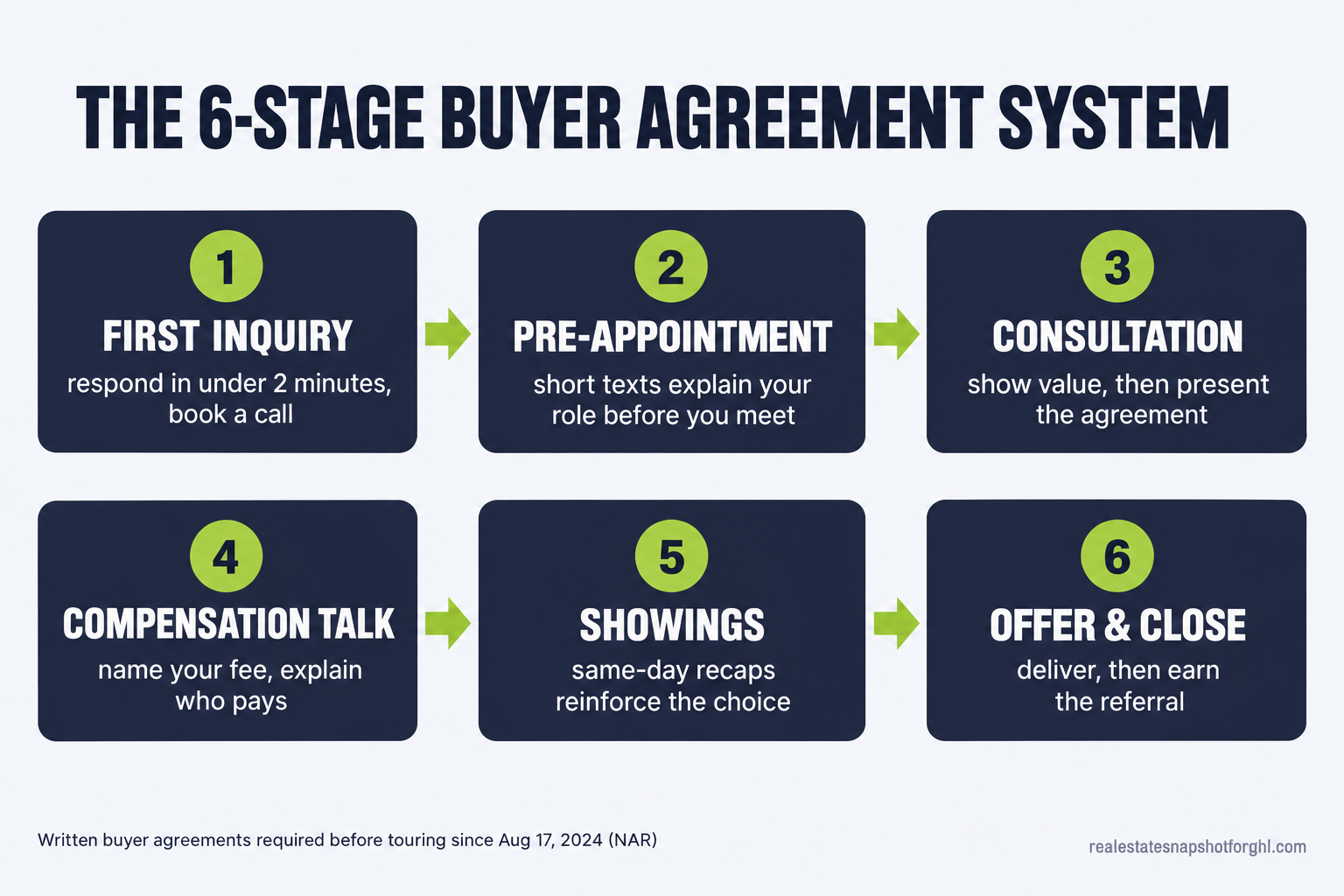
The six-stage buyer agreement system
The signature happens at stage four. Everything before it exists so that by the time you send the form, the buyer already understands why. Here are the six stages and the one job each does.
- First inquiry. Respond fast, sound human, book a real conversation.
- Pre-appointment education. A short sequence that explains your role before you meet.
- The buyer consultation. The meeting where you earn the agreement, not ask for it.
- The compensation conversation. Naming your fee and who pays it, without flinching.
- Showings and reinforcement. Proving the agreement was worth signing.
- Offer and close. Delivering, and setting up the referral that starts the next cycle.
Miss stage two and you land at stage four cold. That is the whole failure pattern in one sentence.
Stage 1: The first inquiry
The job: answer fast, sound human, and turn a form fill into a booked call, not a signature.
Speed matters more than polish here. The lead who messaged your listing is comparing you, in that moment, to whoever else replies, and the first agent to respond usually wins the conversation (speed-to-lead playbook). Do not lead with the agreement. Lead with help: your first message answers their question and offers the next step.
How it breaks: you reply four hours later with “Thanks for your interest, please sign the attached agreement so we can proceed.” That is a toll booth, and the buyer bounces. The fix is a missed-inquiry auto-response that buys you time and sounds like you, wired up once and forgotten (missed-call text-back).
Stage 2: Pre-appointment education
The job: explain what a buyer’s agent does, and why they now sign an agreement, before you are face to face. Almost everyone skips this stage, and it is the one that saves the signature.
Between booking the consultation and the meeting, send two or three short messages. Not a legal lecture, a plain-English preview. One text explains that you will walk them through how you get paid and what they are protected by. One short video, even a 60-second selfie clip, does more than any PDF. By the time they sit down, they already expect to sign something and have a rough idea why.
This is where a follow-up system earns its keep. A human agent juggling six deals forgets the pre-appointment sequence. An automated one never does (follow-up sequences that get answered).
How it breaks: you book the consult and go dark until the meeting. The buyer arrives with no context, you produce a two-page form in the first ten minutes, and now you are explaining a legal document cold while they get nervous. Silence between booking and meeting is the most expensive gap here.
Stage 3: The buyer consultation
The job: earn the agreement in conversation. The form is the last five minutes of a good meeting, not the first.
Structure the consultation so value comes before paper. Walk through their goals, timeline, and financing. Show them how you will find homes that never hit the portals, how you negotiate, how you manage inspection and closing. Then, and only then, frame the agreement as the thing that makes it official: “Everything I just described, that is what this agreement commits me to do for you.” Buyers do not resist signing with someone they trust. Value, then form.
How it breaks: you open with “before we start, I need you to sign this.” Even a buyer who likes you tenses up, because you asked for commitment before you gave value. Reorder the meeting and most of the friction disappears.
Stage 4: The compensation conversation
The job: state your fee, explain it, and lay out who pays it, without apology or waffling. This is the part agents dread, and it is mostly dread of their own script.
Since offers of compensation left the MLS, you can no longer point at a number the listing side “already promised.” You name your fee in the agreement, then work out who covers it. Often the answer is still the seller: you ask, through the listing agent, for the seller to cover your compensation as part of the deal. Sometimes it is the buyer, in part or full. Either way, the buyer hears it from you in plain terms before they sign. You are not asking permission to charge. You are explaining a fee that is negotiable in how it gets paid, not whether you are worth it.
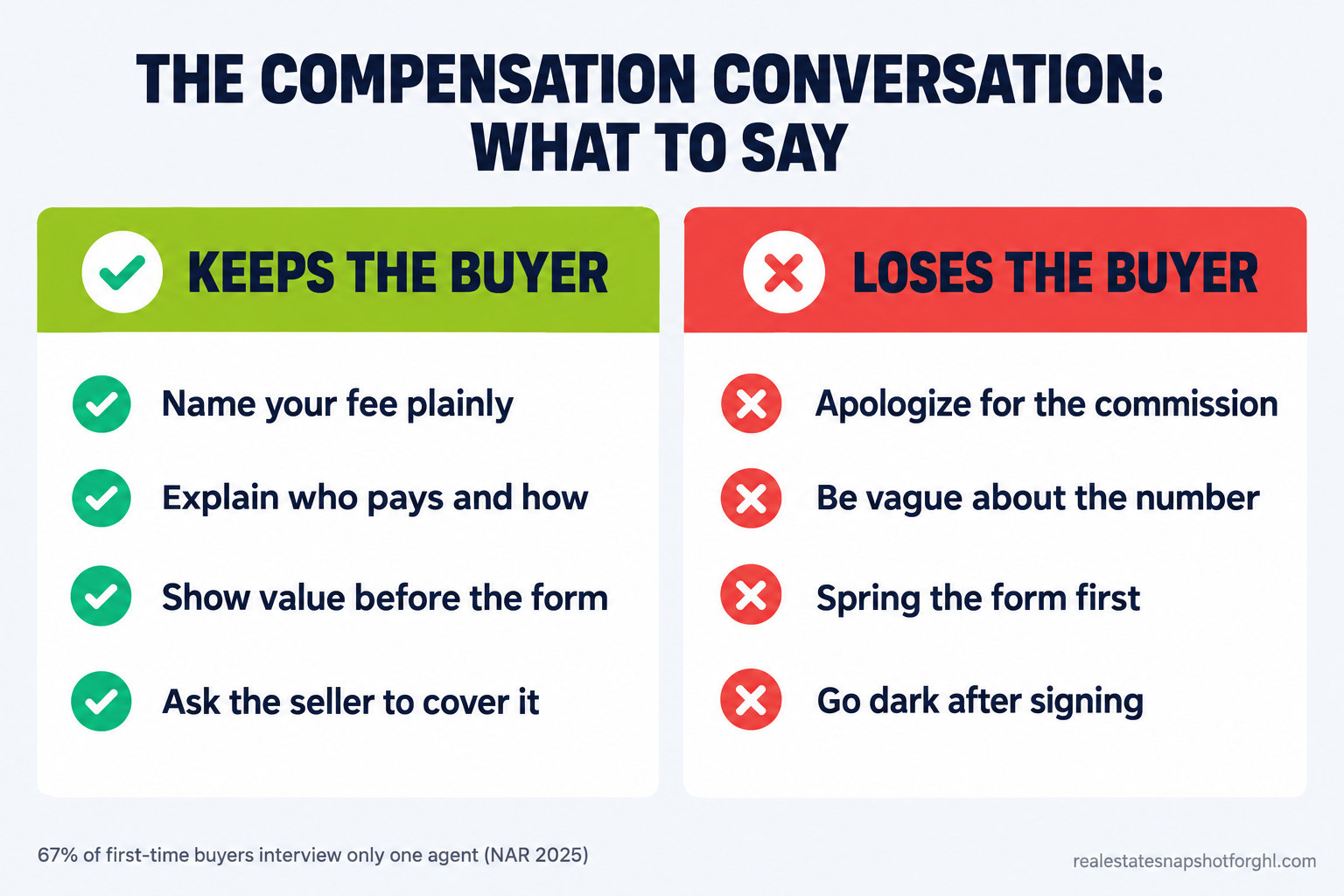
How it breaks: you apologize for your fee. The moment you say “I know this is a lot, but…” you have told the buyer it is not worth it. The other failure is vagueness: if you cannot say clearly who pays and how much, the buyer assumes the worst and stalls. Rehearse this until it is boring to say. Boring is confident.
Stage 5: Showings and reinforcement
The job: prove the agreement was worth signing, fast, so buyer’s remorse never sets in.
The first showing after signing is where trust is confirmed or quietly lost. Show up prepared, know the comps, point out what a buyer would miss, and send a same-day recap. Every small proof tells the buyer they made the right call, which matters because a buyer agreement is only as strong as the buyer’s willingness to honor it. Automated confirmations, reminders, and recaps mean nobody feels forgotten, run by the same CRM and workflow engine as the pre-appointment sequence.
How it breaks: you go quiet after the signature. The buyer signed an exclusive agreement, did not hear from you for a week, and now feels trapped rather than served. Consistent, small touches prevent it.
Stage 6: Offer and close
The job: deliver the outcome, then convert a happy client into the next referral.
Keep the buyer informed through inspection, appraisal, and financing so the last stretch feels handled. Then, at close, do the thing most agents forget: ask for the review and set up the stay-in-touch that makes this client refer you for years (post-close referral engine; sphere of influence playbook).
How it breaks: you close and vanish. The buyer had a great experience, never heard from you, and two years later lists with the agent who did stay in touch. The agreement got you the deal. Follow-up after close gets you the next three.
Steal this: the scripts
Keep the structure, adjust the wording to sound like you, and route the automated pieces through your CRM so they never get skipped.
Five messages, sent at the right moment, turn the agreement from an ambush into an expected, understood step.
Run the system for a solo agent, a team, and a brokerage
The same six stages, three very different builds.
The solo agent. You are the whole system, so automation is the only way the pre-appointment and recap messages actually go out. Wire up three automated touches: the first-inquiry auto-reply, the pre-appointment sequence, and the same-day recap prompt. Keep the consultation and compensation conversation human, always. Your risk is not too much automation, it is going dark between steps because you got busy on a closing.
The 2 to 5 person team. Now consistency across people is the problem. One agent nails the consultation, another springs the form cold, and conversion swings by who caught the lead. Standardize the scripts as team templates, route inquiries to the fastest responder, and put the pre-appointment sequence on autopilot so no buyer arrives uneducated. A shared pipeline, from new lead to consult booked to agreement signed to under contract, tells you where buyers stall.
The brokerage. At scale the issue is training and compliance. New agents fumble the compensation conversation and expose the brokerage. Build the six-stage system into onboarding, give every agent the same compliant scripts and sequences, and track agreement-signed rates by agent so you can coach the ones losing buyers at stage four. Brokerages that treat the buyer agreement as a trainable skill out-recruit the ones that leave each agent to wing it.
The compliance you cannot skip
None of the scripts above override your state law or your broker’s forms. Get these right.
The federal practice changes. A written buyer agreement is required before you tour a home with a buyer, and it must disclose your compensation specifically and conspicuously. Offers of compensation are no longer allowed in the MLS, though they remain negotiable off-MLS (NAR settlement FAQs). The Clear Cooperation Policy is still active, now with delayed-marketing options under Multiple Listing Policy Statement 8.5, so know your MLS’s rules before you hold a listing back.
Agency law is not the same in two states, and this is the part agents get wrong. In Florida, dual agency is banned outright and the default is a transaction-broker relationship, so a “buyer agency agreement” there does not mean what it means elsewhere. Colorado restricts designated and dual agency. California permits disclosed dual agency and layers on its own disclosure burden. Most other states allow disclosed dual agency. Do not copy a script or form from an agent in another state and assume it is legal in yours. Confirm the relationship type and the exact form with your broker.
Texting and calling those buyers is regulated too. The automated messages in this system are still governed by TCPA consent rules and, for SMS, A2P 10DLC registration. Get real consent, honor opt-outs, and register your campaigns (is texting real estate leads legal).
Objections
“Won’t asking a buyer to sign before showing scare them off?” It scares off buyers who do not understand why, which is exactly what stages one and two prevent. Buyers who arrive already knowing what a buyer’s agent does, and expecting to sign something, do not flinch. The fear comes from surprise, and this system removes it.
“What if I already pay for Follow Up Boss or BoldTrail?” Then you already have somewhere to store contacts. The gap is the automated pre-appointment and recap sequences, and whether they actually fire on time. If you are weighing what these platforms cost, our teardown of what real estate CRM software actually costs in 2026 breaks down every vendor.
“Do I need to be technical to run this?” No. The human parts, the consultation and the compensation conversation, are pure agent skill, and the automated parts are set up once. The point of a done-for-you system is that you are not building workflows at 11pm, you are having conversations with buyers during the day. Start with the residential agent system and add from there.
Frequently asked questions
Do buyers legally have to sign an agreement before I show them a house?
Under the NAR practice changes effective August 17, 2024, an agent must have a written, signed buyer representation agreement in place before touring a home with a buyer, and that agreement must disclose the agent's compensation. Confirm your state's exact form and rules with your broker, since agency law varies by state.
How do I explain the buyer agency agreement without scaring the client?
Explain your value before you send the form. Use a short pre-appointment sequence and a consultation that walks through what you do, then frame the agreement as the thing that makes that commitment official. Buyers resist signing cold, not signing after they understand what they are getting.
Who pays the buyer's agent commission now?
Since offers of compensation are no longer posted in the MLS, you name your fee in the buyer agreement and then negotiate who covers it. Often the seller still covers it through the listing agent as part of the offer. Sometimes the buyer covers part or all. The key is to state the number up front so there are no surprises.
What do I say when a buyer pushes back on the commission?
State the fee plainly and do not apologize. Explain that in most deals the seller covers it through their listing agent, and that if a particular seller will not, you will know before the buyer is committed to that home. Vagueness and apology are what lose buyers, not the number itself.
Is the buyer agency agreement the same in every state?
No. Florida bans dual agency and uses a transaction-broker model, Colorado restricts designated and dual agency, and California permits disclosed dual agency with its own disclosure rules. Never reuse another state's script or form without confirming it is valid in yours, and any automated texts or calls in your follow-up must still follow TCPA and A2P 10DLC rules.