

It is a Thursday evening. On Saturday you spent two hours showing a pre-approved buyer three homes. They loved the second one, said they loved working with you, and promised to talk to their partner. That was three weeks ago. You texted once, they replied “still thinking!”, and you have not heard from them since. Then a coworker mentions seeing that same buyer at an open house last Sunday, walking the property with a different agent.
You did not lose that buyer at the showing. You lost them in the silence after it. A buyer who goes quiet mid-search almost never fires you on purpose. They drift, because nobody stayed in the picture while they waited, and in 2026 the wait is long. This post is the system that fills that silence: seven stages that keep an active buyer engaged from first contact to the closing table, the message copy to steal, and the way each stage breaks.
Table of contents
- What a cold buyer actually costs you
- Why buyers go quiet in 2026
- The seven-stage buyer nurture system
- Stage 1: Lock the relationship at first contact
- Stage 2: Qualify in the first conversation
- Stage 3: Put the home search on autopilot
- Stage 4: Nurture the ten-week wait
- Stage 5: Close the feedback loop after every showing
- Stage 6: Catch the “ready now” signal
- Stage 7: Keep a paused search warm
- Steal this: the buyer nurture copy
- Run it for solo, team, and brokerage
- The compliance you cannot skip
- Objections
- Frequently asked questions
What a cold buyer actually costs you
A cold buyer is worse than a lost lead, because you already did the expensive part: the inquiry, the rapport, the comps, the Saturday of showings. That cost is sunk when they buy with someone else, and you lose more than a commission. You lose the referral and the sphere they would have joined.
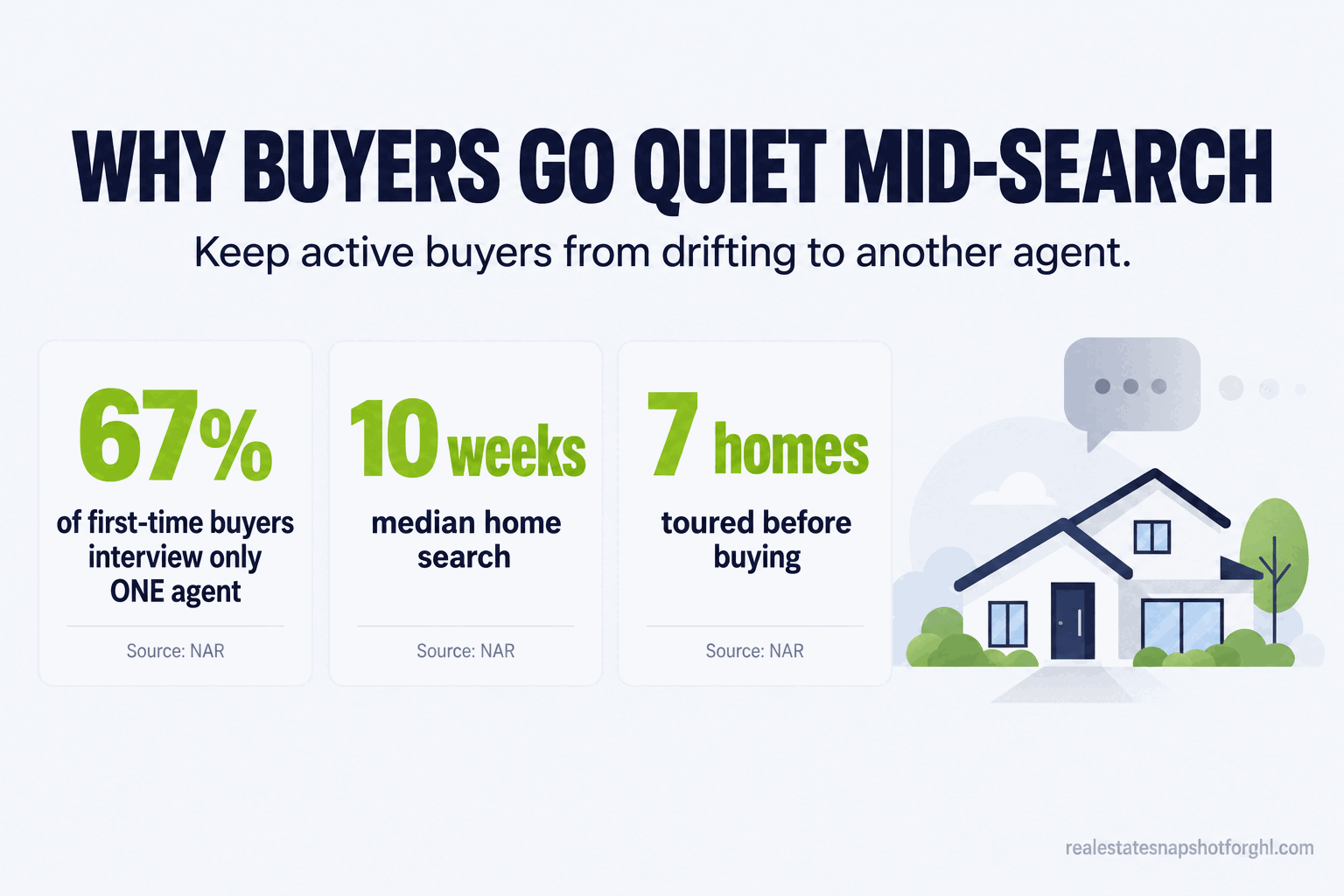
The math is brutal because most buyers do not shop around for an agent. In NAR’s most recent Profile of Home Buyers and Sellers, 67% of first-time buyers and 76% of repeat buyers interviewed only one agent before choosing (NAR Profile of Home Buyers and Sellers). If you are the one agent they are talking to, the business is almost yours to lose. The second you go silent, you open the door for whoever shows up next, and that buyer rarely interviews a third.
The referral angle makes it worse. 43% of buyers found their agent through a referral, and 18% used an agent they had worked with before (NAR Profile of Home Buyers and Sellers). A buyer you nurture to the closing table is the top of a referral tree, and one who drifts away takes that whole tree with them.
Why buyers go quiet in 2026
Buyers are not rude, the 2026 search is just slow. The median buyer spends about ten weeks searching and tours around seven homes before buying (NAR Profile of Home Buyers and Sellers), and this market stretches that out, with inventory at a ten-year high of 4.9 months in August 2026 and sales down to a 3.98 million annual rate (NAR Existing-Home Sales). Ten weeks is a long time to stay top of mind when your only contact is “saw this listing, want to see it?” Nurture exists to own those weeks, not just the showings inside them.
The seven-stage buyer nurture system
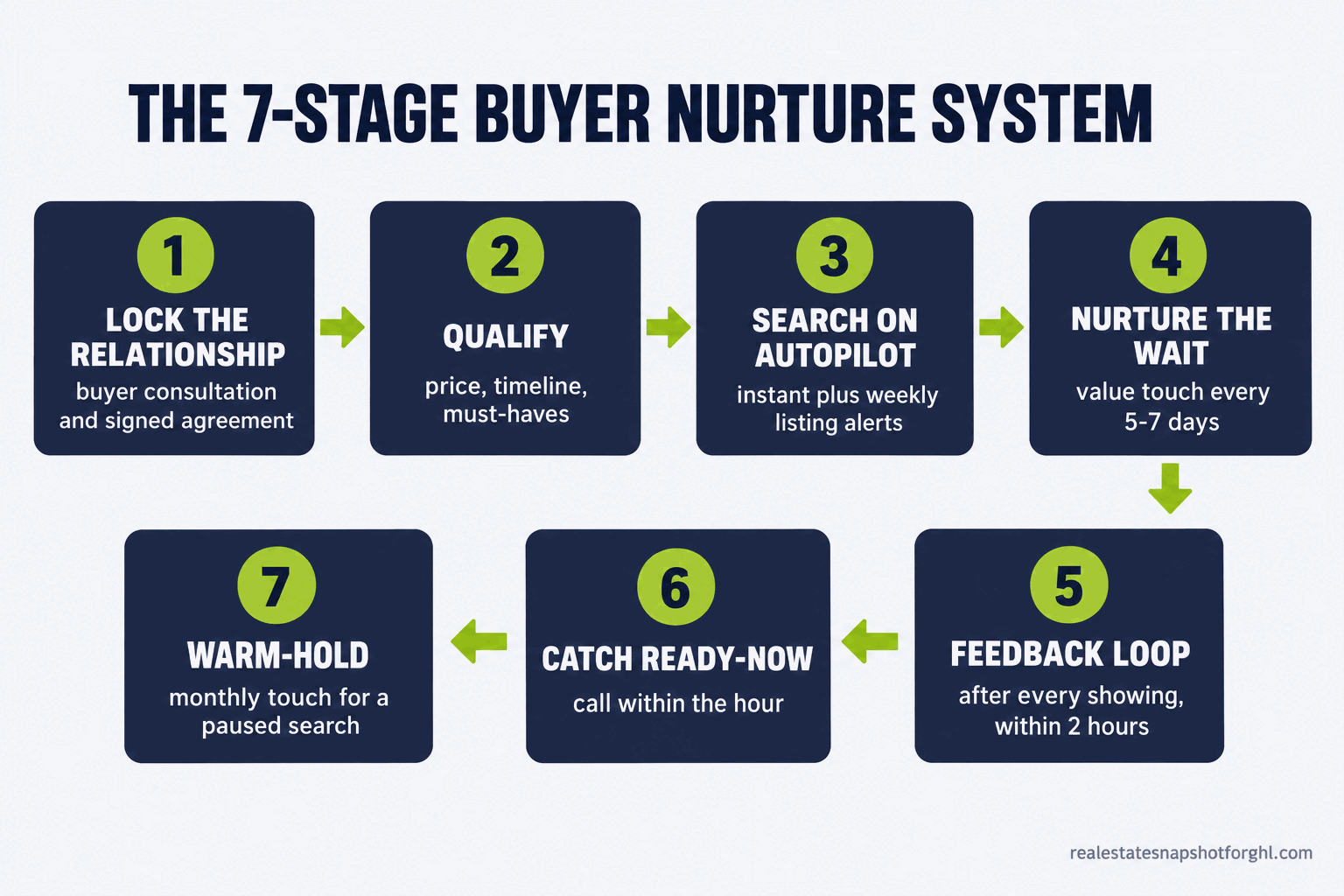
Each stage closes one gap where a buyer drifts, from the first contact through a paused search. Skip one and the buyer leaks out through that hole.
Stage 1: Lock the relationship at first contact
Nurture starts the moment a buyer raises their hand, not after the first showing. The goal of the first contact is a real working agreement, not a one-off tour. Under the 2026 practice rules, a buyer’s agent has to sign a written buyer agreement with the client before touring a home (NAR Settlement FAQs). That is not red tape, it is the best commitment device you have ever been handed: a buyer who sat through a short consultation and signed chose you on purpose, and is far harder to peel away. So treat the first touch as a two-step close: respond fast, then book a buyer consultation before any showing, where you explain how you work and set the expectation that you will send homes and check in. Our guide to explaining the buyer agency agreement without losing the client covers that conversation.
How it breaks: you skip the consultation and tour because the buyer is “ready now,” they go quiet, and because nothing was formalized they feel free to call the next agent. A showing without a relationship is the most common way a hot buyer evaporates.
Stage 2: Qualify in the first conversation
A nurture sequence is only as good as what it knows. If your system does not know a buyer’s price band, timeline, must-haves, and the one dealbreaker that kills a home, every message is a generic blast they learn to ignore. Capture the essentials in the first conversation as structured CRM fields, not a note you never read again: budget and pre-approval status, target areas, beds and baths, the non-negotiables, and the honest timeline. That timeline decides the cadence, because a buyer who wants in by spring gets a different rhythm than one “watching for the right thing” with no deadline.
How it breaks: the discovery lives in the agent’s head. Three weeks later nobody remembers whether they needed a yard or a home office, so the alerts send the wrong homes and the buyer concludes you were not listening. Clean tagging also keeps a CRM from becoming a junk drawer.
Stage 3: Put the home search on autopilot
This is the engine, and most agents run it manually until they burn out. Instead of you remembering to check the MLS, the system sends two things automatically: an instant alert the moment a matching home hits the market, and a weekly digest of everything new with price drops flagged. The instant alert wins fast-moving listings; the digest is the heartbeat that keeps you in their inbox even in a quiet week. This matches how buyers shop, since more than half found the home they purchased online (NAR Profile of Home Buyers and Sellers), so if your alerts are faster and better filtered than their portal, you become the source they trust. Our playbook on listing-alert drip campaigns breaks down the setup.
How it breaks: the filters are too loose, so the buyer gets ten mismatched homes a day, tunes out, and mutes you. Tight criteria from Stage 2 keep alerts curated. The second break is a bare listing link with no human wrapper; one line from you on top (“this one has the yard you wanted”) turns an alert into a touch.
Stage 4: Nurture the ten-week wait
Here is the stage nobody builds, and it is where most buyers go cold. Between showings there may be nothing new worth sending for weeks, so if your only reason to reach out is a new listing, you vanish during every dry spell. The fix is a value cadence on a timer, independent of inventory: a light, useful touch every five to seven days that is not “want to see a house.” Rotate the content so it never feels canned, like a neighborhood update, a rate note, a “what has changed on your end?” check-in, then a moving checklist. None of it pushes for a showing. All of it says “I am still working for you and I know your search.” This is the same muscle as a good sphere nurture program.
How it breaks: the cadence turns into pressure. If every touch is “are you ready yet?” the buyer feels chased and pulls back, so the timer delivers value, not pressure. The other break is a pure drip; a buyer can smell one, so prompt yourself every couple of weeks to send a genuinely personal message.
Stage 5: Close the feedback loop after every showing
A showing is not the end of a touch, it is the start of the next one. The moment a buyer walks out they have an opinion, and that opinion is the most useful data you will get all week. Capture it fast, with a short request sent within an hour or two: what did you like, what was a dealbreaker, does this change what we look for next? Then feed the answer back into the Stage 3 filters so the next batch is sharper. This tightens your search and proves you are paying attention, the reassurance a wavering buyer needs. A buyer who tours seven homes is giving you seven chances to show you listen (NAR Profile of Home Buyers and Sellers). The agent who adjusts after every tour feels like a partner, and our open-house follow-up system uses the same loop.
How it breaks: the request goes out a day late, after the buyer has moved on, so you get a shrug instead of a signal. Automate the send so it fires when you log the showing, not whenever you remember.
Stage 6: Catch the “ready now” signal
Somewhere in the ten weeks, a buyer shifts from browsing to buying. The signals are small: they reply faster, they ask about one home twice, they mention a lease ending or a pre-approval about to expire. Miss that shift and you treat a ready buyer like a casual one, and they find someone who matches their urgency. So build the triggers in: a buyer who opens the same listing three times, replies to a digest, or clicks “schedule a showing” should jump your queue and ping you to call. On a warm buyer the faster human touch wins, the same rule our speed-to-lead playbook lays out for a cold lead.
How it breaks: the signal fires but routes into the same slow lane as everything else. If a “ready now” buyer gets the standard Tuesday digest instead of a call within the hour, the trigger was pointless; escalation has to change what happens, not just add a tag.
Stage 7: Keep a paused search warm
Not every search ends in a purchase this quarter. Rates move, a job changes, the right home does not show up, and the buyer says “let’s pause.” This is the most dangerous moment in the journey: a paused buyer stops replying, you stop reaching out, and three months later they restart with a different agent who sent a note that week.
A pause is not a goodbye, it is a cadence change. Move the buyer to a monthly warm-hold track: one valuable touch a month, a market update or a “still here when you are ready” note, with alerts dialed down to only strong matches. This is the same logic behind reviving a cold past-client database, applied before the buyer goes fully cold.
How it breaks: pause gets treated as stop. The agent clears the buyer off the board and the automation shuts off. A paused buyer who hears from you once a month is still yours; one who hears nothing belongs to whoever contacts them next.
Steal this: the buyer nurture copy
Paste these in and swap the bracketed bits. Every message assumes the buyer opted in and signed a buyer agreement (see compliance, next).
Instant reply to a new buyer inquiry (fires in seconds, before a human):
Hi [first_name], this is [agent] with [team]. Got your note about [address / “finding a home in Maple Grove”]. Before I send homes, let’s grab 15 minutes so I send the right ones, not every one. Free [today 5pm] or [tomorrow morning]?
Weekly digest intro line (on top of the auto-generated roundup):
Morning [first_name], here’s everything new in [area] under [price] this week. The first one has the [fenced yard] you wanted. Reply with a number and I’ll book a showing.
Between-tours value touch (fires on the 5-7 day timer, no listing):
Hey [first_name], quick market note for [neighborhood]: [three homes on your list sold this month, all within 2% of asking]. Nothing new worth showing you yet, but I’m watching. Anything change on your end since we talked?
Post-showing feedback request (fires within 2 hours of the tour):
Thanks for touring [address] today, [first_name]. Quick gut check so I sharpen the search: what did you like, and what was the dealbreaker? Even a one-word answer helps me find the next one faster.
Warm-hold monthly touch (for a paused search):
Hi [first_name], no pressure at all, just keeping you posted. Here’s what [area] did this month: [prices, inventory, one standout home]. Whenever you’re ready to pick the search back up, I’m one text away.
Each message names the person, references their actual search, and ends with a question or a clear next step. That is what turns a scheduled touch into a conversation instead of a notification they swipe away.
Run it for a solo agent, a small team, and a growing brokerage
The seven stages do not change. Who runs the human parts does.
The solo agent. Nurture protects your buyers from your own busy weeks. Let automation carry Stages 3, 4, and 5 end to end so alerts, the value cadence, and the post-showing request fire without you. Your job is the consultation, a personal note every couple of weeks, and the fast call when Stage 6 trips. A done-for-you system earns its keep here, because the cadence runs whether or not you had a good week.
The small team of three to eight. The risk is a buyer falling between the agent who met them and the one covering a showing. Standardize the track so every buyer gets the same consultation, alerts, and cadence, and put one person, often an ops lead or a virtual assistant, in charge of tagging every new buyer the day they sign. The biggest win here is a shared Stage 6 “ready now” alert.
The growing brokerage. At fifteen-plus agents the goal is consistency across very different follow-up habits. Centralize the templates, cadence, and compliance settings, and make “percent of active buyers in a live nurture track” a number the team lead watches. If you are weighing building this in-house against a proven version, our CRM software cost breakdown shows what the platforms charge once you add seats.
The compliance you cannot skip
Buyer nurture sends automated texts and emails, so a few rules apply. None of this is legal advice, and specifics vary by state.
Buyer agreements come first. Under the 2026 practice rules you need a written buyer agreement before touring a home, and offers of compensation can no longer be posted in the MLS (NAR Settlement FAQs). Build that step into Stage 1.
TCPA (texting consent). Automated marketing texts need prior express consent (FCC telemarketing and robocall rules). Only auto-text buyers who opted in, record when and how, and honor STOP instantly.
A2P 10DLC (carrier registration). Register your brand and campaign, or carriers filter your messages and your nurture quietly never arrives (CTIA messaging principles). Our real estate SMS compliance guide walks through it.
CAN-SPAM (email). Every automated email, including your weekly digest, needs a working unsubscribe, an honest subject line, and a valid address (FTC CAN-SPAM guide).
Objections
“Won’t all these automated messages annoy my buyers?” Only if they are generic or too frequent. A weekly digest filtered to their exact search, plus a useful note every few days, is help, not noise. The annoying version is ten mismatched listings a day; this cadence is built to feel like a sharp assistant.
“I already have a CRM. Doesn’t it do this?” It probably can, and almost nobody has built it. Most agents pay for a capable CRM and use the contact list and nothing else. The consultation booking, the value cadence, the post-showing trigger, and the warm-hold track were never set up. The question is not whether your CRM can nurture, it is whether anyone configured it to.
“My buyers only want to hear from me when there’s a house.” That belief is exactly why buyers go cold. If the only time you exist is when a listing drops, you are absent for the nine weeks between homes, and absence is where the other agent walks in.
“I’m not technical. Can I run this?” You run the relationship by replying and touring; the technical part is built once and runs on triggers and timers. Loading a buyer in is a tag, not a project, and if building it from scratch feels out of reach, a done-for-you install is the point.
Frequently asked questions
What is buyer nurture in real estate?
Buyer nurture is the system of scheduled, relevant touches that keeps an active home buyer engaged from first contact through closing. It combines instant and weekly listing alerts, a value cadence between showings, post-showing feedback requests, and a warm-hold track for paused searches, so the buyer never goes cold.
Why do real estate buyers go quiet or stop responding?
Usually because the search is long and the decision is heavy, not because they are rude: the median buyer search runs about ten weeks and seven home tours, and the 2026 market stretches that out. An agent who only makes contact when a listing drops disappears during the gaps, and the buyer drifts to whoever stays in touch.
How often should I follow up with an active buyer?
A useful default is a light, valuable touch every five to seven days during an active search, on top of instant alerts for strong matches and a weekly digest; for a paused search, dial it back to one touch a month. Most touches should deliver value, like a market update, rather than asking if they are ready to buy.
Can I automate buyer follow-up without sounding like a robot?
Yes, if automation holds the cadence and you hold the voice. Write each template in plain language, use the buyer's first name and actual search criteria, and add a one-line human note on top of each listing alert so the sequence never feels like a drip.
Is it legal to send automated texts to home buyers?
Yes, if the buyer opted in. Automated marketing texts require prior express consent under the TCPA, you must register for A2P 10DLC so carriers deliver them, honor opt-outs instantly, and follow CAN-SPAM on email. You also need a written buyer agreement before touring under the 2026 rules. None of this is legal advice; confirm the specifics for your state.