

You close a deal, the settlement statement says the commission is twelve grand, and you already feel the dopamine. Then the brokerage takes its cut, the royalty comes off the top, the transaction fee hits, and self-employment tax is waiting in the spring. The number you actually keep is a different number, and most agents never sit down and do the math until a slow quarter forces them to.
Your real take-home is the total commission, times your side of the deal, times your split after the brokerage cut, minus franchise and transaction fees, minus any referral fee, before tax. On a typical deal that chain can turn a $12,000 gross commission into $6,000 to $9,500 in your pocket, depending entirely on which brokerage model you signed under. Here is the formula, the models, and worked examples to run your own number in five minutes.
Table of contents
- Why your gross commission lies to you
- The anatomy of a commission
- Model 1: the fixed percentage split
- Model 2: the graduated split
- Model 3: the cap model
- Model 4: 100% plus a flat fee
- Model 5: team splits
- Model 6: referral and franchise fees
- Three scenarios: solo, team member, team lead
- Steal this: the take-home worksheet
- What the 2024 settlement changed
- Objections
- Frequently asked questions
Why your gross commission lies to you
The gross commission is the number on the closing statement. It is not the number you keep, and the gap is where agents quietly go broke in a thin market.
The median existing-home price was $429,100 in August 2026, up 1.6% year over year, while existing-home sales slid to a 3.98 million annual pace, down 2.0% for the month (Mortgage News Daily, reporting NAR). Fewer deals at a higher price means every closing carries more weight.
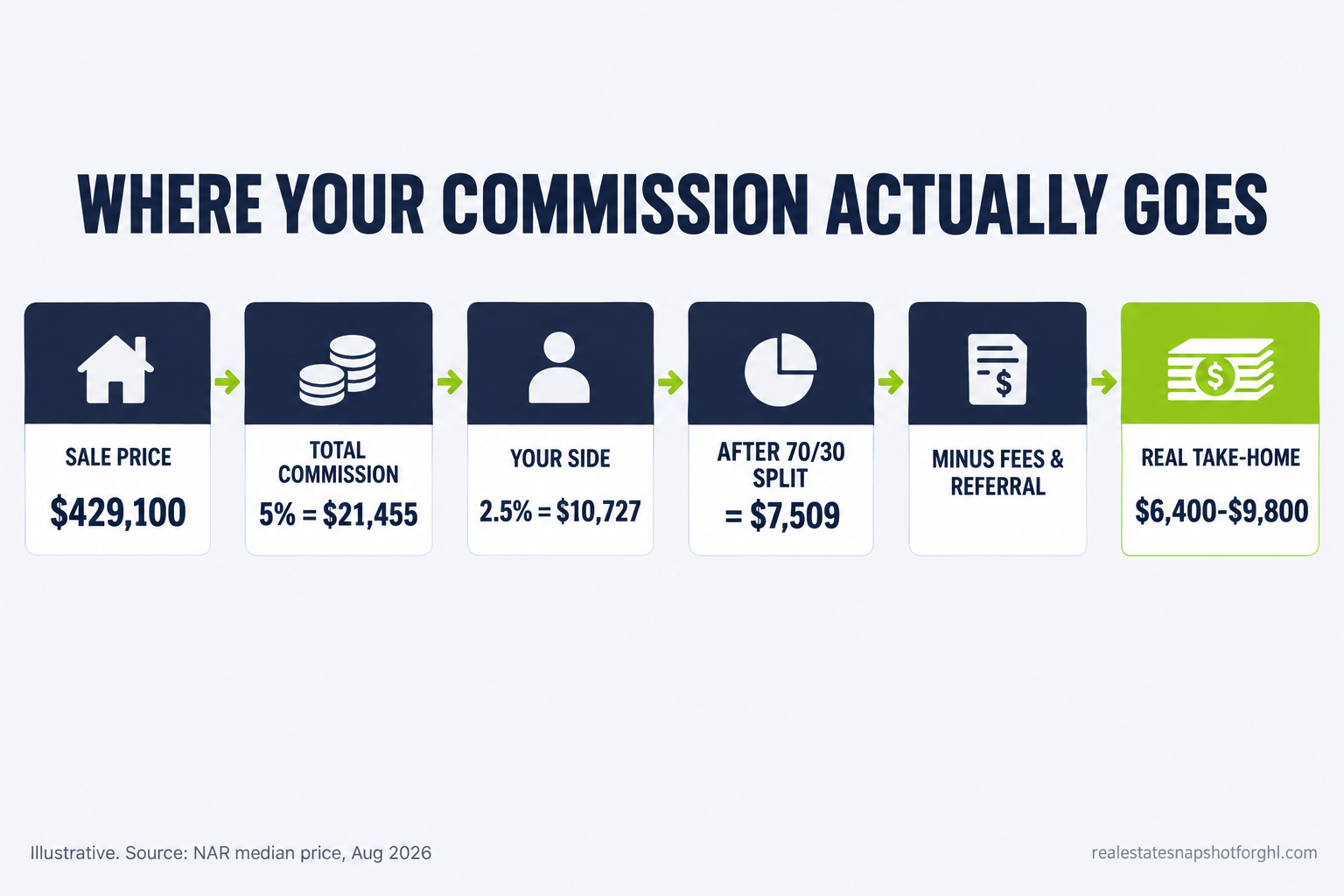
A $429,100 sale at a 2.5% buy-side commission is $10,727. But you represent one side, your broker takes a cut, a franchise may skim a royalty, there is a transaction fee, and a referred lead costs you a quarter off the top. Run the chain and that $10,727 lands anywhere from about $6,400 to $9,800. If you have never worked out your true net per deal, you are flying blind. Chasing a higher split while bleeding deals to slow follow-up has the math backwards: 70% of a deal you close beats 100% of a deal you lose.
The anatomy of a commission
Every commission runs through the same chain. Learn it once and you can calculate any brokerage’s model.
- Sale price. The contract price. Example: $429,100.
- Total commission rate. Historically about 5% to 6% of sale price, split between both sides, and always negotiable. At 5%, that is $21,455.
- Your side. You earn one side, usually half. At 2.5%, that is $10,727.
- Your split. The brokerage takes its cut. On 70/30 you keep $7,509.
- Franchise royalty. Branded franchises skim a royalty off the top, often 6%, usually capped per year.
- Transaction and monthly fees. A flat fee per closing ($0 to $1,700) plus any desk or technology fee.
- Referral fee. If someone sent you the client, you owe a cut of your gross, commonly 25% (The Close).
- Tax. You are a 1099 contractor, so set aside roughly 25% to 30%.
The number after step 7 is your pre-tax take-home. Every model below just handles steps 4 through 7 differently.
Model 1: the fixed percentage split
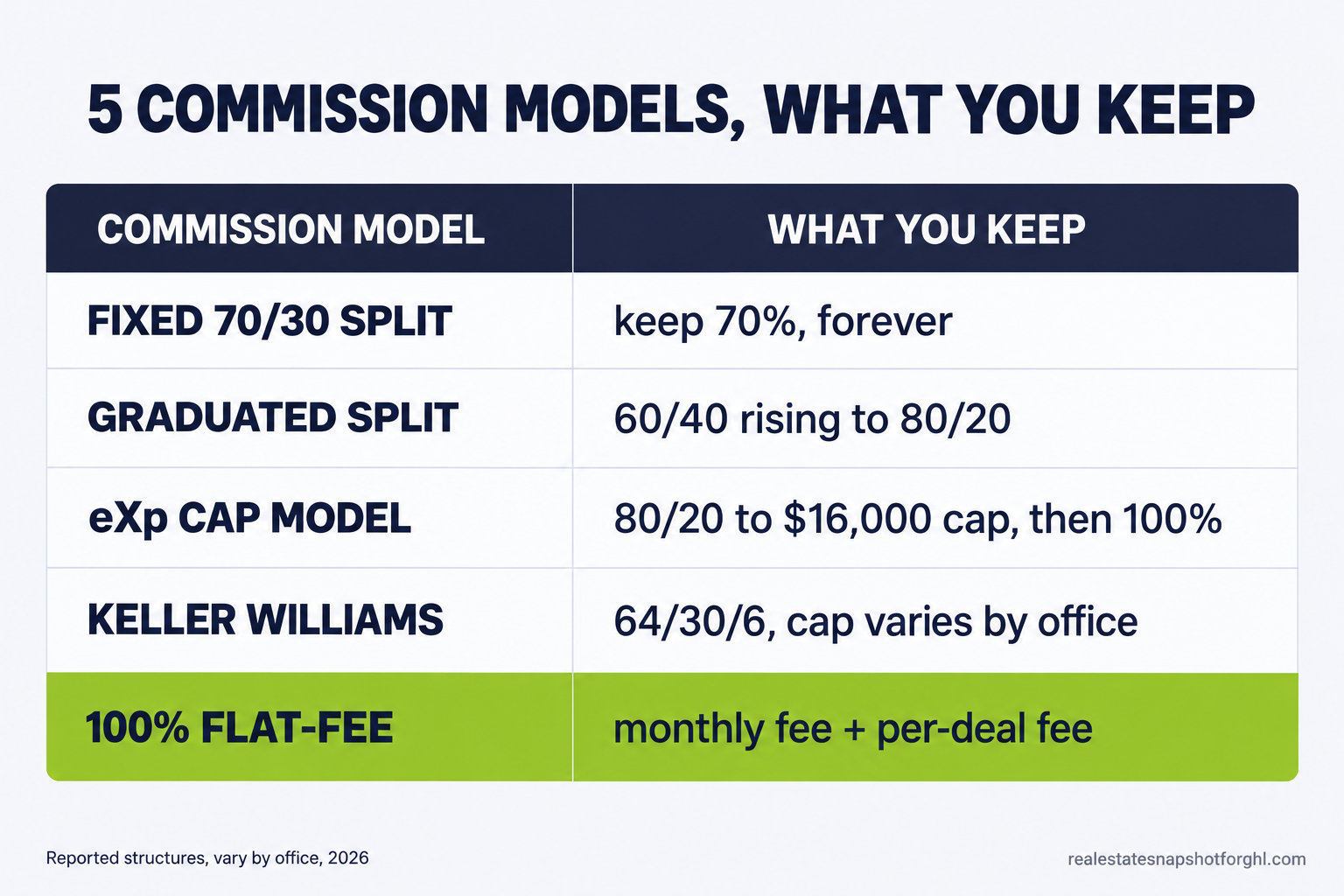
You and the house agree on a split, say 70/30, and it never changes. Keep 70% of every side, forever.
Math. Your side x your split. On a $10,727 side at 70/30, you keep $7,509.
Right for: new agents and anyone doing fewer than six or eight deals a year. The 30% buys training, a desk, errors-and-omissions coverage, and a brand, cheaper than a flat annual fee you would never earn back on low volume.
How it breaks. The split is a flat tax on production. Close 25 deals and you still hand over 30% of each, which on a strong year is $40,000 to a brokerage doing nothing extra. Many fixed shops quietly offer a better split once you threaten to leave. Ask.
Model 2: the graduated split
A sweetener on the fixed model. You start lower, say 60/40, and once year-to-date production crosses a threshold your split improves to 70/30, then 80/20, resetting each anniversary year.
Math. Track cumulative gross commission and apply whatever tier you are in when each deal closes.
Right for: mid-volume agents wanting upside without leaving a traditional brokerage.
How it breaks. The reset is the trap. Every anniversary you drop to the bottom tier and climb again, so a steady 12-deal agent rarely enjoys the top tier. And the brokerage sets the thresholds high enough that most agents never reach the best one. If the 80/20 tier starts at $150,000 and you do $90,000, that top number is marketing, not your reality.
Model 3: the cap model
The model that reshaped the industry. You pay your split only until you have paid the brokerage a set amount in a year, the cap. After that you keep close to 100% for the rest of your anniversary year.
eXp Realty: 80/20 until you have paid $16,000 in company dollar, then 100%. Your 20% hits $16,000 once you produce $80,000 in gross commission, so a capping agent pays $16,000, keeps everything above it, and pays a monthly tech fee around $85 plus a per-transaction fee after the cap (movewithmomentum).
Keller Williams: framed as 64/30/6. You keep 64%, the market center takes 30% toward its cap, and KW International takes a 6% royalty capped at $3,000 a year. The market-center cap is set locally, with estimates from roughly $18,000 to $36,000 by office (ListWithClever; passandearn). Once both caps are paid, you keep 100%.
Right for: high producers. Do $150,000 at eXp and you pay $16,000 plus fees, keeping about $132,000, versus $105,000 on a flat 70/30.
How it breaks. The cap is a bet on your own volume. Cap in March and it is brilliant. Do eight deals and never reach it, and you paid a full split all year with none of the upside, which is a fixed split with fees bolted on. Always get your office’s cap and fee schedule in writing, because KW caps vary widely by city.
Model 4: 100% plus a flat fee
You keep 100% of every commission and pay a flat monthly fee plus a flat fee per transaction. No split. HomeSmart, Realty ONE Group, and United Real Estate are the best-known names.
Math. Your full side, minus a monthly fee, minus a per-transaction fee. Neither big brand publishes one national number because offices are independently owned. A 2026 survey of Realty ONE Group offices found monthly fees from $0 to $300 and per-transaction fees of about $200 to $1,700 (Real Estate Witch).
Right for: established agents who generate their own business. If you do 15 to 30 deals a year with your own lead sources and follow-up, paying a few hundred a month to keep 100% is the cheapest model.
How it breaks. The fees are flat, so they are brutal on low volume. A $400 monthly fee is $4,800 a year whether you close 2 deals or 20. They also strip out the training and lead flow a new agent needs, so switching too early stalls good agents out.
Model 5: team splits
Join a team and there is a split before the brokerage split. The team lead provides leads, systems, and coaching, and takes a cut of every deal you close on team business, commonly 50/50, sometimes better once you prove out.
Math. Two splits stack. On a team at 50/50 inside a brokerage at 70/30, you keep 50% of 70%, which is 35% of your side. On a $10,727 side that is $3,754 before fees.
Right for: brand-new agents with no sphere, no leads, no systems. A good team hands you enough at-bats to learn the business. Half of a deal you would never have gotten beats 100% of nothing.
How it breaks. Agents stay years past the point where they should have gone solo, handing away 65% of their side on deals they now generate themselves. The signal to leave: when most of your deals come from your own sphere, the team split is pure cost. Build a past-client referral engine and the math flips.
Model 6: referral and franchise fees
These hit on top of whatever model you are in, and agents forget to budget for them.
Referral fees. When another agent or a relocation company sends a client, you owe a cut of your gross, typically 25%, with negotiated rates of 20% to 40% (The Close). It comes off your gross before your split, so on a $10,727 side a 25% fee is $2,682 gone, then your brokerage splits what is left. A referred deal can net a third less than one from your own sphere, which is why reviving your own database beats buying referrals.
Franchise royalties. Branded franchises take a royalty off the top, often around 6%, usually capped per year (at KW, 6% capped at $3,000). It funds the national brand and is non-negotiable at most franchises. Independents skip it, which is one reason a strong independent can beat a big name on effective split.
Both are legal, but referral fees are tightly regulated: in most states only licensees can receive one, and RESPA Section 8 restricts paying anyone not performing a service. Co-marketing with a lender or title company is a riskier area covered in our RESPA Section 8 guide.
Illustrative pre-tax take-home on $100,000 of annual gross commission, after the brokerage cut and typical fees, assuming the agent caps on the cap models. Fees vary by office, so treat these as directional, not quotes.
Three scenarios: solo, team member, team lead
The right model depends on where you sit. Same framework, three ways.
Solo agent, 8 deals a year. Average side $10,000, so $80,000 gross. A 100% flat-fee shop at $400 a month plus $300 a transaction costs $7,200 and keeps about $72,800 before tax. A 70/30 fixed split keeps $56,000. For a self-sufficient solo, flat-fee wins by roughly $16,000. But if they still need training and leads, the 70/30 is the honest choice, because support means more closings.
Team member, 12 deals, mostly team leads. Average side $10,000, so $120,000 gross. On a 50/50 team split inside a 70/30 brokerage, they keep 35%, about $42,000. It stings on paper, but if 10 of 12 deals came from the team, that is $42,000 they would not otherwise have earned. The question is whether the leads are real.
Team lead, 40 deals across the team. The math inverts. The lead keeps a share of every agent’s deal, pays the split on their own production, and carries leads, admin, and software for everyone. A cap model or a lean independent matters enormously here, because the lead caps many times over and every avoidable cost multiplies.
The pattern: low volume favors support, high volume favors keeping more. Know which one you are, and re-run the number every year.
Steal this: the take-home worksheet
Fill in your real figures and stop at line 7 for your pre-tax net.
REAL TAKE-HOME WORKSHEET (per deal)

1. Sale price .......................... $ __________
2. Total commission rate ............... ____ %
   -> Total commission (1 x 2) ......... $ __________
3. Your side (usually 50%) ............. ____ %
   -> Your gross side .................. $ __________
4. Referral fee owed, if any ........... ____ %  (often 25%)
   -> Subtract from your gross side .... - $ ________
5. Your brokerage split ................ ____ % to you
   -> Keep this share of line 4 ........ $ __________
6. Franchise royalty, if any ........... ____ %  (often 6%, capped)
   -> Subtract .......................... - $ ________
7. Transaction fee this deal ........... - $ ________
   =====================================================
   PRE-TAX TAKE-HOME ................... $ __________

Then set aside ~25-30% of line 7 for self-employment and income tax.
Annualize it. Multiply your realistic deal count by your average take-home per deal, then subtract fixed monthly fees times twelve. That annual number, not the split on the recruiting flyer, is what you compare between brokerages. Two agents on the same 70/30 split can net $15,000 apart once fees and referral costs are in.
Use it to negotiate. Walk into a split conversation with your actual production and worked take-home under each model. Brokerages negotiate splits more often than they admit, especially with a producer holding real numbers.
What the 2024 settlement changed
The NAR settlement that took effect August 17, 2024 rewrote how buyer-side commission gets set, and it hits lines 2 and 3 of your worksheet directly.
Two rules matter. Offers of buyer-broker compensation can no longer appear in the MLS; sellers can still pay a buyer’s agent, but the offer is negotiated off the MLS (NAR, facts.realtor). And agents working with buyers must sign a written buyer agreement before touring a home, stating compensation in a specific, non-open-ended amount, with language making clear commissions are fully negotiable (Illinois REALTORS).
So your buyer-side commission is now whatever you negotiated in writing, capped at that amount, not a number you assume off the listing. Agents keeping their rate are the ones who can explain their value, a conversation we broke down in our buyer agency agreement guide. The models above did not change, but the gross you plug into them is now earned on every buyer deal.
Objections
“Isn’t a higher split always better?” No, and it is the most expensive myth in real estate. A 100% model with $6,000 a year in fees is worse than 70/30 if you close three deals, because you never earn the fees back. The split percentage is meaningless without your deal count next to it.
“Should I just join a 100% brokerage and keep everything?” Only if you generate your own business and do not need training or leads. New agents who join one to keep more commission usually close fewer deals, because nobody is feeding them at-bats.
“Does the 2024 settlement mean I make less now?” It means your buyer-side commission is negotiated in writing, not assumed. Agents who can articulate their value hold their rate; those who cannot discount. It did not cut your pay, it moved the decision into a conversation you win on every buyer deal.
“I close enough deals, why am I still broke?” Volume without a tracked net per deal is a trap. If referral fees, a bad split, and flat fees quietly eat a third of every commission, you can be busy and broke at once. Do the worksheet on your last ten closings; the leak is almost always in the fees.
Frequently asked questions
How do I calculate my real estate commission split?
Sale price x total commission rate (often 5-6%) x your side (usually 50%), then keep your split percentage of that. Subtract any referral fee, franchise royalty, and transaction fee. The result is your pre-tax take-home for that deal.
What is a good commission split for a real estate agent?
It depends on your volume. New or low-volume agents often do best on a 70/30 fixed split because the support helps them close more. High producers do better on a cap model or a 100% flat-fee brokerage.
What does a cap mean in real estate commission?
A cap is the maximum your brokerage takes from you in a year. You pay your split on each deal until your contributions reach the cap, then keep close to 100% for the rest of your anniversary year. eXp caps at $16,000; Keller Williams market-center caps run roughly $18,000 to $36,000 by office.
How much is a typical real estate referral fee?
Around 25% of the receiving agent's gross commission, with negotiated rates of 20% to 40%. It comes off your gross before your brokerage split, so it hits harder than agents expect.
Did the 2024 NAR settlement change commission splits?
It did not change the split between you and your brokerage. It changed how buyer-side commission is set: offers of compensation left the MLS, and buyers must sign a written agreement stating your compensation before touring a home.
The split is only half the equation
You can negotiate a perfect split, cap early, join the leanest flat-fee shop in your market, and still be broke if the leads you paid for die in your inbox while you are at a showing.
The commission was never the problem. The problem is the other inquiries that month nobody texted back inside a minute, the past clients who listed with the agent who called first, and the showings that no-showed. Fix your split and you keep a bigger slice of the deals you close. Fix your follow-up and you close more deals, which moves the number far more than any split ever will. That is the job of the Real Estate Snapshot: speed-to-lead, sphere nurture, expired revival, and showing automation inside your GoHighLevel account, so more of every commission reaches the closing table.