

It is the first week of January and your phone is quiet. The fall closings have funded and the pipeline you rode in October has emptied out. So you promise to finally text the past clients you have not spoken to since their closing. Then a referral calls, you get busy, and the database goes back to sleep.
That gap is the whole problem. Your business is seasonal. Your follow-up cannot be, or you spend every January rebuilding a pipeline you already paid to fill.
Here is the short version: build one follow-up calendar for the year, then run a different play each season instead of the same scattered one. Reset and deepen the sphere in winter, ramp listings and wake buyers in spring, protect speed-to-lead through the May-to-July surge, re-engage stalled leads in late summer, and harvest reviews and referrals in fall. The agent who touches the right contacts at the right time wins the next listing, because most of that business was never coming from a cold portal lead.
Table of contents
- Why a calendar beats a sequence
- What a cold database costs you
- The year at a glance
- Winter: reset and deepen the sphere
- Early spring: ramp listings, wake buyers
- Peak season: protect speed-to-lead
- Late summer: re-engage the stalled
- Fall: harvest reviews and referrals
- Run it for your size
- Steal this: the seasonal copy
- The compliance step most agents skip
- Objections
- Frequently asked questions
Why a calendar beats a sequence
Most follow-up advice hands you a sequence: five texts on a fixed day-1, day-3, day-7 schedule. That is great for a brand-new lead and useless for the 400 people already in your database, who are not all at day one.
A calendar fixes that. Instead of “what message comes next for this person,” you ask “what is the whole database due this month.” You can answer that on a Monday, and it scales from 150 contacts to 2,000. It also lines your effort up with the market: NAR data shows the typical home sells in a median of 31 days in June but 49 days from December through February (NAR).
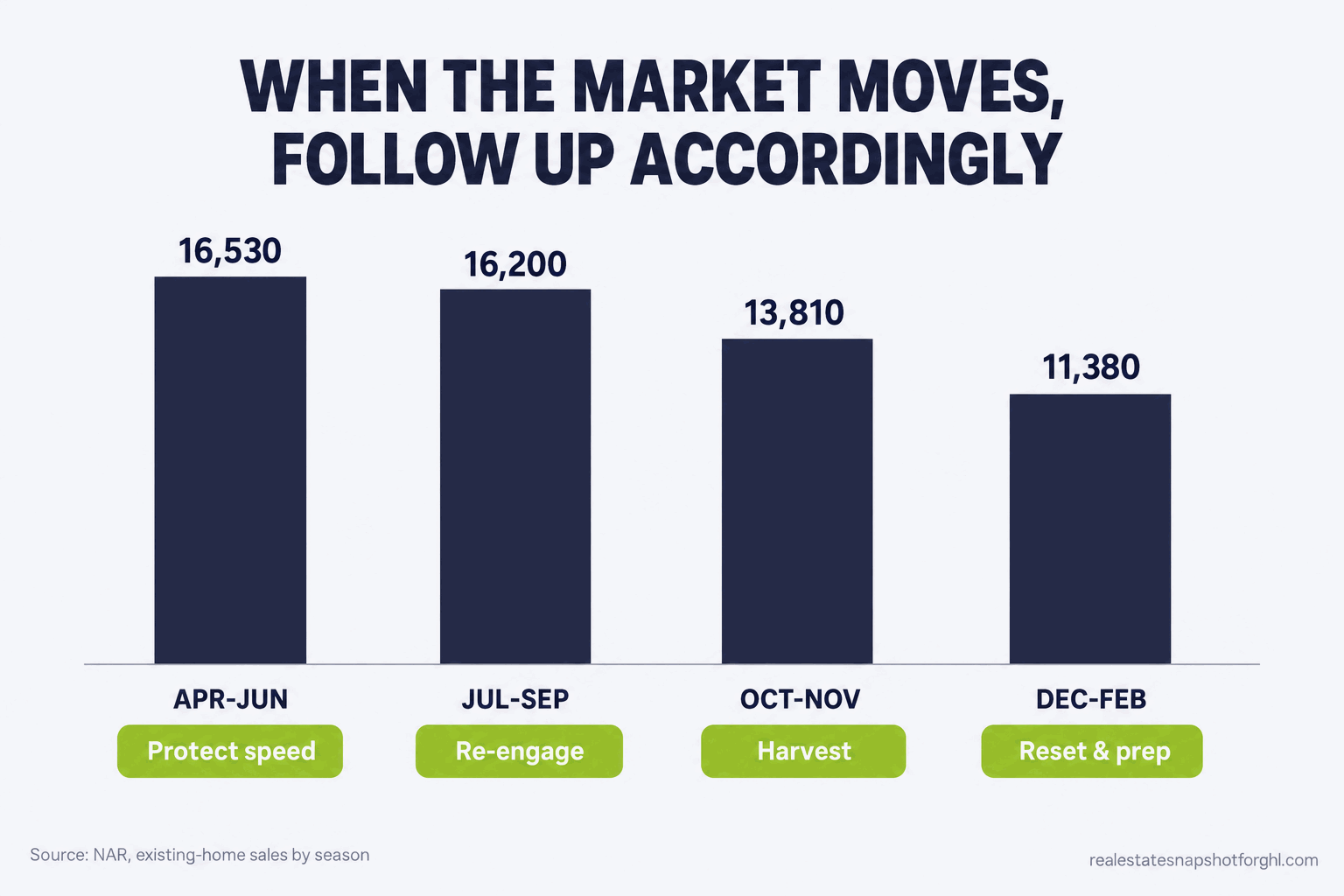
Average existing-home sales per day by period. Source: NAR, Navigating the Housing Market.
The chart is the argument: activity runs about 45% higher per day in spring than in deep winter, so push the right play into the right window.
What a cold database costs you
The median REALTOR gets 28% of business from repeat clients and 22% from referrals by past clients, about half of all business (NAR 2026 Member Profile). On the seller side it is starker: 66% of 2025 sellers used a past agent or a referral (NAR 2025 Profile). That is the half of your pipeline that evaporates when you go quiet for eight months.
Say you closed 12 deals last year and six were repeat or referral. If the database goes cold and you lose a third of that to an agent who stayed in touch, that is two closings. At a median price near $429,100 (NAR, August 2026), that is real money forfeited by not sending a text. You did not lose those deals to a better agent. You lost them to a more consistent one.
The year at a glance
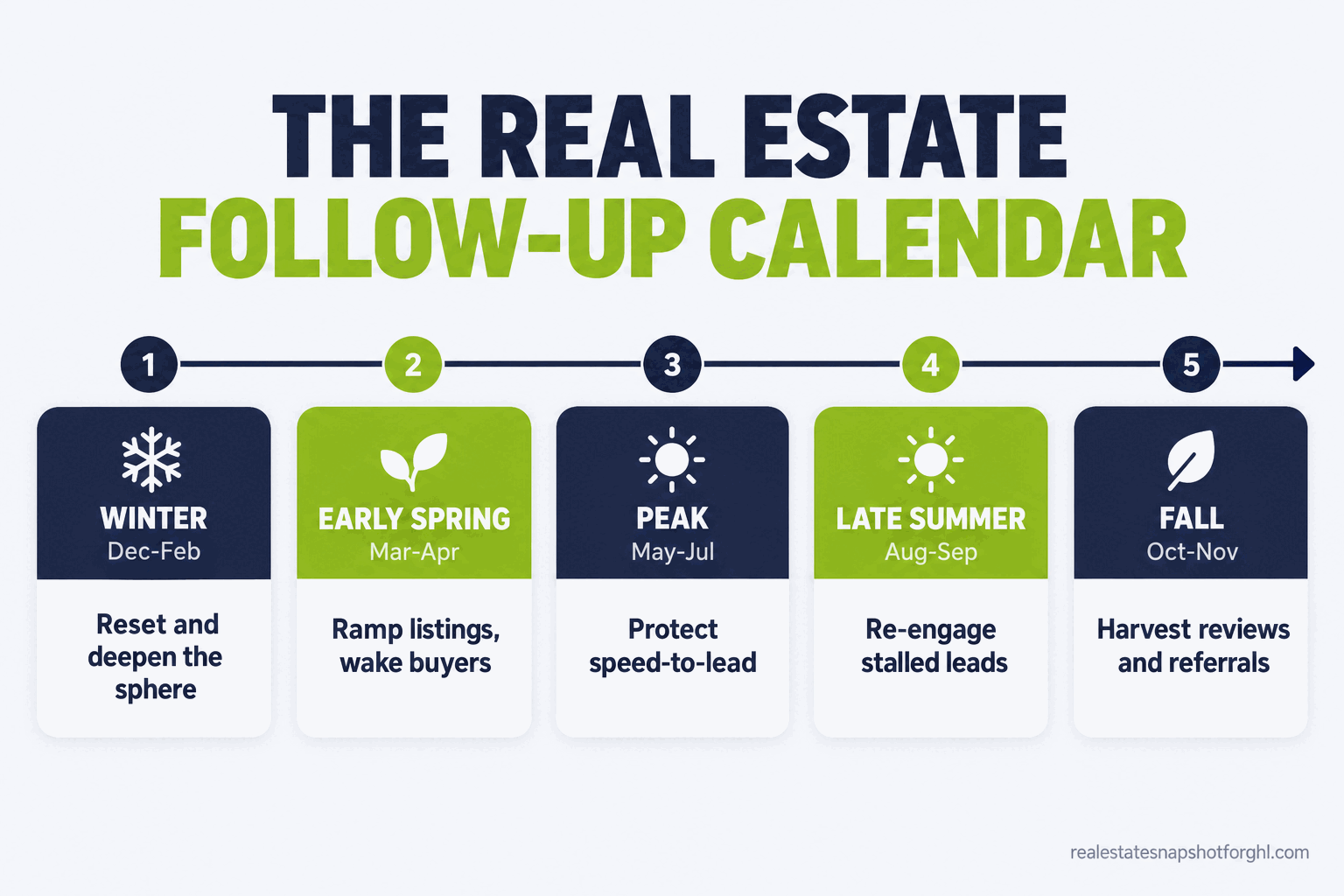
Five phases, one primary job each.
- 1Dec - Feb
Winter: reset and deepen
Clean the database and have real conversations with your A-list.
- 2Mar - Apr
Early spring: ramp
Home-value touches to owners; re-activate stalled buyers before the surge.
- 3May - Jul
Peak season: protect speed
Guard your 60-second lead response and showing follow-up.
- 4Aug - Sep
Late summer: re-engage
Work the leads and sphere that went quiet in the rush.
- 5Oct - Nov
Fall: harvest
Ask for reviews and referrals from the summer closings.
Each phase below gives you the setup, the touches, and the way it breaks.
Winter: reset and deepen the sphere
Winter is slow, which makes it your prep season: fix the database and have real conversations.
Setup. Merge duplicates, fix bounced numbers, and tag everyone by relationship (past client, sphere, active buyer, active seller, cold lead). If you cannot segment, you cannot run a calendar. Then pick your “A-list,” the 50 to 150 people most likely to transact or refer soon. They get personal touches, not blasts.
The touches. Send one personal, non-salesy year-start text to the A-list in the first two weeks of January, a note that names something real. Schedule a light monthly market email to the full database with one local number. A winter call campaign pays off too: twenty real conversations a week with past clients seeds more spring listings than any ad.
How it breaks. Two opposite failures. One, you send a mass “Happy New Year” blast that reads like a mailer; keep the blast to a real market note and make the A-list touches personal. Two, you clean the database, feel productive, and never call anyone. The cleanup is not the work; the conversations are.
Early spring: ramp listings, wake buyers
Sellers decide in late winter and early spring, so by the time the May surge hits, the listing was won in March. Early spring has two jobs: get in front of likely sellers, and wake up buyers who went cold over winter.
Setup. Build a simple home-value touch for every past client and sphere contact who owns. On the buyer side, restart a listing alert for every lead who inquired in the last 12 months and never transacted, so they see new inventory the day it hits.
The touches. To owners, in early March: a home-value check-in framed around “a lot of people list in spring, here is what your place might be worth now.” To stalled buyers, by mid-March: a re-activation text that leads with a specific new listing, not a generic “still looking?”
How it breaks. Agents wait until May to start listing conversations and arrive a month after the seller signed with someone else. Spring prep is a March job. The other break: firing a valuation link at every contact, including renters, which trains people to tune you out. Send it to owners only, which is why winter tagging matters.
Peak season: protect speed-to-lead
May through July is the surge. NAR puts average daily existing-home sales at their yearly high here, with the typical home selling in a median of 31 days in June (NAR). This is when the money is made and when the system is most likely to collapse.
Median days on market by period. Source: NAR, Navigating the Housing Market.
Setup. The peak-season job is not launching new campaigns. It is protecting the two touches that convert: the under-60-second first response to a new inquiry, and the showing follow-up. Before May, wire an instant auto-text to every new lead and a same-day follow-up to every showing. Our speed-to-lead guide covers the setup.
The touches. Instant reply to every inquiry, around the clock, because a 9pm portal lead does not wait until morning. A same-day “great to see you today” text after every showing. A weekly check-in with every active buyer and seller.
How it breaks. This is where small shops bleed. A lead comes in Saturday at a showing, nobody replies until Monday, and it is gone. The fix is automation that answers in seconds so a human can follow up when they surface. The second break is vanishing on your sphere for three months; keep the monthly email on autopilot even when you are flat out, because the fall plan depends on you not disappearing.
Late summer: re-engage the stalled
August and September are, by NAR’s framing, the two slowest months of the year (NAR). Use the lull to re-engage everything that stalled during the surge: leads you never got back to, buyers who paused, the sphere you ignored since May.
Setup. Pull a report of every lead and buyer with no contact in 45 days: that is your re-engagement list. Separately, tag every spring showing that did not result in an offer.
The touches. To stalled leads: a low-pressure text that offers an easy out and an easy yes. To summer-paused buyers: a note tied to the market shift, because by late summer inventory is usually higher and competition softer. To the sphere: resume the personal touches you dropped in June.
How it breaks. Agents treat slow months as vacation, so nothing is planted in August and the pipeline is thin by October. Avoid guilt-trip messages (“I haven’t heard from you”); nobody owes you a reply, so lead with something useful. Our database reactivation playbook goes deeper.
Fall: harvest reviews and referrals
Fall is harvest. The summer closings are still warm and people are reachable before the holidays, your best window to turn finished deals into reviews, referrals, and next year’s listings.
Setup. List every client who closed since May; that is your review-and-referral target. Build a post-close touch that asks for a review first, then, separately and later, asks who they know. Never ask for both in one message. Set a holiday touch for the full database for late November.
The touches. A review request to every recent closing, sent within days of a positive moment, routed to Google first. A separate referral ask a few weeks later. A warm, no-ask holiday message to the whole database before Thanksgiving. Our post-close referral engine breaks down the timing.
How it breaks. The biggest miss is never asking for the review because you felt awkward, so your reputation stalls while a competitor’s grows. Automate the ask so your feelings never enter it. The second break is asking a client who had a rocky closing. Route a quick satisfaction check first and send the public review ask only to the happy ones.
Run it for your size
The calendar is the same shape for everyone. What changes is how much you automate versus do by hand.
Solo agent, ~150 contacts. Run most of this personally, because your personal touch is the product. Automate only what you will otherwise drop: the instant lead reply, the showing follow-up, the review request. Keep the A-list calls manual: a 50-person A-list is 10 calls a week in January.
Small team, ~600 contacts. The by-hand version breaks here. You need shared tagging so a lead does not get three texts from three agents, and routing so the first available person responds. Automate the full cadence and reserve human time for the A-list. Our guide on lead routing for small teams covers the mechanics.
Large team, 2,000-plus contacts. At this size the calendar is infrastructure. Every phase runs as an automation with a human layer on top for the highest-value relationships, and you track which season’s push produced which closing. The failure mode is a junk-drawer CRM where nothing is tagged, so data hygiene becomes the job. In every case the point is the same: the system should not depend on whether you remember what month it is.
Steal this: the seasonal copy
Plain on purpose. Short, specific, sendable. Adapt the details, keep the brevity, honor opt-outs.
Winter A-list check-in (mid-January, one-to-one):
Hey [First name], happy new year. Saw [specific detail: the kids are back in school / you finished the kitchen]. No agenda, just thinking of a few people I want to stay close to this year. How are things?
Spring owner value touch (early March):
Hi [First name], a lot of people in [neighborhood] are testing the spring market and prices have moved since you bought. Want a quick, no-obligation estimate of what your place might be worth today? Takes me five minutes.
Spring buyer re-activation (mid-March, lead with a real listing):
[First name], this just hit the market and it fits what you were after last fall: [address, beds/baths, price]. Still want me watching for these? I can turn your alerts back on today.
Peak-season showing follow-up (same day):
Great seeing you at [address] today. On a scale of “not for me” to “let’s talk offer,” where did it land? Happy to pull a couple of comps either way.
Late-summer re-engagement (early August, easy out):
Hi [First name], circling back with zero pressure. Still thinking about a move in the next few months, or should I pause the updates for now? Either answer is totally fine.
Fall review then referral (within days of closing, then two weeks later):
It was a pleasure helping you [buy/sell] [address]. If you have two minutes, a quick Google review would mean the world: [link]. Thank you. … [Two weeks later] If anyone you know is thinking of buying or selling, I would love an introduction.
The compliance step most agents skip
Before you schedule a single seasonal text, get the basics right, because a database campaign is where agents quietly break federal rules.
Texting needs consent and a working opt-out. You need prior express written consent to send marketing texts and must honor opt-outs promptly under the TCPA. The FCC’s “one-to-one” consent rule was vacated in January 2025, but revocation rules are in force and a “STOP” must stick (Kelley Drye). Register your number for A2P 10DLC or carriers filter your blasts out. Our SMS compliance guide walks through registration.
Email needs an unsubscribe. Every marketing email, your monthly market note included, needs a real unsubscribe link and your physical address under CAN-SPAM.
Targeted ads trigger Fair Housing. If any seasonal push includes paid ads, housing is a special ad category on Meta and your targeting is restricted (Fair Housing and Facebook ads). None of this is legal advice; when in doubt, ask your broker or a compliance attorney.
Objections
“Won’t monthly messages annoy people?” Only if they are generic and all about you. A one-line market note or a relevant new listing is useful; a “just checking in!!” with no substance is noise. Always give an easy opt-out.
“I already pay for a CRM. Why a calendar?” The CRM is the filing cabinet. The calendar is the plan for what goes in and out of it each month. Most agents have the contacts and no system that fires the right touch at the right time.
“I’m not technical. This sounds like a lot.” It is a lot to set up once and nearly nothing to run after. If the first build is the blocker, that is the gap a done-for-you install closes.
“My market is different from national averages.” It is, and local patterns matter more, especially in the South where NAR notes seasonality swings harder. Use the national rhythm as a default and tune it to your own closing data. The shape, prep in winter, protect in summer, harvest in fall, holds nearly everywhere.
Frequently asked questions
How often should I contact my real estate sphere?
A workable baseline is a light value touch monthly to the full database (a short market email), plus personal touches to your A-list of 50 to 150 contacts every four to six weeks. No past client should go more than a quarter without hearing from you.
What is the best month to start a real estate follow-up calendar?
January. It is your lowest-volume season (NAR puts average daily existing-home sales at their yearly low in December through February), so you have time to clean your database and build the automations before spring. If it is not January, the second-best time is today.
Is seasonal follow-up different for buyers and sellers?
Yes. Sellers decide in late winter and early spring, so owner home-value touches belong in February and March. Buyers are active a bit later and respond year-round to specific new listings. Tag the two groups separately so each gets the right touch.
Can I automate all of this without sounding like a robot?
Automate the timing and the routine touches (instant lead replies, showing follow-ups, review requests, the monthly email). Keep your A-list personal touches human, and have the automation hand off to a person the moment someone replies with a real question.
How many past clients do I need to stay in touch with?
Focus hardest on your A-list, the 50 to 150 people most likely to transact or refer soon, and keep the rest on a lighter monthly touch. With repeat and referral making up roughly half of a typical agent's business (NAR 2026 Member Profile), the A-list is where most of next year's income hides.
What if I can only do one season well?
Do fall. The review and referral harvest from your existing closings has the fastest payback: reviews build your reputation year-round, and referrals from happy clients are the cheapest, highest-converting leads you will ever get.
It is the first week of January again, a year on. Only this time the phone is not silent, because the referral calling today came from a review you asked for in October, from a client you closed in July, who you first met because you sent a specific listing in March. That is not luck. That is a calendar doing its job while you did yours. Build it once, run a different play each season, and stop rebuilding your pipeline from scratch every winter.