

It is 8:15 on a Tuesday. A buyer fills out the form on your team’s website asking about a listing. The lead drops into a shared inbox. One agent is on a listing appointment, one is asleep after a late closing, and the third assumes somebody already grabbed it. Nobody calls. At 11:40 the buyer fills out the same form on a competitor’s site, gets a call back in ninety seconds, and books a showing for that afternoon. You paid for that lead. You just never answered it.
That is not a people problem. It is a routing problem. When a lead has no clear owner and no clock on it, it falls into the gap between busy people. The fix is a system that decides, automatically, who owns each new lead, how fast they must respond, and what happens when they do not. This post is that system: six stages, the exact message copy, the routing models that fit a two-to-eight person shop, and how each part breaks.
Table of contents
- What a dropped lead actually costs
- The six-stage routing system
- Stage 1: One inbox for every source
- Stage 2: Set the response SLA
- Stage 3: Pick a routing model
- Stage 4: Automate the first touch
- Stage 5: Escalate when the clock runs out
- Stage 6: Keep a scoreboard
- Steal this: the routing copy
- Run it for solo, team, and brokerage
- The compliance you cannot skip
- Objections
- Frequently asked questions
What a dropped lead actually costs
A lead you already paid for is the most expensive thing to waste, because the money is gone whether you call or not. The 2026 market makes that worse. Existing-home sales ran at a 3.98 million annual rate in August 2026, down 2.0% from the month before, with the median price at $429,100 (NAR Existing-Home Sales). Fewer deals are moving, so every real inquiry has to be worked. First-time buyers were 30% of sales in that report, and they reward whoever answers first.
The response-time math is well documented. Harvard Business Review, reporting on research led by Professor James Oldroyd, found companies that contacted an online lead within an hour were nearly seven times more likely to qualify it than those that waited an hour longer, and more than sixty times more likely than firms that waited a day (Harvard Business Review). The same study found the average first response took 42 hours and 23% of firms never responded at all. A shared inbox with no owner routinely burns far more than an hour.
Persistence is the other half. Commonly cited industry figures put it bluntly: roughly 80% of sales take five or more follow-ups, while close to half of salespeople give up after one attempt (Invesp). Treat those as industry lore, not hard science, but the direction is right. Routing fixes the first touch, then has to guarantee the second, third, and fourth. Our lead conversion benchmarks breakdown has the real-estate numbers.
The six-stage routing system
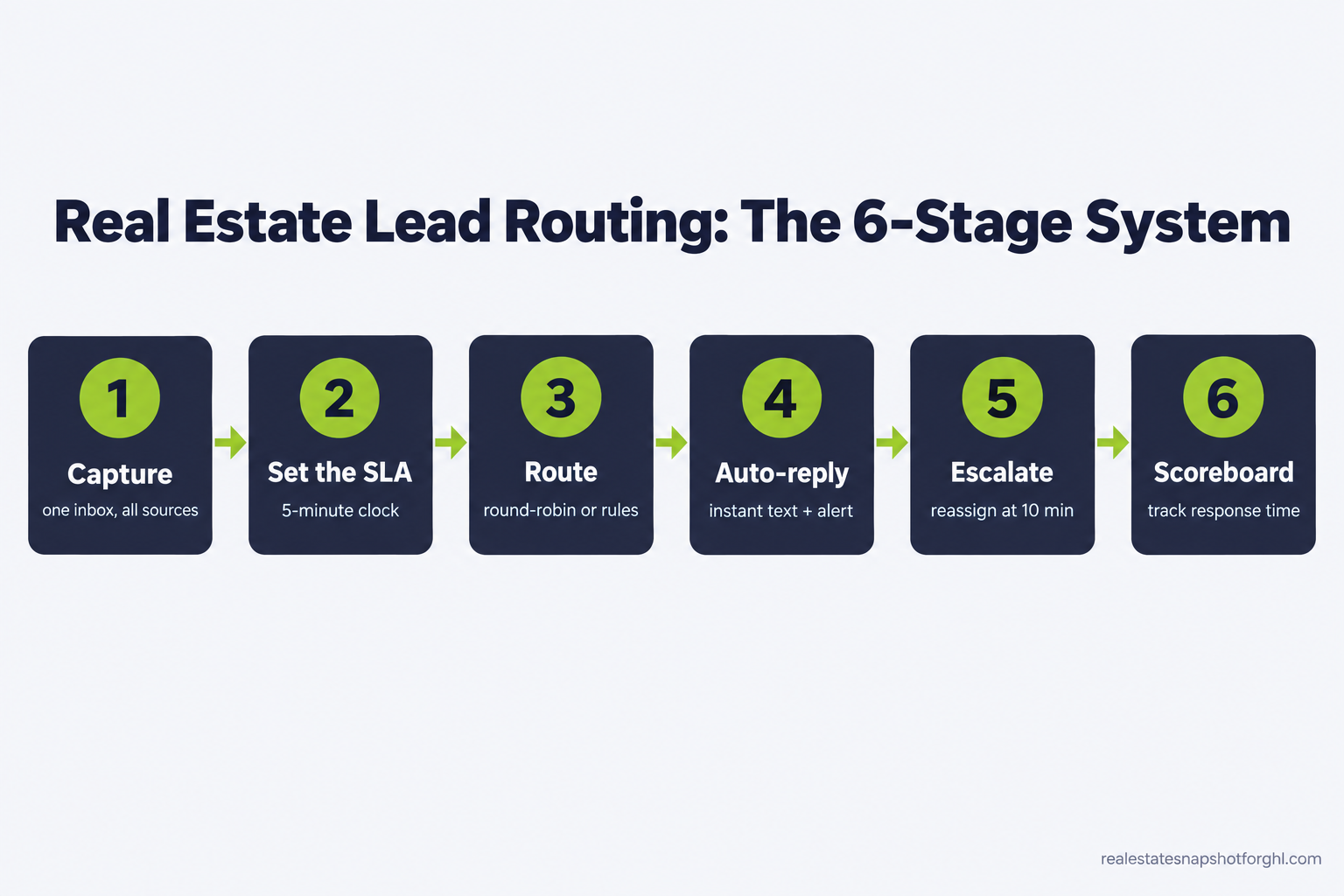
Each stage closes one gap. Capture pulls every source into one place. The SLA puts a clock on the lead. The routing model decides who owns it. Automation answers before a human can. Escalation catches the leads a busy agent misses. The scoreboard keeps everyone honest. Skip one and the lead leaks out through that hole.
Stage 1: One inbox for every source
You cannot route what you cannot see. Inquiries arrive in six places: the website form, Zillow and Realtor.com, a Facebook lead form, Google, the occasional call, and a referral text to a personal phone. If each source lives in its own app, no single system knows a lead exists, so routing is impossible. The fix is one inbox: every source feeds one CRM that timestamps the lead the second it arrives and tags where it came from. That timestamp is what every later stage runs on. Our guide to connecting every lead source into one place covers the plumbing, and the piece on having too many tools and no time to follow up explains why consolidation beats adding another app.
How it breaks: a portal like Zillow routes the lead to its own app first, and your CRM only sees it after a delay. Connect the portal through the official integration so leads hit your inbox in real time, not in a nightly batch.
Stage 2: Set the response SLA
An SLA (service-level agreement) is a promise with a clock: every new lead gets a first human response inside X minutes. For a hot buyer or seller inquiry, X is five minutes or less, because that is where the Oldroyd research shows contact odds peak. For a lower-intent sign-up like a home-value download, a longer window is fine, but it still needs a number. Write it down: five minutes during business hours, fifteen in the evening, and a defined overnight rule handled by automation. Our speed-to-lead playbook for realtors goes deeper on why the first five minutes decide the lead.
How it breaks: the team agrees on five minutes but has no way to measure it, so the SLA quietly becomes “whenever.” If you are not timestamping the lead and the first response, you do not have an SLA, you have a hope.
Stage 3: Pick a routing model
This is the decision most teams never actually make, so leads default to “whoever feels like it.” Pick one model on purpose. The three that work for small teams:
| Routing model | How it works | Best for | The risk |
|---|---|---|---|
| Round-robin | Each lead goes to the next agent in a rotation | Teams where agents are roughly equal and you want fairness | A slow agent still gets their turn and sits on leads |
| Shared pond / first-to-claim | Leads drop into a pool; the first agent to claim one owns it | Hungry teams that answer fast | Quiet leads nobody claims get orphaned without a backstop |
| Rules-based | Leads route by source, price band, area, or language | Teams with specialists (luxury, a Spanish speaker) | More setup, and the rules need an owner |
Most two-to-four person teams start with round-robin plus a hard escalation rule, because it is fair and simple. As you add specialists, layer in rules: luxury leads to the luxury agent, a specific ZIP to whoever farms it, Spanish-language form fills to your bilingual agent. First-to-claim works for a hungry team, but only if you pair it with Stage 5, or the boring leads rot.
How it breaks: you choose round-robin but one agent is on vacation, so a quarter of your leads route to a phone that is off for a week. Build an availability toggle that pulls an agent out of the rotation. A routing model with no concept of who is available is just a slower way to drop leads.
Stage 4: Automate the first touch
No human is fast enough to hit a five-minute SLA every time, at a showing, at dinner, asleep. So the first touch is never a human. The moment a lead lands and gets assigned, automation fires an instant, human-sounding text and email and alerts the owning agent on their phone. The automation buys the critical minutes; the human closes the gap. The instant reply confirms you got the inquiry and asks one question back. Then an AI chatbot or AI caller can carry the conversation if the lead replies before your agent is free. This is the same engine behind a good follow-up sequence, pointed at the first sixty seconds instead of the first week.
How it breaks: the auto-text sounds like a robot (“Thank you for your submission. An agent will contact you shortly.”), so the lead ignores it. Write it like a person texting: use the first name and the specific property, and end with a question. The second common break is double-texting after the lead replies. Build a reply-detection stop so any human reply pauses the sequence immediately.
Stage 5: Escalate when the clock runs out
This stage separates a routing system from a routing wish. When the assigned agent misses the SLA, the lead does not sit, it reassigns. A simple ladder: Agent A gets the lead with a five-minute timer. At five minutes with no logged contact, the system texts Agent A a reminder and starts a second timer. At ten minutes, the lead reassigns to Agent B or back to the pond, and the team lead gets a heads-up. The lead never feels the delay, because the automated first touch already answered them. For leads that have already been sitting, our Zillow lead conversion guide covers the recovery play.
How it breaks: escalation with no teeth. If reassignment is a polite nudge Agent A can ignore, nothing changes. Tie it to the scoreboard and make reassigned leads visible to the team lead. People respond to what gets measured, not to what gets requested.
Stage 6: Keep a scoreboard
What you do not measure, you cannot route. The scoreboard is a simple dashboard showing, per agent and per source: median first-response time, percentage of leads contacted inside the SLA, follow-up touches, and conversion to appointment. When an agent can see their median response time next to everyone else’s, the five-minute SLA stops being a suggestion. It also tells you which sources earn their keep: if website leads get answered in three minutes and convert while portal leads sit for an hour, you have a routing problem on one source, not a lead-quality problem. Our lead cost and cost-per-closing breakdown ties this back to what each source costs.
How it breaks: the dashboard exists but nobody looks at it. Put the three numbers that matter, median response time, SLA hit rate, and appointments set, into the Monday huddle. A scoreboard reviewed once a quarter changes nothing.
Steal this: the routing copy
Paste these in and swap the bracketed bits for your details. Every text assumes the lead opted in (see compliance, next).
Instant auto-reply text (fires within seconds, before a human):
Hi [first_name], this is [agent] with [team]. Thanks for reaching out about [the home on Oak St]. Quick question so I send the right info: are you hoping to see it this week, or still getting a feel for the area? Either way I can help.
Instant auto-reply email (same trigger, for form fills with an email):
Subject: About [address], one quick question Hi [first_name], got your inquiry about [address]. I pulled two similar homes nearby in case the first one moves fast. Before I send them, what is your ideal move-in window? Reply here or text me at [number].
Agent alert (to the owning agent’s phone, same instant):
NEW LEAD: [first_name], [source], re: [address]. SLA 5 min. Tap to call: [number]. Reply CLAIM to lock it.
Escalation nudge (to the owning agent at the 5-minute mark):
[agent], [first_name] from [source] is still unworked, 5 min on the clock. It reassigns in 5 more. Call now: [number].
Reassignment notice (to Agent B and the team lead at 10 minutes):
Reassigned: [first_name] ([source], re: [address]) moved to [agent_B]. Original owner missed SLA. Clock restarted.
First human call opener (what the agent says when they call):
Hi [first_name], it’s [agent] with [team]. You just asked about [address], so I figured I’d call instead of making you wait on a text. Is now okay for sixty seconds?
Each message names the person, references the property or source, and ends with a question or a clear next action. That is what turns an auto-reply into a conversation, not a receipt.
Run it for a solo agent, a small team, and a growing brokerage
The six stages do not change. Who does the human parts does.
The solo agent. You are the whole rotation, so routing is about not letting your own busy days drop leads. Let automation own Stage 4 completely: every lead gets the instant text, email, and a push to your phone. Your SLA is “whenever I surface from a showing,” so the automated first touch and an AI chatbot or caller are your only backstop. Skip the routing model (there is only you) and keep the scoreboard to one number: median response time this week.
The small team of three to eight. This is where routing earns its keep, because this is where leads fall between people. Pick round-robin plus hard escalation, add a rule or two for specialists, and use the availability toggle so vacations do not route leads into the void. One person, often an ops lead or a virtual assistant, owns the scoreboard and reads it out every Monday. The biggest win here is Stage 5: with a real escalation rule, your fastest agent stops being the only one who ever works a lead.
The growing brokerage. At fifteen or more agents the goal is consistency across people with different habits. Centralize the routing rules, the SLA, and the compliance settings so nobody freelances, and make SLA hit rate by team a management metric. If you are weighing building this yourself against installing a proven version, our CRM software cost breakdown lays out what the platforms charge once you add seats.
The compliance you cannot skip
Routing sends automated texts and emails, so a few rules apply. None of this is legal advice.
TCPA (texting consent). Automated marketing texts need prior express consent, and the standard has been litigated through 2026, so take the strict path (FCC telemarketing rules). Only auto-text people who opted in on your form, record when and how, and honor STOP instantly.
A2P 10DLC (carrier registration). To send business texts to US numbers reliably, register your brand and campaign, or carriers filter your messages and your fast first touch silently never arrives (CTIA messaging principles). Our SMS compliance guide walks through registration.
CAN-SPAM (email). Every automated email needs a working unsubscribe, an honest subject line, and a valid physical address (FTC CAN-SPAM guide).
Fair Housing (routing rules). Rules-based routing is powerful and also where you can get into trouble. Route by source, price band, area, and language only. Never route, prioritize, or deprioritize a lead based on race, color, religion, sex, familial status, national origin, or disability (HUD Fair Housing Act). Language routing to a bilingual agent is a service; demographic routing is a federal problem you do not want.
Objections
“We already have a CRM. Doesn’t it do this?” It can, but almost nobody has built it. Most teams pay for a capable CRM and use a fraction of it: leads come in, but the auto-reply, the routing model, the escalation, and the scoreboard were never set up. The question is not whether your CRM can route, but whether anyone configured it.
“Won’t automation make us sound robotic?” Only if you write robotic copy. The instant text above uses a first name, names the specific home, and asks a question. A late human reply sounds worse than a fast, well-written automated one.
“Our team is only three people. Isn’t this overkill?” Three people is exactly where leads get dropped, because everyone assumes someone else has it. A solo agent at least knows every lead is theirs. The moment two agents share a lead source, you need routing.
“We are not technical. Can we actually run this?” The team runs it by living inside one inbox and answering fast; the technical part is built once and then it runs. Capture, assignment, the auto-reply, escalation, and the scoreboard are configuration, not daily work. If building it yourself feels out of reach, that is what a done-for-you install solves.
Frequently asked questions
What is lead routing in real estate?
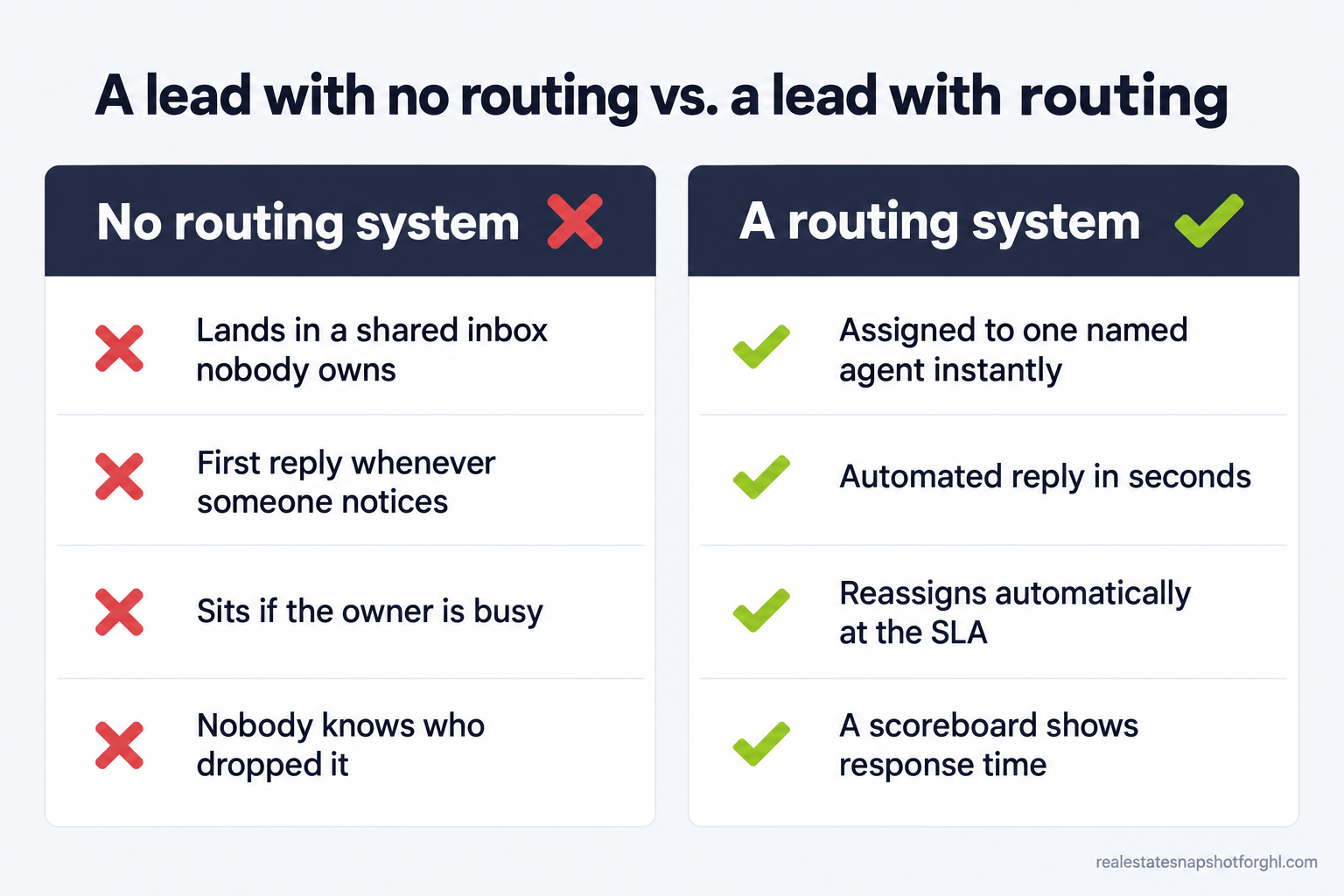
Lead routing is the system that decides who owns each new lead, how fast they must respond, and what happens if they do not. Instead of leads landing in a shared inbox nobody owns, routing assigns each one to a named agent instantly, fires an automated first touch, and reassigns the lead if the owner misses the window.
How fast should a real estate team respond to a new lead?
Ideally within five minutes for a hot inquiry. Harvard Business Review, reporting on research led by Professor James Oldroyd, found contacting an online lead within an hour makes you nearly seven times more likely to qualify it than waiting an hour longer. Automation should answer in seconds so a human can follow inside the window.
What is the best lead routing model for a small team?
For most two-to-eight person teams, round-robin assignment plus a hard escalation rule is the simplest fair model: each lead goes to the next agent in rotation, and if that agent misses the SLA, the lead reassigns automatically. As you add specialists, layer in rules-based routing by source, price band, area, or language.
What is a lead response SLA?
An SLA (service-level agreement) is a written promise that every new lead gets a first human response within a set time, for example five minutes during business hours. It only works if you timestamp both the lead and the first response so you can measure it, and if missing it triggers an automatic reassignment.
Can I automate the first response to a real estate lead legally?
Yes, if the lead opted in. Automated marketing texts require prior express consent under the TCPA, you must register for A2P 10DLC so carriers deliver your texts, and you must honor opt-outs. Automated emails must follow CAN-SPAM. Capture consent on your form and keep a record of when and how each lead opted in.