A Zillow invoice lands for $1,800 and you feel fine about it, because two of those leads turned into showings last month. Then you do the math nobody on the sales call does: $1,800 spent, 30 leads worked, one under contract. That one closing cost you $1,800 in lead spend alone, before a single hour of your time. Suddenly the invoice does not feel fine.
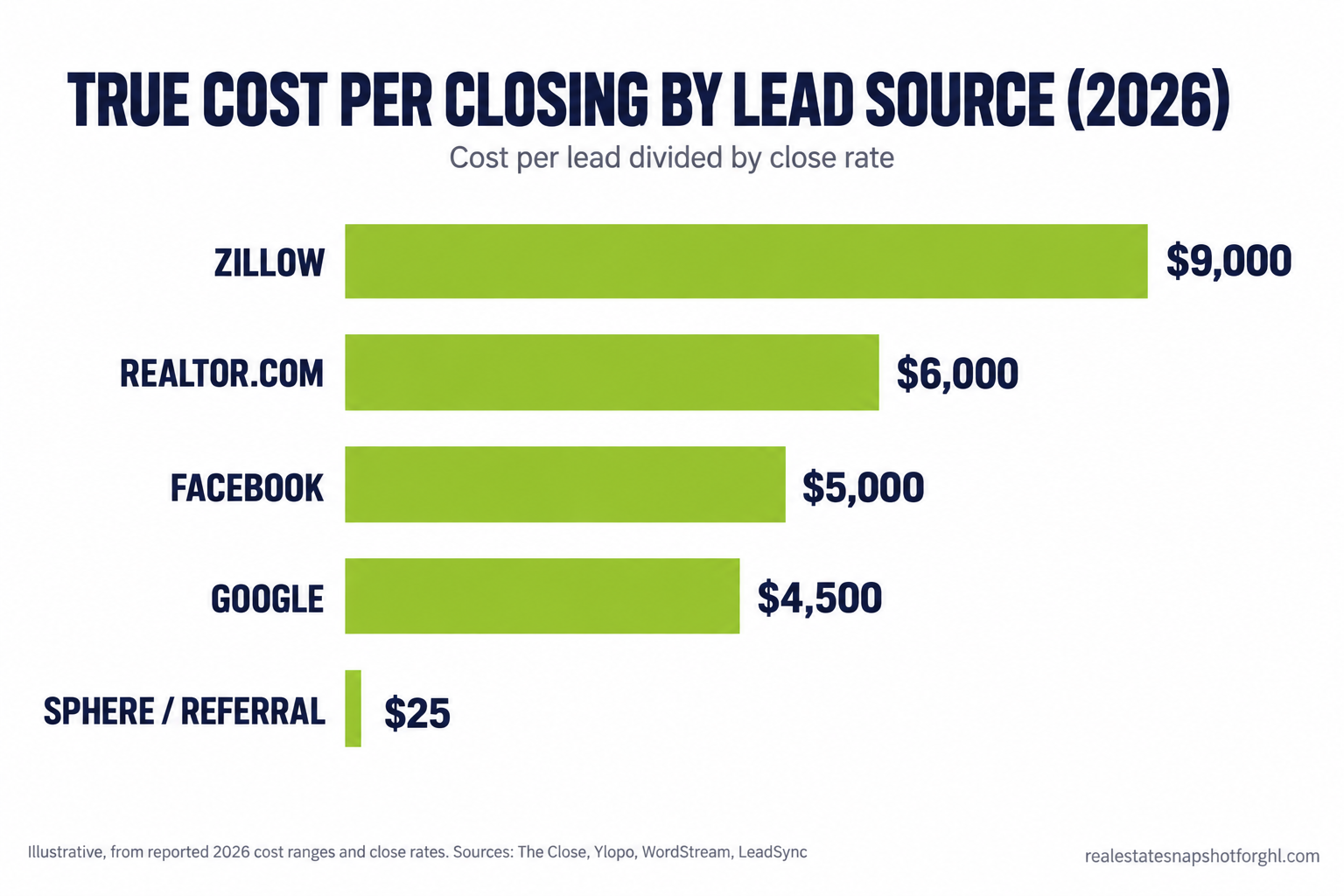
Here is the number that matters. The real cost of a lead is not the price per lead, it is the price per closing: cost per lead divided by your close rate. At a typical portal close rate of 1% to 2%, a $139 to $223 Zillow connection runs $7,000 to $9,000 per closing, a Google lead around $4,500, and a Facebook lead around $5,000. Your own past clients and referrals close at 15% to 40% and cost almost nothing. This teardown runs that math for every major lead source in 2026, names the hidden costs vendors leave off the quote, and gives you the scorecard to run it yourself.
Table of contents
- Why cost per closing is the only number that matters
- What each lead source costs in 2026
- Zillow Premier Agent
- Realtor.com
- Google Ads and Local Services Ads
- Facebook and Instagram lead ads
- Your sphere and past clients
- The three hidden costs nobody quotes you
- Three budgets, three right answers
- Steal this: run your own cost-per-closing math
- Where the compliance line sits
- Objections
- Frequently asked questions
Why cost per closing is the only number that matters
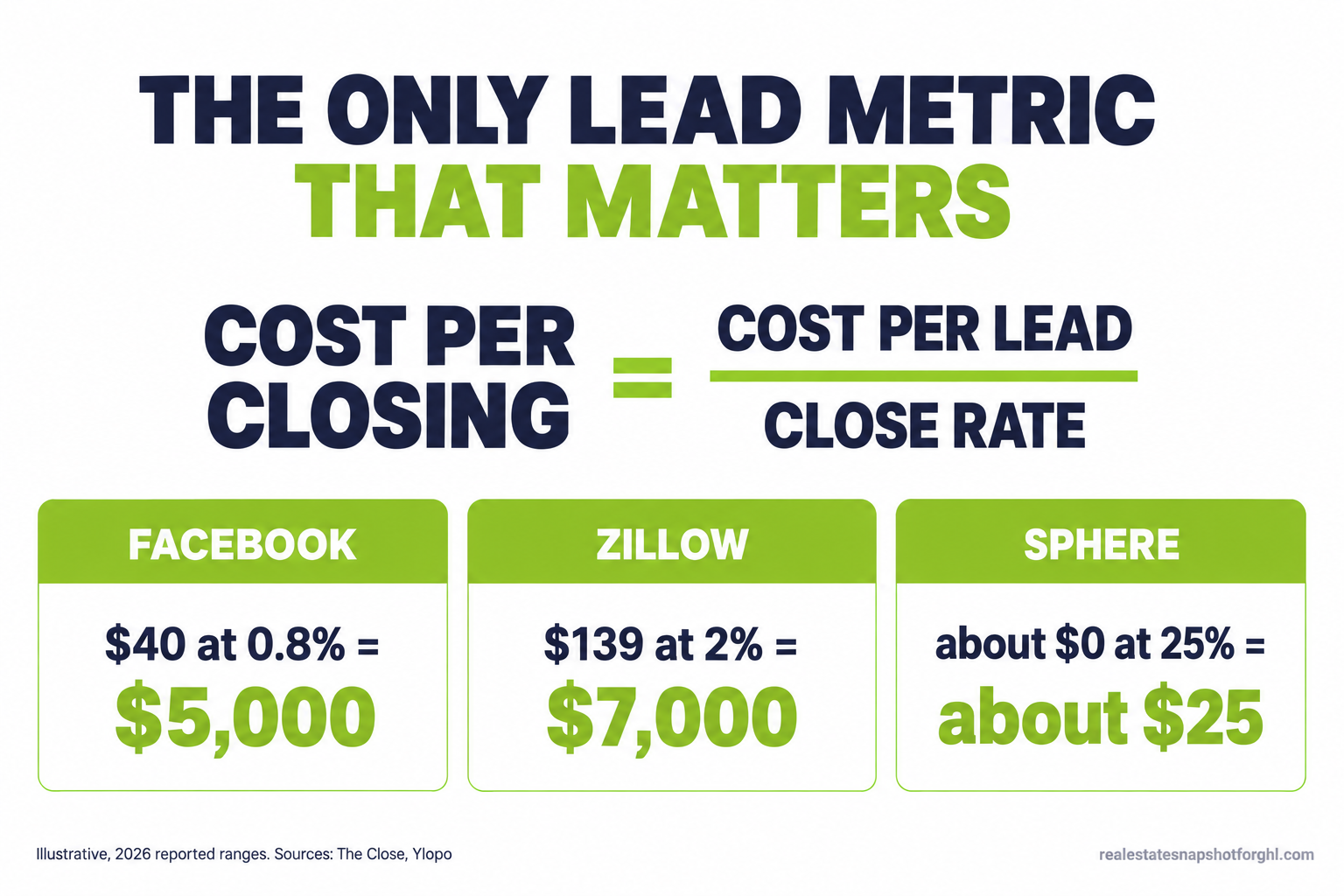
Every lead vendor quotes you a cost per lead, because that is the number that makes them look cheap. But you do not pay your bills in leads, you pay them in closings, and the gap between the two is your close rate. The formula is simple enough to tattoo on your desk:
Cost per closing = cost per lead ÷ close rate.
A $40 lead that closes 1% of the time costs you $4,000 per closing. A $200 lead that closes 4% of the time costs you $5,000. The expensive-looking lead is barely worse, and push the cheap one to 2% with faster follow-up and it wins outright. The price tag told you almost nothing. The close rate told you everything.
The market makes that denominator matter more. The median existing-home price hit $429,100 in August 2026 while sales slid to a 3.98 million annual pace, down 2.0% for the month (NAR). In a thinner market, every lead dollar chases fewer deals, so a low cost per closing is what gets you through the year.
What each lead source costs in 2026
None of the portals publish official per-lead pricing, so the cost figures below are reported ranges and the close rates are blended industry benchmarks.
| Lead source | Reported cost per lead (2026) | Representative close rate | Illustrative cost per closing |
|---|---|---|---|
| Zillow Premier Agent | $139 to $223 per connection | ~2% | ~$9,000 |
| Realtor.com | $40 to $120 per lead | ~1.5% | ~$6,000 |
| Facebook / Instagram | $17 to $55 per lead | ~0.8% | ~$5,000 |
| Google Ads / LSA | $60 to $158 per lead | ~2.2% | ~$4,500 |
| Sphere / referral | Near $0 (tools and time) | 15% to 40% | ~$25 |
Cost per closing is cost per lead divided by a representative close rate (sources: The Close, Ylopo, WordStream, LeadSync, ListWithClever, 2025 to 2026); your numbers depend on your market and follow-up. The pattern jumps out: paid sources land between $4,500 and $9,000 per closing, your sphere near zero. The rest of this post is why, and what to do about it.
Zillow Premier Agent
Zillow is the portal most agents start with, and its pricing is an auction, not a price list. You buy a share of voice in a ZIP code, so your cost rises with demand for that ZIP. The Close reports an average $223 per connection in major metros and $139 in non-major metros, with a roughly $50 per ZIP minimum (The Close). Monthly spend runs $300 to $500 in smaller markets and $1,000 or more in metros, and agents in the hottest markets report $20,000 and up to hold meaningful share (ListWithClever).
How it breaks. Zillow connections are shared with up to three agents unless you pay for more exclusivity, so speed is the whole game. At a $139 connection and a 2% close rate you are at about $7,000 per closing; at the all-agent average closer to 1%, you are at $14,000. The vendor cannot fix that denominator, only your follow-up can, which is why Zillow suits an agent or team with a staffed, under-a-minute response and the budget to stay in the auction for several months.
Realtor.com
Realtor.com sells leads two ways. Connections Plus is a monthly subscription by ZIP, reported at about $200 to $1,800 per month depending on exclusivity, with shared leads working out to roughly $40 to $50 each and exclusive territory higher (WebROIMantra; ListWithClever). ReadyConnect Concierge, the old Opcity, flips the model: you pay nothing upfront and hand over a referral fee of about 30% to 35% of the commission at closing (HooQuest).
How it breaks. The subscription leads carry the same portal problem as Zillow, low intent and shared attention, so the close rate sits in the same 1% to 2% band. The pay-at-close referral looks friendlier because there is no monthly bill, but a 33% haircut on a $12,100 commission is about $4,000 handed back on every deal, forever, and it ties your pipeline to a source you do not control. Cheap to start, expensive to depend on.
Google Ads and Local Services Ads
Google gives you two doors. Local Services Ads (the “Google Screened” badge atop the results) are pay-per-lead, reported at $30 to $150 per valid lead, commonly $60 to $75. Standard search ads are pay-per-click, and after you account for how few clicks fill out a form, a residential agent lead can land around $158 (LeadSync).
How it breaks. Google intent is higher than social, because someone searching “homes for sale in [your town]” is further down the path than someone scrolling a feed, so the close rate is a bit better, around 2% to 2.5%. But the per-lead cost is high, and a bad landing page quietly doubles it. Google rewards a conversion-ready website and an instant response, so it only pays for agents who have both.
Facebook and Instagram lead ads
Meta is the cheapest door by cost per lead, and the most misunderstood. WordStream’s benchmark puts real estate lead-form ads around $16.61 per lead, the credible floor (WordStream). Real-world campaigns including management land higher, $35 to $65 in Tier 1 metros and $20 to $45 in Tier 2 markets (SuperAds).
How it breaks. A $17 lead feels like free money until you see the close rate. Meta leads are interruption leads, the person was looking at a cousin’s vacation photos, not searching for a house, so intent is low and the close rate sits under 1% for most agents. A $40 lead at a 0.8% close rate is $5,000 per closing, the same neighborhood as a Zillow lead that cost ten times as much up front. Meta also runs housing ads through a restricted Special Ad Category that limits your targeting. The volume is only worth it if you can hold hundreds of low-intent leads warm for months.
Your sphere and past clients
Now the source that never shows up on a sales call, because nobody sells it to you. Your past clients and the people who already know you close at a completely different rate: referrals and repeat business run 15% to 40%, roughly ten to twenty times a cold portal lead (The Close).
The data is not close. In NAR’s 2025 Profile of Home Buyers and Sellers, 91% of buyers said they would use their agent again or recommend them, repeat buyers made up 79% of all buyers, and the typical agent earns about 20% of business from repeat clients and 21% from past-client referrals (NAR).
The marginal cost of a sphere lead is a text message and a few minutes. Agents still pour money into portals instead because the sphere requires follow-through, and follow-through is the first thing a busy agent drops. The database goes cold, the next agent calls your past client first, and you buy a $200 stranger instead.
Representative close rate by lead source, percent (sources: The Close, Ylopo, 2026). Sphere and referral shown at the low end of their 15% to 40% range, still an order of magnitude above every paid source.
The three hidden costs nobody quotes you
The math above leaves out three costs that never make the quote.
One: the leads you paid for and never worked. Roughly half of agents never follow up after the first attempt, yet most deals take five or more touches. Every lead you buy and abandon after one text is pure waste, and it does not lower your cost per lead, it raises your cost per closing: the denominator shrinks while the spend stays the same. Work 30 leads but follow up on 10, and your effective cost tripled.
Two: your time. A portal lead that needs five calls, three texts, and an email over two weeks is not free to work even if the lead itself were. The hours you spend chasing low-intent leads are hours you are not at a listing appointment, which is why teams hire inside sales agents and why a system that does first-touch follow-up for you changes the math more than switching vendors ever will.
Three: your split. Every figure here is against the gross commission. A median buy-side commission is about $12,100 (2.82% of the median price, per Clever’s February 2026 survey). After a 70/30 broker split you keep roughly $8,470, so a $9,000 Zillow cost per closing does not eat most of your commission, it eats all of it. You worked the deal to lose money, and the math stays invisible until you run it.
Three budgets, three right answers
The right lead strategy is not the same for a solo agent and a 20-person team. Here is how the math plays out at three budgets.
Solo agent, about $500 a month. At a $4,500 to $9,000 cost per closing, $500 a month ($6,000 a year) buys roughly one paid closing a year, maybe two if your follow-up is sharp, a terrible use of a small budget. Skip the portals, spend the money on reviving a cold database and a fast follow-up setup, and let the 15% to 40% close rate of your own sphere carry you. Buy leads later, once the free pipeline runs and you have the hours to work them.
Mid-size team, about $3,000 to $5,000 a month. Now portals can make sense, but only if you fix the close rate first. A team spending $4,000 a month at a 1% portal close rate is lighting money on fire. The same $4,000 at a 3% close rate, achieved with sub-minute response and a real follow-up sequence, is a profitable channel. Fix the denominator before you raise the budget.
Large team or brokerage, $20,000 a month and up. At this scale lead cost is a customer-acquisition cost you manage like any line item, and it only works with instant response, a CRM that routes leads in seconds, and someone accountable for close rate by source. The biggest teams are not buying better leads than you, they are converting the same leads two to three times as often. That is a systems advantage, not a budget one.
Steal this: run your own cost-per-closing math
You need one number per source, updated monthly. Copy this scorecard into a spreadsheet, one row per lead source.
Run it every month and you stop arguing about which vendor is “good” and start seeing which one pays you. For realistic targets on the close-rate side, our conversion benchmarks give you numbers to measure against, and the CRM cost teardown covers the software bill underneath it all.
Where the compliance line sits
Bought leads come with rules the invoice does not mention. A stranger who filled out a Zillow or Facebook form has not necessarily consented to be texted, so texting at scale means registering for A2P 10DLC and honoring opt-outs, or carriers block you and the TCPA exposes you to real damages (our SMS compliance guide covers it). Meta housing ads run through a restricted Special Ad Category that limits targeting under Fair Housing rules, and a pay-at-close referral is worth running past your broker to stay clear of RESPA. Set paid leads up right once, so a fine does not wipe out the cost per closing you worked to calculate.
Objections
“Aren’t bought leads just the cost of doing business?” Only if they pay for themselves, and most agents never check whether they do. A source running above your net commission per closing is not a cost of doing business, it is a subsidy you are paying the vendor. The scorecard tells you which is which.
“My sphere is tapped out, or I am brand new and do not have one.” Then your first job is not buying leads, it is building the asset that closes at 15% to 40% instead of 1%. A new agent with 50 contacts and a consistent nurture system will out-earn one who spends the same money on portals, because portal money buys a deal or two while the sphere compounds. Buy leads to bridge the gap, not instead of growing it.
“Zillow leads closed for me, so they are worth it.” Maybe. The real question is what every Zillow lead cost you per closing across a full year of spend. Survivorship bias is the most expensive feeling in real estate: the one that closed is vivid, the 29 that did not are forgotten, and the invoice counts all 30.
“Isn’t ‘follow up faster’ just another thing I have to buy?” You can do it by hand if you have the hours, and plenty of agents do. The point is that the close rate, not the vendor, sets your cost, so your attention belongs on the denominator. Chasing a lower price per lead from Zillow to Realtor.com just rearranges the small number while the big one sits untouched.
Frequently asked questions
Frequently asked questions
What do real estate leads actually cost in 2026?
Reported cost per lead runs about $17 to $55 on Facebook, $60 to $158 on Google, $40 to $120 on Realtor.com, and $139 to $223 per connection on Zillow. But once you divide by a realistic close rate, the true cost per closing lands around $4,500 to $9,000 for paid sources and near zero for your own sphere.
How do I calculate my true cost per closing?
Cost per closing equals cost per lead divided by your close rate as a decimal. A $40 lead that closes 1% of the time costs $4,000 per closing; the same lead at 2% costs $2,000. Track spend, leads, and closings per source every month and let the numbers decide.
Which real estate lead source has the best ROI?
Your sphere and past clients, by a wide margin. Referrals and repeat clients close at 15% to 40% versus about 0.4% to 1.2% for portal leads, and cost almost nothing beyond follow-up. Among paid sources, the best ROI goes to whichever one you follow up on fastest.
Are Zillow leads worth the cost?
Only with instant, persistent follow-up. Zillow connections are shared with up to three agents and cost $139 to $223 each, so at a typical 1% to 2% close rate you are looking at roughly $7,000 to $9,000 per closing. Against a median buy-side commission near $12,100 before your split, the margin is thin unless your close rate beats the average.
Why do cheap Facebook leads cost so much per closing?
Because they convert poorly. A Facebook lead can cost as little as $17, but these are interruption leads from people who were not searching for a home, so the close rate sits under 1% for most agents. A $40 lead at 0.8% is about $5,000 per closing. Low cost per lead, high cost per closing.
Sources
- NAR: Existing-Home Sales, August 2026; 2025 Profile of Home Buyers and Sellers
- Clever: Average Real Estate Commission Rate (Feb 2026)
- The Close: Zillow Premier Agent Review 2026; Real Estate Lead Generation Statistics
- Ylopo: Real Estate Lead Conversion Rate
- ListWithClever: How Much Are Zillow Leads; Realtor.com Leads
- WebROIMantra: Realtor.com Leads Cost · HooQuest: Realtor.com Leads
- LeadSync: Google Ads for Real Estate
- WordStream: Facebook Ads Benchmarks · SuperAds: Real Estate CPL Benchmarks