

The offer got accepted on a Tuesday. You texted your buyers a round of celebration emojis, said “I’ll be in touch,” and moved on to the next three fires. Now it is seventeen days later, your phone lights up at 9:12pm, and it is them: “Hey, is everything still okay with the house? We haven’t heard anything and we’re getting nervous.” You have been working their file the whole time. The inspection got handled, the appraisal came in fine, the lender is cleared. They just had no idea, because nobody told them.
That silence is the most expensive thing you do in a transaction, and it is invisible because the deal still closes. The keys change hands and the client walks away thinking you vanished during the scariest month of their life, so when their coworker needs an agent next year, they hesitate. The fix is a communication system that runs itself from accepted offer to closing table, so clients always know what is happening and what comes next. This post builds it in seven stages, with the copy to steal and the places it quietly breaks.
Table of contents
- What going quiet in escrow costs you
- The contract-to-close roadmap
- Stage 1: Accepted offer
- Stage 2: Earnest money and escrow
- Stage 3: Inspection and repairs
- Stage 4: Appraisal
- Stage 5: Loan and clear to close
- Stage 6: Walkthrough and signing prep
- Stage 7: Closing and handoff
- Steal this: the message copy
- Solo, team, and with a TC
- Compliance rules you cannot skip
- Objections
- FAQ
What going quiet in escrow actually costs you
Your best lead source is a past client who felt looked after: 91% of recent home buyers said they would use their agent again or recommend them (NAR 2025 Profile). That loyalty is earned, or lost, in the four to six weeks of escrow, where most agents go dark because the selling feels done.
It does not feel done to the client. For a first-time buyer, and 31% of buyers in the three months to October 2026 were first-timers (NAR Realtors Confidence Index), this is the biggest check of their life and a process they have never seen. Every day of silence reads as “something is wrong.” Sometimes it is: about 7% of contracts were terminated and 16% hit a delayed settlement in that period (NAR RCI). When a deal wobbles, the agent texting steady updates keeps a calm client; the one who vanished gets a panicked client who starts googling. Each closing matters more in a thin market too: existing-home sales ran at a 3.98 million annual pace in August 2026, median price $429,100 (NAR).
The contract-to-close roadmap
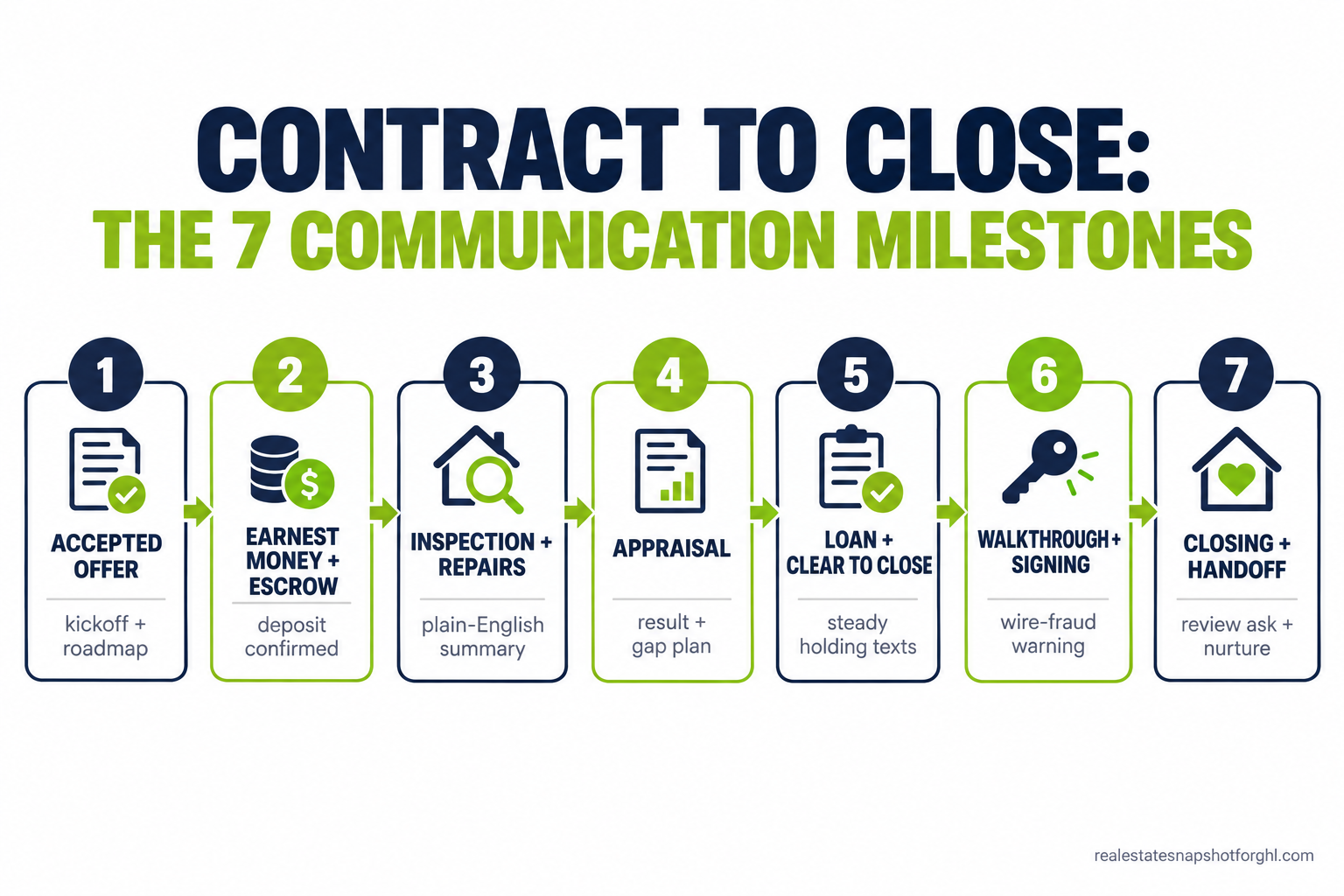
Every residential transaction moves through the same seven checkpoints, shown in the diagram above. Dates shift by state and by deal, but the order holds. The system gives each stage a trigger, a message, and a responsible party, so nothing depends on you remembering to text at 7pm.
Stage 1: Accepted offer, the kickoff
The setup. The hour the contract is signed, one message celebrates, sets the roadmap, and names the next action. Attach a one-page timeline with the real dates: inspection deadline, appraisal window, financing contingency, closing day. People calm down when they can see the road. “Contract signed” is the trigger that fires this and schedules every later message off the key dates.
Where it breaks. The classic failure is a warm kickoff and then nothing for two weeks, which teaches the client your messages are hype, not information. The other break is wrong dates: a deadline off by two days manufactures a crisis, so pull them straight from the executed contract, never from memory.
Stage 2: Earnest money and escrow opened
The setup. Within a day or two, confirm two concrete things: the earnest money deposit was delivered and receipted, and the file is open with the title company or closing attorney. They are the first proof the deal is real, and they set the rhythm: you will hear from me at each step.
Where it breaks. A wire that misses the contractual deadline can technically breach the contract, so the earnest-money due date has to be a hard task, not a hope. The second break is assuming the client knows what “escrow” even means. One plain sentence, “that is your money, held safely and credited back at closing,” removes a worry they never voice.
Stage 3: Inspection and repair negotiation
The setup. The first stage with real moving parts: schedule the inspection, make sure you or the client can attend, then translate the report. Inspection reports terrify normal people because everything reads like a disaster. Your job is a plain-English summary: the three things that matter, what is cosmetic, what you recommend asking for. The booking and reminders run through the same calendar as your showing and appointment automation.
Where it breaks. Silence after a scary report is the worst break in the whole transaction. The client reads the raw PDF, sees “evidence of moisture” and “aging electrical panel,” and assumes the house is collapsing; if your calm summary does not arrive fast, fear fills the gap. The other break is missing the contingency deadline, which is date-stamped in the contract and can cost a credit if blown.
Stage 4: Appraisal
The setup. The lender orders the appraisal; you confirm it is scheduled and relay the outcome the moment you know. At or above price is a one-line good-news text. If it comes in low, your Stage 1 prep pays off: you already explained the options (buyer brings the gap, seller drops, meet in the middle, or renegotiate). Call first on a low number, then follow in writing.
Where it breaks. Appraisal issues delayed around 5% of contracts in the period to October 2026 (NAR RCI), so this is not rare. The break is treating a low appraisal as an emergency instead of a known branch in the road. Set the expectation in the kickoff and it feels like a plan, not a catastrophe.
Stage 5: Loan processing and clear to close
The setup. The longest, quietest stretch, and the one agents disappear into. The lender works through conditions, the client hears nothing for a week, and the nerves creep back. Fight it with a steady low-key check-in even when there is nothing new (the holding text is below): a “nothing to report” message keeps the client from assuming the worst. Deliver one critical warning too: no new credit, no car, no big money moves until after closing, because it can sink the loan.
Where it breaks. Financing is the most common reason a settlement slips, and it shows up here. The break is going silent because “there is nothing to update,” which the client cannot tell apart from “my agent forgot about me.” The second break is forgetting the no-new-credit warning until a buyer finances a sofa the week before closing.
Stage 6: Walkthrough and signing prep
The setup. As closing nears, three things each get a message. Schedule the final walkthrough and confirm the home is in agreed condition. Tell the client what to bring to signing: valid photo ID and funds by cashier’s check or confirmed wire. And deliver the wire-fraud warning in bold, because this is where buyers get robbed: no legitimate party emails new wire instructions at the last minute, and they must verify at a known number first. By law the lender provides the Closing Disclosure at least three business days before closing (CFPB), so prompt the client to read it.
Where it breaks. The wire-fraud warning is not optional. Skipping it is how a client loses their entire down payment to a spoofed email. The other break is a vague “see you at closing” that leaves the buyer unsure what to bring.
Stage 7: Closing and the post-close handoff
The setup. Closing day gets a genuine congratulations and the logistics. Then the system keeps going, which most agents never do. A day or two after close, while the good feeling peaks, a review request fires, routed so a thrilled client lands on your Google profile and anyone unhappy reaches you privately first (how to get more real estate reviews). Then the client moves into the quarterly check-in and home-anniversary note your post-close referral engine runs on autopilot.
Where it breaks. The near-universal break is treating closing as the finish line. The deal is done; the relationship just started. If the review ask never fires, your profile stays thin. If the client never hears from you again, the next agent who sends a market update becomes “their agent,” and the referral you earned walks away.
Steal this: the milestone message copy
The software is replaceable. The copy is the asset. Write these once, trigger them off your pipeline stages, and a client never has to ask for an update again.
Stage 1, accepted offer (same day):
Congratulations [First name], the offer is ACCEPTED and we're officially under
contract on [address]! Here's what's next and when: inspection by [date], appraisal
around [date], clear-to-close by [date], closing [date]. I'll text you at every step
so you're never guessing. Timeline attached. First up: booking the inspection.
Stage 3, inspection summary (same day as report):
Inspection's done. Short version: the house is in good shape. Three things worth
noting: [A], [B], [C]. The rest is normal wear and cosmetic. My recommendation is
we ask the seller for [X]. Full report attached. Quick call to walk it through?
Stage 4, appraisal came in low (call first, then this):
As we talked about at the start, the appraisal came in at [$], which is [$] under
our price. This happens and we have good options: cover the gap, ask the seller to
adjust, meet in the middle, or renegotiate. No decision this second. Here's what I'd
suggest and why: [...]. Call me when you have 10 minutes.
Stage 5, the quiet-stretch holding text (every 3-5 days):
Checking in so you're not left wondering: still on track, closing is still [date].
Nothing you need to do except the big one, no new credit, no big purchases, no
moving large sums until after we close. I'll text the second we're clear.
Stage 6, signing prep + wire warning (Closing Disclosure issued):
Almost there. Final walkthrough is [date/time]. For signing on [date], bring valid
photo ID and your funds by cashier's check or confirmed wire. IMPORTANT: wire fraud
is real. I will NEVER email you new wire instructions. If you get any, call me or
[title] at a number you already have before sending a dollar.
Stage 7, post-close review ask (day after closing):
[First name], congratulations again, the keys are yours! It meant a lot to help you
get here. If you have 60 seconds, a quick Google review helps the next family find
me the way you did: [link]. And if anything fell short, tell me first, I'd rather fix it.
Run it solo, as a team, and with a TC
The seven stages do not change. Who presses the button does.
Solo agent, roughly $60k to $150k GCI. You are the agent and the coordinator, so the system carries the communication you cannot. Automate the kickoff, the escrow confirmation, the holding texts, and the review ask hardest, because those are the ones you drop when you are busy. Keep the human calls for the two moments that need you: a scary inspection report and a low appraisal. Our sphere nurture guide covers the post-close half.
Two-to-four-person team. Now the risk is “I thought you were updating them.” A shared pipeline with one owner per deal fixes it: the trigger fires the sequence, and every teammate can see which stage a file is in and what went out last. Name one person as the client’s single point of contact.
Team with a dedicated transaction coordinator. A TC is the best hire in real estate, and the system makes them twice as effective. Let the automation send the predictable, dated messages so the TC spends their hours on judgment work: chasing a slow lender, calming a nervous buyer, catching the deadline about to slip.
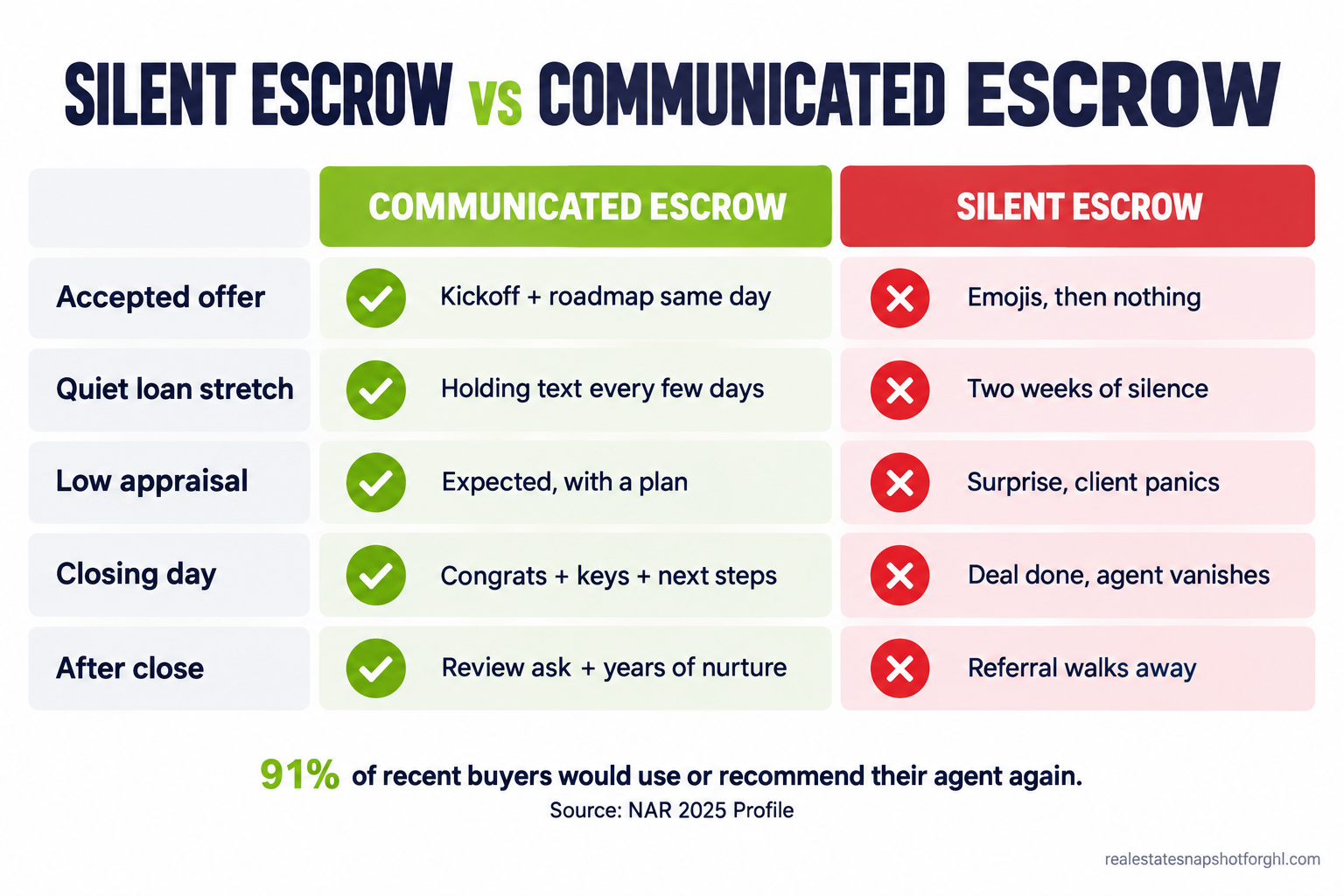
A silent escrow vs a communicated one
| Communicated escrow | Silent escrow | |
|---|---|---|
| Accepted offer | Kickoff + full roadmap same day | Emojis, then nothing |
| The quiet loan stretch | Holding text every few days | Two weeks of silence |
| Low appraisal | Expected, with a plan ready | Surprise, client panics |
| Closing day | Congrats + keys + what's next | Deal done, agent vanishes |
| After close | Review ask + years of nurture | Referral walks to the next agent |
Percent of recent buyers who would use or recommend their agent again, and the share of contracts hitting each issue in the three months to October 2026. Sources: NAR 2025 Profile and NAR Realtors Confidence Index.
The compliance rules you cannot skip
Automated client texting is legal, but it has rules. Transactional updates about the client’s own purchase are on solid ground, but you still honor an opt-out instantly, and business texting in the United States runs through registered A2P 10DLC campaigns or carriers filter your messages (The Campaign Registry). Federal telemarketing and Do Not Call rules still apply to anything beyond “your transaction” (FCC). The full breakdown is in our guide to legal real estate texting and A2P 10DLC.
The bigger trap at the closing table is RESPA. If you co-market with the lender or title company touching this deal, splitting the cost of a flyer, an app, or a gift, Section 8 of the Real Estate Settlement Procedures Act bans paying or receiving anything of value for a referral of settlement business (CFPB, Regulation X). Agents break this without meaning to, so read RESPA Section 8 for real estate co-marketing before you split a single invoice with a lender.
Objections
“Won’t all these texts feel robotic during an already stressful time?” The opposite. The stress comes from not knowing. A plain, timely “here is where we are” reads as attentive, as long as it uses their name, references their actual deal, and sounds like you firing off a quick note. Robotic is a form-letter blast.
“I already have a transaction coordinator. Do I need this?” The system makes a TC better, it does not replace one. Right now your TC is probably sending the predictable messages by hand, which eats the hours they should spend chasing the slow lender. Let the automation handle the routine and point your TC at the judgment calls.
“My deals are all different. How can a sequence handle that?” The spine is identical every time: offer, escrow, inspection, appraisal, loan, walkthrough, close. That spine is 80% of the communication and never changes. The sequence carries it; you handle the 20% that is unique to each deal.
“What if the deal falls through? Do I keep sending updates?” Yes, and this is when it matters most. A terminated contract with a silent agent is a client who never calls again. One where you explained what happened keeps a client who trusts you. Build a branch: when a deal dies, the sequence stops and a personal call takes over.
Back to that Tuesday. In the fixed version, your buyers got the kickoff within two hours, a steady text at every milestone, and a clear-to-close note they screenshotted to their parents. They never sent the 9:12pm text, because they already knew the answer. And when their coworker needs an agent, there is no hesitation.
FAQ
What is the contract-to-close process in real estate?
Every step between an accepted offer and the closing table: earnest money and opening escrow, the home inspection and repairs, the appraisal, loan processing and the lender's clear-to-close, the final walkthrough and signing prep, and closing day. It usually runs four to six weeks, and each step is a point where a client needs to hear from their agent.
How often should I update a client during escrow?
At every milestone, plus a low-key holding message every three to five days during the quiet loan-processing stretch even when there is nothing new. The silence is what scares clients, not the news. A 'still on track, closing is still [date]' text prevents the panicked 'is everything okay?' call.
Why does communication during escrow affect referrals?
Loyalty is earned in escrow, not at the offer. 91% of recent buyers said they would use their agent again or recommend them (NAR 2025 Profile), and that depends on the client feeling taken care of through the weeks most agents go quiet.
Is it legal to send automated texts to clients during a transaction?
Yes, with the right setup. Updates about the client's own purchase are transactional, but you must honor opt-outs and business texting runs through a registered A2P 10DLC campaign or carriers filter it (The Campaign Registry). Telemarketing and Do Not Call rules still apply beyond the transaction (FCC).
What happens to the communication if the deal falls apart?
The automated sequence stops and hands off to a personal call. About 7% of contracts were terminated in the three months to October 2026 (NAR RCI). A client who hears a clear explanation keeps trusting you; one met with silence does not call again.
When should I ask for a review, and how?
A day or two after closing, while the good feeling is fresh, routed so happy clients land on your public profile and anyone unhappy reaches you privately first. Closing day itself is for congratulations and logistics.
Devin Callahan writes about GoHighLevel implementation for real estate teams: clean pipelines, tagging that survives contact with a real brokerage, and automations that keep clients informed without double-texting them at 2am. This is educational content for real estate professionals, not legal, compliance, or tax advice. Texting rules, RESPA, and closing requirements change, so confirm current requirements with the FCC, the CFPB, and your broker before you launch outreach.