

Your seller sits across the kitchen table and says it under their breath: “I do not want the whole neighborhood knowing we are selling. Can we just do it quietly, off Zillow, maybe to your buyers first?” It is a fair question, and more sellers are asking it. Say yes the wrong way and you can get the listing banned from Zillow for its entire life, draw a fine from your MLS, and cost your seller thousands in a lower sale price.
So here is the plain answer up front. Yes, you can hold a listing back in 2026, but only through a few specific doors, and the moment you market the home to the public you start a clock that gives you one business day to put it in the MLS. This is the Clear Cooperation Policy, and 2025 and 2026 rewrote the rules around it. Here is what it requires, the three legal ways to keep a listing private, what going dark really costs the seller, and the words for that kitchen table.
Table of contents
- What the Clear Cooperation Policy actually requires
- What counts as “marketing to the public”
- The three legal ways to hold a listing back
- Zillow’s listing ban and the Compass fight
- What going private really costs your seller
- What it costs you when you get it wrong
- Your state may already restrict it
- Three scenarios: solo agent, small team, brokerage
- Steal this: the seller script and consent language
- Objections
- Frequently asked questions
What the Clear Cooperation Policy actually requires
The Clear Cooperation Policy is an NAR rule every Realtor-affiliated MLS enforces, and its core is one sentence: within one business day of marketing a property to the public, the listing broker must submit the listing to the MLS for cooperation with other participants (NAR). An MLS works because every member shares listings so every buyer, through any agent, can see them, which NAR ties to equal access.
In March 2025, NAR kept Clear Cooperation and added a new option, Multiple Listing Options for Sellers, a legitimate and documented way to delay public marketing without breaking the rule (NAR).
The part that trips agents up is that the clock is not started by listing the home, it is started by marketing it. You can sign a listing agreement and not start the clock at all, as long as you do not promote the property. The second you do, you have one business day to file it.
What counts as “marketing to the public”
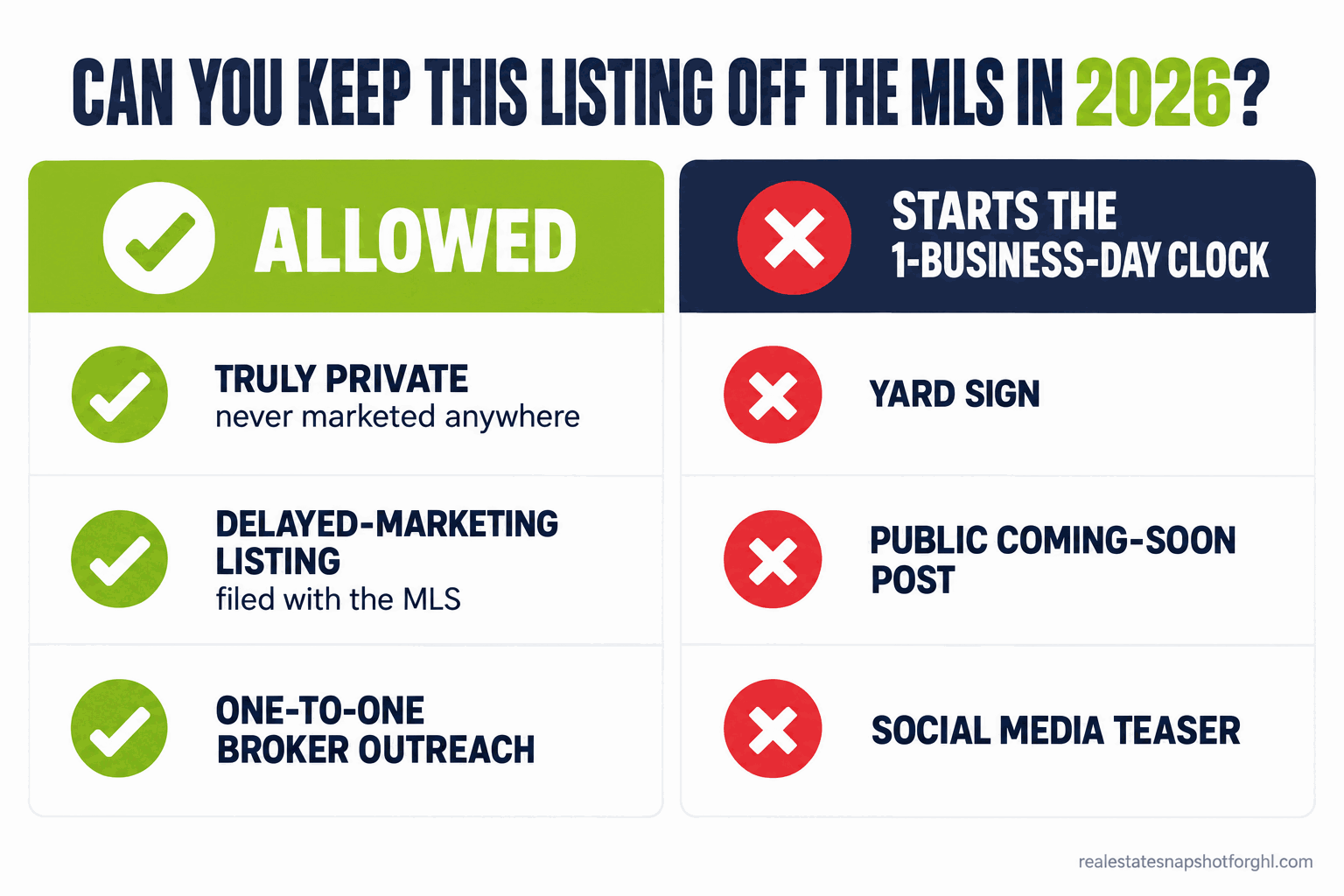
This is where good agents get fined, because the definition is wider than most assume. It means any communication about the listing that reaches more than one brokerage or any consumer who is not already your client. NAR is explicit that multi-brokerage communications count; one-to-one communications between brokers do not.
These all start the clock: a yard sign or “coming soon” rider; a coming-soon post on your site, your brokerage site, or an IDX feed; a social teaser, even a Story that says “DM me for the address”; an email blast to your buyer list or to agents at other firms; a flyer in the neighborhood; and posting in a private listing network or multi-brokerage group chat.
These do not, as long as they stay private: a one-to-one call or text to a single agent, a conversation inside your own brokerage, and prep work like staging and paperwork.
The failure mode is the “soft launch.” An agent teases the listing on Instagram for a week before it hits the MLS. That teaser is public marketing: the clock started with the first post, and a week of buzz is six days past the deadline. Use a path the policy allows instead.
The three legal ways to hold a listing back
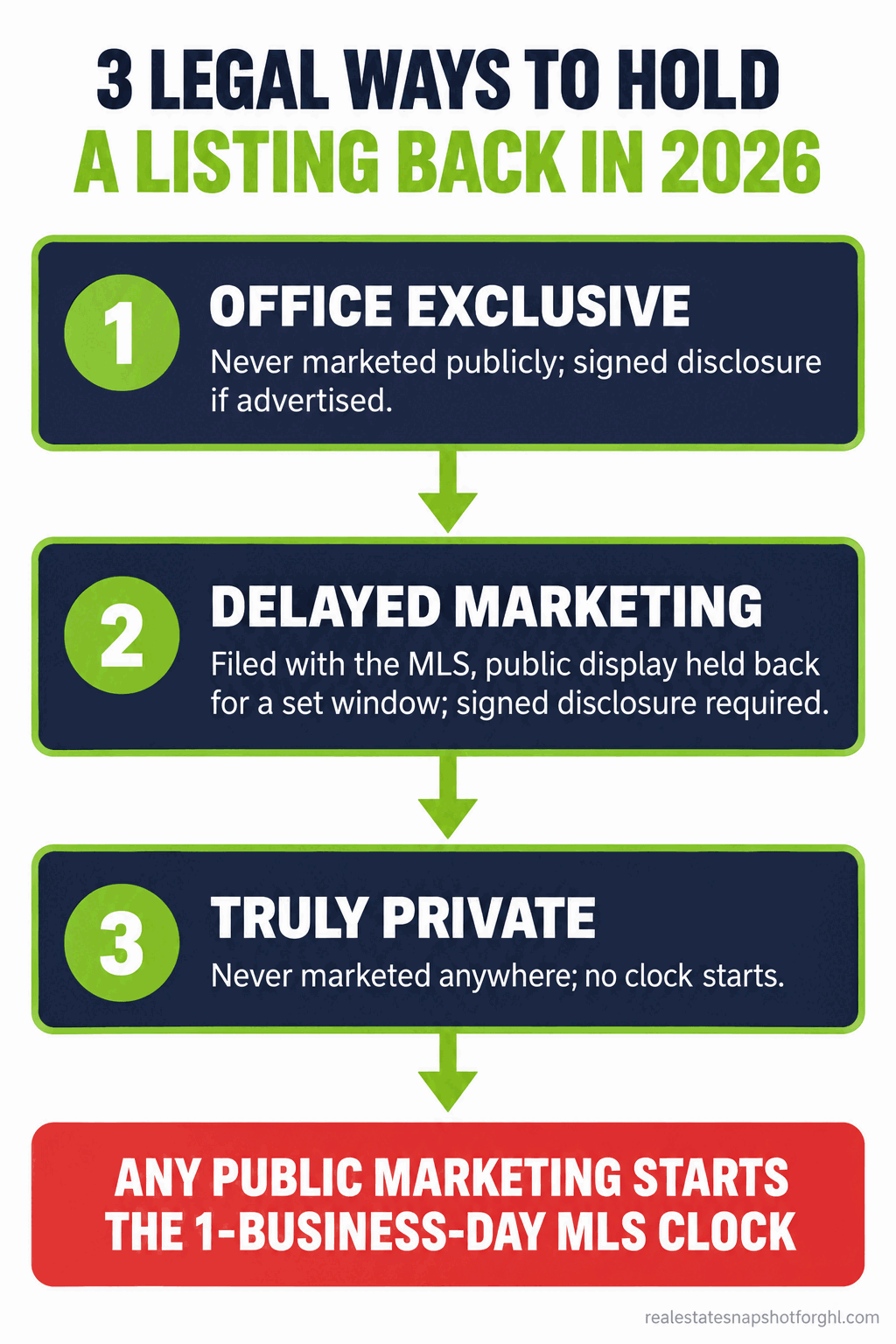
There are three doors, and two need paperwork.
1. The true office exclusive. You keep the listing inside your brokerage and never market it to the public: no sign, no post, no multi-brokerage outreach, though you may show it to your own clients. The catch: under the 2025 policy, an office exclusive that gets publicly advertised must go to the MLS, and the seller signs a disclosure acknowledging they are waiving public exposure (NAR).
2. The delayed-marketing listing. This is the new door NAR built in 2025, and the right answer for most sellers who want a head start. You file the listing with the MLS, so it counts as cooperated, but you hold back the public-facing piece: IDX display and portal syndication are delayed for a set period, with each MLS deciding how long. The seller signs a disclosure giving informed consent to waive immediate public marketing. It is the legal version of a soft launch, and almost nobody who asks to “go private” needs more than this.
3. The listing that is never publicly marketed at all. A genuinely private sale is not a violation because the clock never starts. This is the narrow lane for a real privacy need, a public figure or a sensitive situation. It is legitimate, and the lane most likely to cost the seller money.
Zillow’s listing ban and the Compass fight
Even if your MLS gives you room, Zillow can take it away. In April 2025, Zillow rolled out its Listing Access Standards: if a listing is marketed to the public anywhere and is not on the MLS within one business day, Zillow refuses to display it for the life of the listing, and enforcement started June 30, 2025 (HousingWire). That is not a fine, it is a blackout: the home goes invisible on the country’s biggest portal, even after you later add it to the MLS.
Compass, which built a business around “exclusive” inventory, sued to stop the rule. In February 2026, a federal judge in New York denied its request for an injunction, so Zillow kept enforcing, and Compass dropped the suit the following month (Real Estate News). The practical result: a listing never marketed publicly is fine with Zillow, but one you tease publicly and keep off the MLS is exactly what Zillow blacklists, and enforcement has not been uniform in every market (Inman). Betting a seller’s sale on that gap is a bad bet. “Off the MLS” and “off Zillow” are now the same decision.
What going private really costs your seller
A home gets its top price only when enough buyers compete for it, so the privacy a seller asks for usually comes out of their own pocket. Zillow studied off-MLS sales from 2023 and 2024 and found sellers who skipped the MLS typically sold for less, with the gap worst in diverse neighborhoods. In majority-minority ZIP codes, off-MLS homes sold for about 3.2% less, a gap of roughly $9,850 per home, compared with about 1.2% or $3,700 in majority-white areas, and the loss ran highest in majority-Hispanic ZIP codes, about $13,730 (Real Estate News; RISMedia).
Estimated dollars lost selling off-MLS versus on-MLS, by neighborhood type, 2023-2024. Source: Zillow research, via Real Estate News.
Zillow is not a neutral party here, and its later 2023 to 2025 analysis put the gap lower, around 1.3%. But even the conservative number is real money. The median existing-home price was $416,700 in October 2026, while sales fell to a 3.75 million annual pace, the slowest since the Great Recession (NAR). With first-time buyers only 29% of sales, every buyer who never sees the home is a lost bid, and a 1.5% haircut on a median home is more than $6,000. Most sellers, once they see the math, choose exposure.
There is also a fair housing dimension, even if no court has ruled on it: homes that trade inside private networks reach mostly the buyers already connected to the right agents, which can reinforce who gets access to which neighborhoods. That is the equity concern NAR points to, and part of why regulators are moving.
What it costs you when you get it wrong
The seller takes the price hit; you take the fine. Penalties are set by each MLS, so they vary, but the pattern is a tiered fine that climbs with each violation.
| MLS | First violation | Second | Third |
|---|---|---|---|
| Central Panhandle (FL) | $500 | $1,000 | $5,000 + 30-day suspension |
| NTREIS (North Texas) | $1,000 | $2,500 | $5,000 + committee review |
| SABOR (San Antonio) | $200 | $300 | $400 |
| Alleged max (a South FL MLS) | up to $15,000 |
Figures above are examples from published MLS rules, not a national standard; your own rulebook binds you (CPAR). A repeat offender can lose MLS access, which for most agents is the business, and one mishandled “coming soon,” plus the Zillow blackout, can cost you a listing you cannot re-expose.
Your state may already restrict it
The MLS rule is no longer the only one. Washington signed SB 6091 in March 2026, and as of June 11, 2026 a private listing exhibited without concurrent public marketing is an “unfair practice” under state law, with a narrow exception for genuine health or safety needs (Seattle Agent; Washington DOL). Wisconsin acted first in late 2025, Connecticut’s SB 340 takes effect October 1, 2026, and bills are moving in Illinois, Hawaii, and New York (RISMedia).
The rules genuinely differ by where you practice. An agent in Seattle has a statutory ban an agent in Phoenix does not, and an office exclusive that is routine in one state may be an unfair practice next door. Before you promise a seller a private sale, check your state law and your MLS rulebook together, because either one can override the other.
Three scenarios: solo agent, small team, brokerage
The right move changes with your size.
The solo agent. Your risk is the accidental trigger, and no one is watching your Instagram. Never tease a listing publicly before it is MLS-ready, and when a seller asks to go quiet, default to the delayed-marketing listing. Your best defense against the pull of pocket listings is a buyer database so warm you do not need secrecy to create urgency, which is what database reactivation builds.
The small team (2 to 10). Your risk is coordination. One agent soft-launches on social while the listing coordinator thinks it is still in prep, and the clock has been running for days. Put one rule in writing, no public marketing until the listing is in the MLS or logged with the signed disclosure on file, and assign one person to own that log. It is the same discipline that keeps a team from dropping inquiries, covered in lead routing for small teams.
The brokerage. Your risk is culture. If your firm promotes “exclusive” inventory as a selling point, you are one viral post away from a pattern of violations and, in a growing number of states, an unfair-practice claim. Train every agent on what starts the clock, standardize the disclosure, and document every office-exclusive decision.
Steal this: the seller script and consent language
The hardest part is not the rule, it is the conversation. A seller who wants privacy can hear “we have to put it on the MLS” as “my agent will not do what I asked,” so reframe it as protecting their money.
Objections
“My seller does not want neighbors to know. Am I supposed to ignore that?” No. You honor it with a delayed-marketing listing, which keeps the home off the consumer portals for your MLS’s window while still filing it so you stay clean. The neighbors do not see a Zillow listing, and the buyer pool still gets its shot.
“Everyone in my market does pocket listings. Why should I be the careful one?” Because enforcement is about paper trails, not how common it is, and a competitor, a buyer’s agent, or your own MLS can start one. Several states have made it a legal question now, not just an MLS one, and careful is the cheap option.
“Tracking a one-business-day clock across every listing sounds like a job.” It is one checklist and one habit. A CRM that logs the listing date and reminds you before the deadline removes the human error, the kind of follow-through a single connected system is for.
“What about a genuine privacy case, like a public figure?” That is the legitimate private-listing lane, fine as long as the home is never marketed publicly. Get the seller’s informed, written consent, keep it off every channel, and remember that a few states now limit even this.
The seller at your kitchen table does not want to lose money, they want to feel in control. A documented launch gives them the quiet start and the full price, without betting your MLS access on a loophole. For what has to appear once you do market the home, see real estate advertising rules in 2026, and for the conversation that comes right before this one, how to explain the buyer agency agreement without losing the client.
Frequently asked questions
Frequently asked questions
Can I legally keep a listing off the MLS in 2026?
Yes, but only three ways: a true office exclusive that is never marketed to the public, a delayed-marketing listing filed with the MLS while public display is held back for a set window, or a genuinely private sale with no public marketing at all. The moment you market the home to the public, the Clear Cooperation Policy gives you one business day to submit it to the MLS.
What counts as marketing a listing to the public?
Any communication about the listing that reaches more than one brokerage or any consumer who is not already your client: a yard sign, a coming-soon post, a social teaser, a flyer, an email blast to agents or buyers, or posting in a private listing network. A one-to-one conversation with a single agent, and prep work with your seller, do not count.
What happens if I violate Clear Cooperation or Zillow's standards?
Your MLS can fine you, with tiered penalties that climb with each violation and can reach thousands of dollars plus suspension. Separately, Zillow bans a publicly marketed off-MLS listing for the life of the listing, making the home invisible on the largest portal even after you later add it to the MLS.
Does a private listing actually cost my seller money?
Usually yes. Zillow's research on 2023 and 2024 sales found off-MLS homes sold for less, with sellers in majority-minority ZIP codes losing about $9,850 per home versus about $3,700 in majority-white areas, because a smaller buyer pool means less competition. Even a conservative 1.3% to 1.5% gap is thousands of dollars on a median-priced home.
Do private-listing rules differ by state?
Increasingly, yes. Washington made a private listing without concurrent public marketing an unfair practice as of June 11, 2026, Connecticut's law takes effect October 1, 2026, and Wisconsin acted in late 2025. Always check your state law and your local MLS rulebook together before promising a seller a private sale.
This article is a plain-English operator’s guide for real estate professionals and is not legal advice. Clear Cooperation, MLS rules, and state private-listing laws vary by market and change often, so before you hold any listing back or market a home privately, confirm the current rules with your MLS and a qualified real estate attorney in your state.