

A first-time buyer fills out your form on a Sunday night. You call Monday. They sound excited, say they have been looking on Zillow for a while, and then it comes out: they are renting, they have not talked to a lender, and they hope to buy “sometime next year, maybe.” You book nothing. Six weeks later the lead is dead in your CRM next to forty others.
That buyer was not a waste of time. You just ran an active-buyer playbook on a not-yet-ready buyer, and it failed on contact. First-time buyer leads do not convert in a weekend because first-time buyers do not buy in a weekend. They buy in six to eighteen months, after they fix their credit, save a down payment, and work up the nerve. The agent who stays useful across that stretch is the one who closes them. This is the long-game follow-up system that keeps a first-time home buyer warm from “just looking” to the closing table: six stages, the copy to steal, and how each stage breaks.
Table of contents
- What a written-off first-time buyer actually costs you
- Why first-time buyer leads feel like a waste of time in 2026
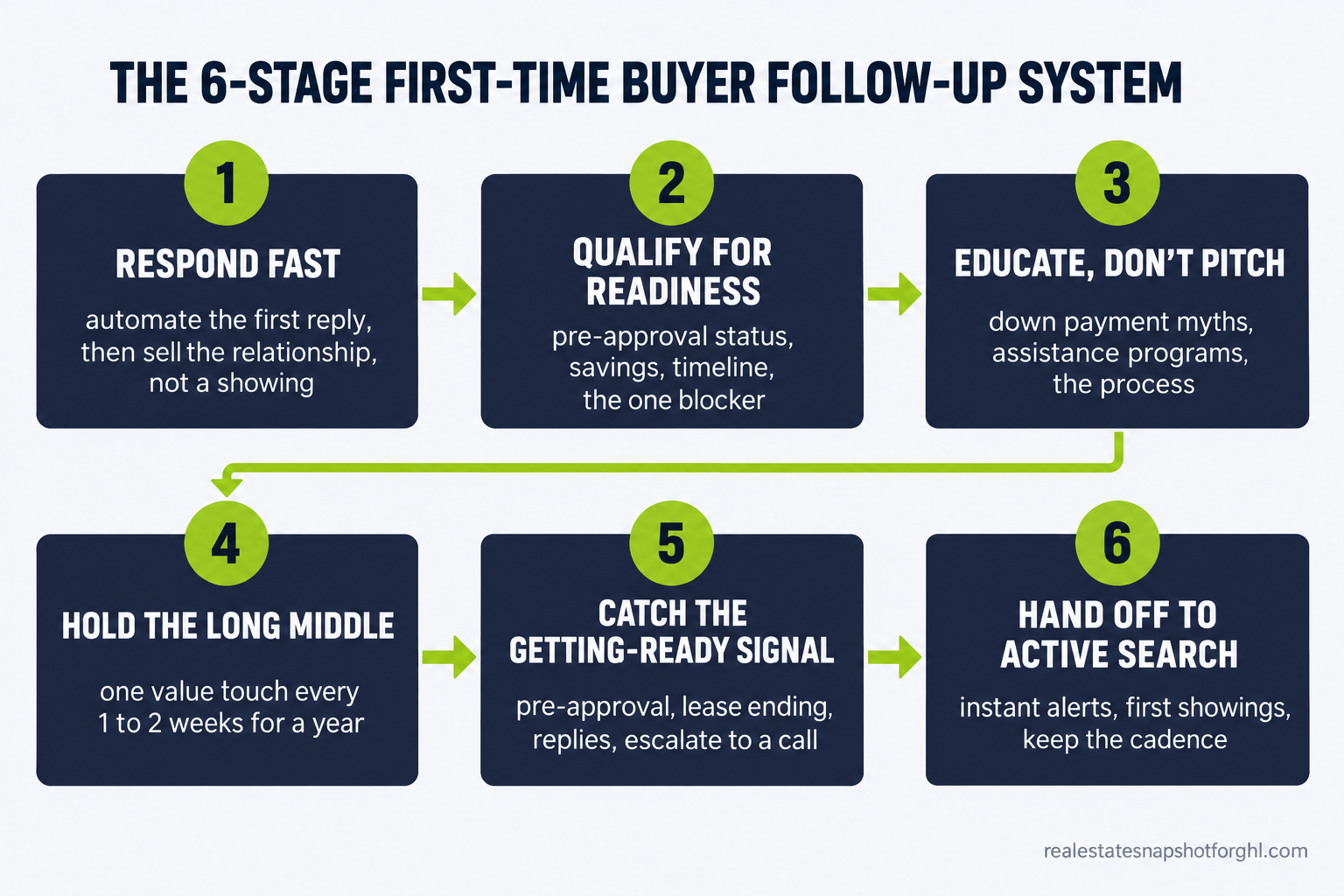
- The six-stage first-time buyer follow-up system
- Stage 1: Respond fast, then sell the relationship
- Stage 2: Qualify for readiness, not interest
- Stage 3: Educate instead of pitch
- Stage 4: Hold the long middle with a value cadence
- Stage 5: Catch the “getting ready” signal
- Stage 6: Hand off to an active search
- Steal this: the first-time buyer copy
- Run it for solo, team, and brokerage
- The compliance you cannot skip
- Objections
- Frequently asked questions
What a written-off first-time buyer actually costs you
A first-time buyer lead looks cheap to abandon because nothing is happening yet. The cost shows up a year later, when the buyer you forgot about closes with the agent who did not forget.
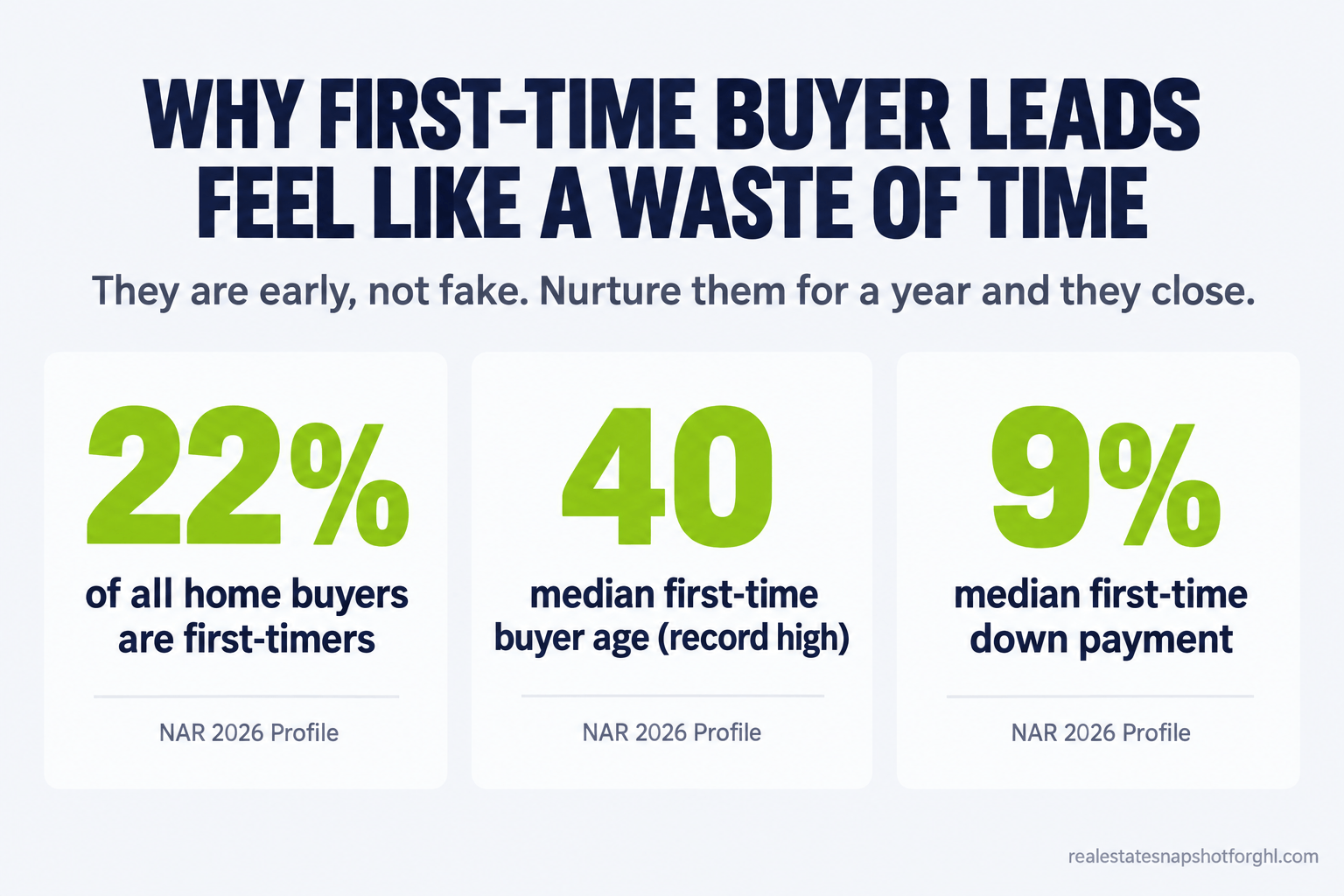
First-time buyers were 22% of all home buyers in 2026, up from a record-low 21% (NAR 2026 Profile), a smaller slice than the historical norm, so the ones who do buy are worth fighting for. They are also loyal once you earn them: 90% of buyers used an agent in 2026, the highest in four decades, and 88% would use that agent again or recommend them (NAR 2026 Profile). Walk a buyer through their scariest financial decision and they refer their whole circle. Write off the lead and you write off that referral tree.
The market rewards patience too. Sales ran at a 3.75 million annual rate in October 2026, down 8.8% year over year, median existing-home price $416,700 (NAR Existing-Home Sales), and the 30-year fixed sat near 7.1% in mid-November 2026 (Freddie Mac PMMS). At a 7% rate and a $416,700 median, a first-time buyer moves over months, and the patient agent is the one standing there at the end.
Why first-time buyer leads feel like a waste of time in 2026
These leads feel like a waste because you measure them on the wrong clock: you judge a lead by whether it becomes a showing this week, and a first-time buyer almost never does. The gut that files them under junk is wrong.
Two things make the 2026 first-time buyer slow on purpose. First, money. First-time buyers put down a median 9%, while repeat buyers put down 19%, and a quarter of first-timers leaned on a gift or loan from family and friends to do it (NAR 2026 Profile). Saving even 9% of a $400,000-range home while renting takes months. Second, nerves. The median first-time buyer is now 40, an all-time high (NAR 2026 Profile). They waited this long because the step feels enormous, and they will not be rushed by an agent chasing a showing.
Median down payment by buyer type, 2026. Source: NAR 2026 Profile.
The lead is not bad, it is early, and treating early like dead is the mistake. The rest is how you hold a year-out renter with light, useful contact instead of one hard push, without burning an hour a week per lead.
The six-stage first-time buyer follow-up system
Each stage closes one gap where a first-time buyer leaks out. Skip a stage and the buyer slips onto another agent’s board.
Two ways to work a first-time buyer lead
| The 'book a showing' reflex | The long-game system | |
|---|---|---|
| First move | Push for a showing | Book a buyer consultation |
| First goal | Get them in a car | Move them toward pre-approval |
| Main tool | 'Ready yet?' texts | A year-long value cadence |
| Month 12 | They close elsewhere | They close with you, then refer |
Stage 1: Respond fast, then sell the relationship
Speed still matters. In the widely cited lead-response research, contacting a web lead within five minutes instead of thirty made you roughly 100 times more likely to reach them and 21 times more likely to qualify them (lead response management study). You cannot hit that by hand at a showing, so automate the first reply and let the human call follow fast (speed-to-lead playbook). But for a first-time buyer, the goal of that first contact is a relationship, not a showing: book a short consultation, explain how you work, and promise to stay in touch.
How it breaks: you reply fast, then push for a Saturday showing. The buyer, nowhere near ready, hears pressure and ghosts. That is how a first-time lead dies in week one.
Stage 2: Qualify for readiness, not interest
Their interest is never the question. Their readiness is. The first conversation has to surface where they actually are, captured as structured CRM fields. Four things decide everything: have they talked to a lender, what are they saving toward a down payment, what is their honest timeline, and what is the one thing between them and a mortgage (credit, savings, a lease). That last answer sets the cadence. A pre-approved buyer saving hard gets a near-active track; one with a 590 credit score and no savings gets a twelve-month education track and a handoff to a lender who does credit repair.
How it breaks: you qualify for interest (“want to buy a house?”) instead of readiness (“been pre-approved?”). The useful question is what has to happen first. Clean tagging also keeps a CRM from becoming the junk drawer that swallows your follow-up.
Stage 3: Educate instead of pitch
This stage separates the agent a first-time buyer trusts from the one they block. They do not know what they do not know, and that scares them into waiting. Teach the three things every first-time buyer gets wrong. First, the down payment: most believe they need 20%, and the real first-time median is 9% (NAR 2026 Profile). Second, assistance: there were a record 2,833 homebuyer assistance programs nationwide in Q3 2026, many with no first-time requirement, per Down Payment Resource (HousingWire), and most buyers have never heard of the one in their county. Third, the process, which the Consumer Financial Protection Bureau lays out plainly and you can hand over as a checklist. Point them to a HUD-approved housing counselor when credit or budget is the blocker.
Down payment assistance programs nationwide grew every quarter in 2026 to a record 2,833. Source: Down Payment Resource, via HousingWire.
How it breaks: you lead with listings instead of lessons. A buyer scared of the money is not moved by a pretty kitchen. Education first, inventory second.
Stage 4: Hold the long middle with a value cadence
This is the stage nobody builds, and it is where first-time buyers go cold. For months there may be nothing to show them, so if your only reason to reach out is a new listing, you vanish for the stretch that matters most. The fix is a value cadence on a timer: one light, useful touch every week or two that is not “want to see a house.” Rotate the content so it never feels like a loop: a credit tip, a market note, a loan-type explainer, a local down payment program. None of it pushes. All of it says, “I am still here and making your purchase easier.” It is the same muscle as a good sphere nurture program and the long-horizon cousin of database reactivation.
How it breaks: the cadence turns into pressure. If every touch is “ready yet?” the buyer feels chased, so the timer delivers value, not demands. And drop a personal note every few weeks, because a pure drip is easy to smell.
Stage 5: Catch the “getting ready” signal
Somewhere in the long middle, a first-time buyer flips from someday to soon. The signals are small: they reply to your market note for the first time in months, mention a lease ending, or say they “finally talked to a lender.” Miss the flip and they find an agent who matches their new urgency. So build the triggers in. A buyer who opens three emails in a week or clicks a “get pre-approved” link should jump your queue and ping you to call. The highest-value trigger is a completed pre-approval: the day it lands, be on the phone within the hour.
How it breaks: the signal fires but routes nowhere. If a “getting ready” buyer gets the standard Tuesday newsletter instead of a call, the trigger was pointless. Escalation has to change what happens next, not just add a tag nobody sees.
Stage 6: Hand off to an active search
When the buyer is pre-approved and ready, the system changes gears but not hands. The relationship you spent a year building is the whole asset, so the handoff to an active search has to feel like one continuous conversation. Switch them onto instant listing alerts, book the first showings, and keep the human cadence going. From here the full buyer nurture system that keeps an active buyer from going quiet mid-search takes over, and everything you taught in Stage 3 pays off: a buyer who understands the process moves faster and wavers less.
How it breaks: you treat a ready buyer like a brand-new lead and re-ask everything you already know. Nothing kills a year of trust faster than “remind me, what is your budget?” The CRM should carry every answer forward.
Steal this: the first-time buyer copy
Paste these in and swap the bracketed bits. Each assumes the buyer opted in (see compliance). Keep them short and pressure-free.
Instant reply to a fresh inquiry (fires in seconds, before a human):
Hi [first_name], this is [agent] with [team]. Thanks for reaching out about buying in [area]. No rush at all, first-time buying should not feel rushed. Can I grab 15 minutes to learn where you are and map out the steps? Free [today 5pm] or [tomorrow AM]?
Education touch, down payment myth (Stage 4):
Quick myth-buster, [first_name]: most first-time buyers put down about 9%, not 20%. There are also 2,800-plus down payment assistance programs out there right now. Want me to check which ones work in [county]?
Value cadence, market note (Stage 4, rotating):
Morning [first_name], quick note on [neighborhood]: [three homes in your range sold this month, median around $X]. Nothing to do, just keeping you in the loop. How is the [saving / credit] going?
Getting-ready trigger, pre-approval (Stage 5):
This is huge, [first_name], congrats on the pre-approval! That is the hard part done. Want to grab a call this week and line up the first homes to see? We can move as fast or slow as you like.
Each message names the person, references their real situation, and ends with a low-pressure question. That is the difference between a touch they answer and a blast they mute.
Run it for a solo agent, a small team, and a growing brokerage
The six stages do not change. Who runs the human parts does.
The solo agent. First-time buyers are where your busy weeks do the most damage, because the payoff is a year out. Let automation carry Stages 1, 3, and 4 so the instant reply, education, and value cadence fire without you. Your job is the consultation, the call when Stage 5 trips, and a personal note every few weeks.
The small team of three to eight. The risk is a buyer falling between the agent who took the call and whoever is covering. Standardize one first-time buyer track and put one person, often an ops lead or a GoHighLevel virtual assistant, in charge of tagging and routing each new buyer the day they arrive. The shared win is a team-wide “getting ready” alert.
The growing brokerage. At fifteen-plus agents, the goal is consistency across very different habits. Centralize the templates, education, and compliance settings, and make “percent of first-time buyers in a live nurture track” a number the team lead watches. Our real estate CRM software cost breakdown shows what the per-seat platforms charge once you add agents.
The compliance you cannot skip
A year-long automated cadence to not-yet-clients is the kind of marketing that gets agents in trouble, so build it on consent from day one. None of this is legal advice.
- Texting consent and A2P 10DLC. Get explicit opt-in before you text, honor every STOP, and register under A2P 10DLC so messages deliver. Our real estate SMS compliance guide covers setup, and the FCC’s TCPA rules are the federal backstop.
- Calling rules. If you call leads, scrub against the National Do Not Call Registry and keep your own internal list current.
- Fair Housing. Keep everything you send and every audience you target neutral. When you advertise for first-time buyers, Meta’s special ad category restricts housing targeting, as our guide to Fair Housing-compliant Facebook ads explains, and HUD enforces the Fair Housing Act.
- Lender and down payment partners. If you co-market with a loan officer, do not trade referrals for anything of value. That is RESPA Section 8 territory, where well-meaning agents break federal law.
Objections
“First-time buyers never actually buy, they just waste my time.” Some stall out, so you automate the holding pattern instead of spending live hours on it. The ones who do buy are a loyal, referral-heavy 22% of the market who used an agent 90% of the time (NAR 2026 Profile). You are betting a few minutes of automation on a pool of future closings.
“I already pay for Follow Up Boss (or a portal CRM). Why do I need this?” Most lead tools route and remind, they do not run a patient, year-long, education-led sequence on their own. If yours does, build this inside it. If you find yourself manually nudging first-time buyers, that is the gap this closes, the same gap behind why so many leads never convert.
“Won’t a year of messages annoy them?” Only if the messages are about you. A useful tip and a check-in that respects their timeline is the opposite of a pushy weekly “ready yet?”, and it is why 88% of buyers would recommend their agent (NAR 2026 Profile). Value-first does not burn a list, pressure does.
“Do I need to be technical to run this?” No. With a done-for-you system the triggers, tags, and sequences are already built. You handle the conversations, the software handles the memory and timing.
Frequently asked questions
How long should I nurture a first-time buyer lead before giving up?
Plan for six to eighteen months, not six weeks. First-time buyers put down a median of 9% and the median buyer is now 40, so getting mortgage-ready takes time. A light automated cadence lets you stay with them for a year at almost no cost, so you never have to 'give up' the way manual follow-up forces you to.
What is the single most important first step with a first-time buyer?
Move them toward a lender and a pre-approval, not a showing. Pre-approval turns a someday buyer into a soon buyer and surfaces the real blocker (credit, savings, debt) so you build the right follow-up plan instead of guessing.
How often should I contact a not-yet-ready first-time buyer?
One light, useful touch every one to two weeks, rotating between education, a market note, and a personal check-in. It should almost never be 'want to see a house.' Make their eventual purchase easier and you stay welcome in their inbox for a year.
Should I spend money on first-time buyer leads if they take so long to close?
Yes, but judge them on a longer clock and only if you have a system to hold them. A first-time buyer lead with no nurture behind it is wasted money. The same lead inside a year-long education cadence is one of the cheapest closings you can buy, because you paid once and the follow-up runs itself.
How do I teach first-time buyers about down payments without giving financial advice?
Share published facts and point to authoritative sources, not personalized advice. Tell them the median first-time down payment is 9% and that thousands of assistance programs exist, then send them to the CFPB homebuying guide and a HUD-approved housing counselor. For anything specific to their finances, hand them to a licensed lender.
So picture that Sunday-night lead again, the renter who is “maybe buying next year.” A year later a text lands: “Just got pre-approved, like you said. Ready to start looking.” It is from them, because you were the agent who taught them how instead of the one who pushed and disappeared. That is what the long game buys you, and it runs on a system, not your memory. If you would rather have it installed, the first-time buyer follow-up system is prebuilt and live in your account in about 24 hours.