Yes — but the real decision for a Raleigh agent in 2026 is not “website or no website.” It is “own your platform or rent it.” Zillow, Realtor.com, and Instagram already command the traffic, so plenty of Triangle agents quietly wonder whether their own site still earns its keep. The honest answer: a stale brochure site does almost nothing, but an owned, fast, IDX-enabled site that captures and follows up on leads is the one piece of your marketing you actually control — while every portal and social feed is an audience you are renting on someone else’s terms. This post breaks down the trade-off with real numbers so you can decide where your money and time should go.
Table of contents
- The real question: own your platform or rent it
- Where Raleigh home buyers actually start
- Renting your presence: portals and social
- Owning your presence: your own IDX website
- Owned vs rented, side by side
- Why most agent websites get zero leads
- Speed is the tiebreaker
- What a done-for-you Raleigh site looks like
- Frequently asked questions
- The bottom line for Raleigh agents
The real question: own your platform or rent it
Ask “do I need a website?” and you’ll get a decade of contradictory advice. Reframe it as “do I want a marketing channel I own, or ones I rent?” and the decision gets clear.
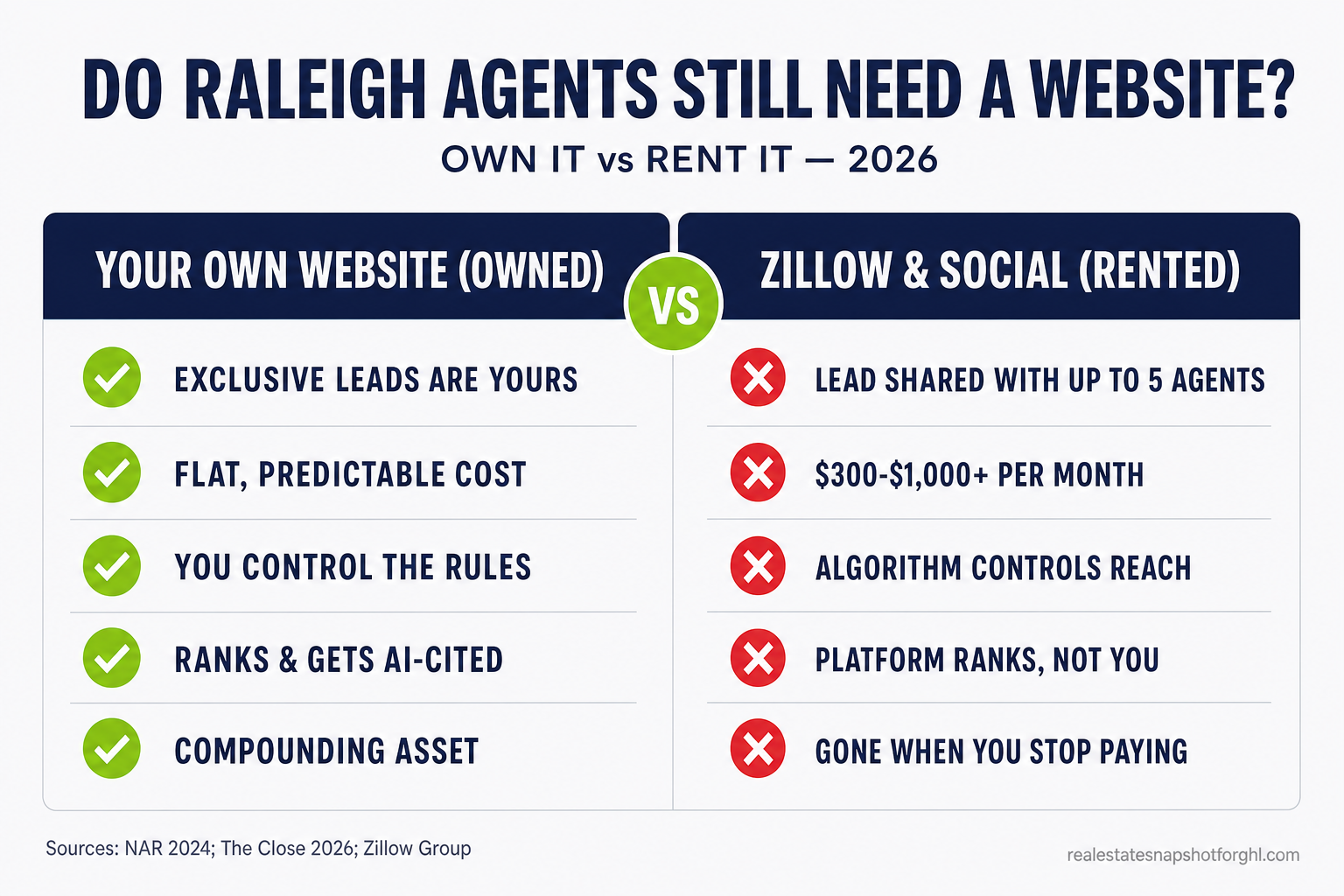
Renting means Zillow, Realtor.com, Homes.com, Instagram, and Facebook. They have enormous reach, and they’ll gladly send you buyers — for a monthly fee, or in exchange for content that lives on their platform under their rules. The moment they change pricing, tweak the algorithm, or route your lead to a competitor, there is nothing you can do about it.
Owning means a website, an email list, and a CRM that are yours. The traffic is smaller at first, but the asset compounds, the rules don’t change under you, and every lead is exclusively yours. In a market as crowded as the Triangle — the Raleigh Regional Association of REALTORS® represents more than 10,000 members, part of roughly 54,000 REALTORS® statewide (NC REALTORS®) — the agents who own a distinct, findable presence are the ones who stop competing purely on who paid Zillow the most this month.
This isn’t either/or in practice. Most successful Raleigh agents rent reach and own an asset. The mistake is renting only — pouring every dollar into portal leads while your own site sits stale, so you never build anything that’s actually yours.
Where Raleigh home buyers actually start
The data is unambiguous: the search begins online. All buyers (100%) use the internet during their home search, and 43% say their first step was looking at properties online, versus just 21% who started by contacting an agent (NAR, 2024).
Here’s the catch that makes your own presence decisive: buyers and sellers rarely shop around for the agent. 81% of sellers contact only one agent before choosing who lists their home (NAR, 2024), and most buyers interview just one too. So the online search doesn’t only decide which house — it heavily shapes which agent gets that single call. When a past client refers you and the prospect Googles your name, what they find (a sharp owned site, or a dated portal profile you share with three competitors) is the moment the relationship is won or lost.
Renting your presence: portals and social
There’s no denying the reach. Zillow Group averaged roughly 221 million monthly unique users and 2.1 billion visits in Q4 2025 (Zillow Group), and Zillow alone accounts for more than half of all U.S. real estate website visits (Statista, 2025). Social is a real lead source too: in NAR’s technology survey, social media was the top tech source of quality leads for 39% of members (NAR, 2025).
But look at what “renting” actually means once you read the terms:
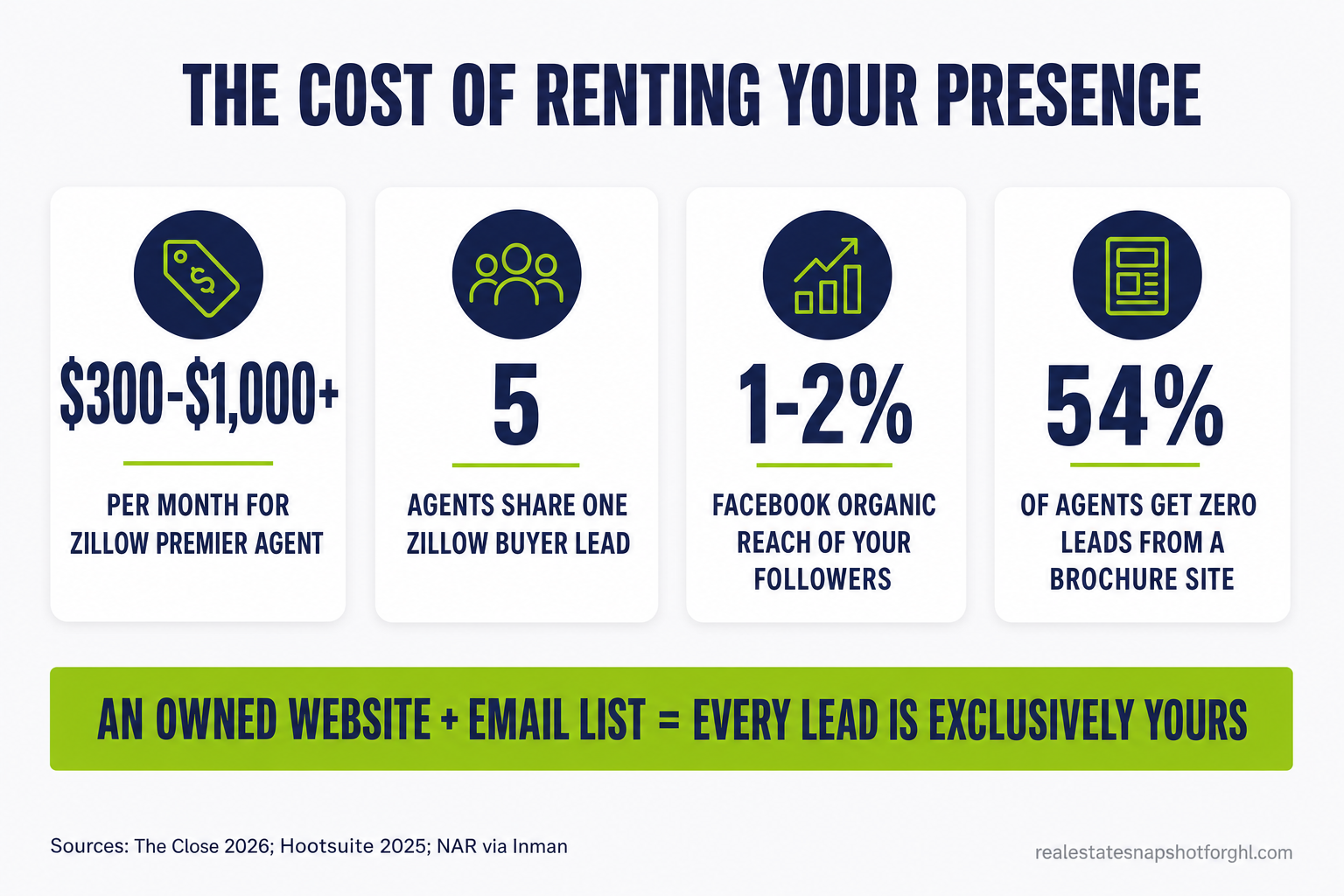
- You pay per lead, and you share it. Zillow Premier Agent commonly costs $300–$500/month in smaller markets and $1,000+ in competitive metros, and Zillow’s own materials describe routing a single buyer to up to five agents (The Close, 2026). You’re buying a contact that four competitors may also be calling.
- The audience isn’t yours. Organic social reach has collapsed — a typical Facebook post now reaches only about 1–2% of your followers and Instagram roughly 2–4% (Hootsuite, 2025). You built the following; the platform decides who sees you, and increasingly the answer is “almost no one, unless you pay.”
- The rules change without you. Pricing, lead routing, and ranking are all controlled by the platform. A profile you don’t own can be de-prioritized, re-priced, or discontinued, and your “pipeline” evaporates with it.
Renting has its place — it buys reach fast while you build. The danger is treating it as your whole strategy. Rent forever and you never own anything; the day you stop paying, you go dark.
Owning your presence: your own IDX website
An owned site flips every one of those downsides. The lead is exclusively yours, the follow-up runs on your terms, and the asset appreciates as your content and local authority accumulate. Concretely, a Raleigh agent’s own site does four things a portal profile can’t:
- Captures exclusive leads. IDX search, home-valuation tools, and neighborhood pages turn a visitor into a contact in your CRM — not a shared Zillow queue. Done right, this is where your IDX lead capture and seller-lead funnels live.
- Ranks for the searches you care about. A page written specifically for “North Hills condos” or “Cary first-time buyers” is how a local agent outranks a national portal for a specific area — the core of local SEO for real estate.
- Gets you cited by AI search. Clean schema and structured content let ChatGPT and Google’s AI Overviews surface your name when someone asks for a Raleigh expert — the emerging channel we cover in the real estate AEO playbook.
- Builds a first-party audience. Every enquiry feeds an email list and CRM you own outright — the audience no algorithm can throttle.
The honest caveat, which most “you need a website” pitches skip: owning a site only pays off if it actually works. Which is exactly where most agents go wrong.
Owned vs rented, side by side
Your own IDX website vs renting portals & social
| Your own website (owned) | Portals & social (rented) | |
|---|---|---|
| Who owns the lead | Exclusively you | Shared — up to 5 agents per Zillow buyer |
| Ongoing cost | Flat monthly, predictable | $300–$1,000+/mo per portal, rising in hot markets |
| Audience control | Your list, your CRM | Algorithm decides reach (~1–4% organic) |
| Rules & pricing | Stable — you set them | Change anytime, without your input |
| Local SEO & AI citations | You rank and get cited | The platform ranks, not you |
| Long-term value | Compounding asset | Disappears when you stop paying |
| Speed to first lead | Slower to build | Fast — you're buying reach |
The pattern is clear: renting wins on speed-to-reach, owning wins on everything that compounds. The right answer for most Raleigh agents is to rent selectively for near-term volume while building the owned asset that makes you less dependent on rent every year.
Why most agent websites get zero leads
Here’s the statistic that should stop the naive “just build a website” advice cold: in NAR’s data, 54% of agents reported getting zero leads from their personal website, and only 2% got more than 100 a year (NAR via Inman). A website is not automatically an asset. A brochure — a pretty page with your headshot, a bio, and a contact form nobody fills out — is a business card that happens to be online.
The difference between a brochure and a lead engine comes down to a few things the average agent site is missing:
- Live IDX search. Buyers want to browse listings on your site, not bounce to Zillow. No IDX, no reason to stay.
- A real capture offer. A home-valuation tool for sellers, saved-search alerts for buyers, a neighborhood guide — something worth trading an email for. General landing pages convert at a median of about 2.6% and up to 7.4% when they’re built for one job (Landingi, 2024); a plain “Contact Us” page converts near zero.
- Instant follow-up. A form that emails an inbox you check Friday is a lead lost. The average company takes 42 hours to respond to a web lead and 23% never respond at all (HBR, 2011) — a gap an AI chatbot and automated speed-to-lead sequence close in seconds.
- Speed and structure. If it’s slow or invisible to search, none of the above matters.
Own a brochure and the skeptics are right — it does nothing. Own a lead engine and it becomes the most valuable channel you have.
Speed is the tiebreaker
Whatever you build, performance decides whether it converts. 53% of mobile visitors abandon a page that takes longer than 3 seconds to load (Google, 2016), and Deloitte’s Milliseconds Make Millions study found that improving load time by just 0.1 seconds lifted retail conversions by 8.4% (Deloitte/Google). Google also treats Core Web Vitals as a page-experience ranking signal (Google Search Central), so a slow site loses on both fronts — it ranks worse and converts worse.
Speed compounds with follow-up. A lead contacted within five minutes is 21× more likely to qualify than one contacted after 30 (MIT/InsideSales). A fast site that captures the lead and an automation that responds instantly is the whole game — which is why we build on a static-first stack and wire every form to immediate follow-up. If you want the platform-by-platform breakdown, see our comparison of the fastest real estate website platforms and the speed-to-lead playbook.
What a done-for-you Raleigh site looks like
You don’t need to become a web developer to own the asset. A done-for-you build gives you the lead-engine version from day one: a fast, static-first site with live IDX search, neighborhood pages for the Triangle areas you farm, a seller net-proceeds estimator, an AI chat widget that answers buyers day and night, and every enquiry pushed straight into a CRM with automated follow-up already running. It’s guaranteed to score 90+ on Google PageSpeed and ships with the schema and llms.txt that get you found by Google and cited by AI answer engines — the same prebuilt website foundation the Real Estate Snapshot is built on.
Frequently asked questions
Do Raleigh real estate agents still need a website in 2026?
Yes — but the useful question is whether you own your marketing or rent it. Portals and social have the reach, yet 100% of buyers use the internet and 81% of sellers contact only one agent (NAR, 2024). Your own IDX site is the only channel where every lead is exclusively yours and the rules can't change under you. A stale brochure site, though, does little — it has to be fast, IDX-connected, and wired to instant follow-up to pay off.
Isn't Zillow enough on its own?
Zillow has unmatched reach — roughly 221M monthly unique users (Zillow Group) — but Premier Agent commonly costs $300–$1,000+ per month and can route one buyer to up to five agents (The Close, 2026). You're renting shared leads. It works as a reach channel, but it builds Zillow's asset, not yours.
Why do so many agent websites get zero leads?
Because most are brochures, not lead engines — 54% of agents got zero leads from their personal site (NAR via Inman). The ones that convert have live IDX search, a real capture offer (home valuation, saved searches, neighborhood guides), instant automated follow-up, and fast load times. Missing any of those and the site just sits there.
Should I invest in my own site or spend on portal leads?
For most Raleigh agents, both — but with a plan to shift the balance. Rent portal reach for near-term volume while you build the owned site, email list, and CRM that make you less dependent on rent each year. Owning is the compounding asset; renting is the fast, expensive top-up.
How fast does a real estate website need to be?
Fast enough that buyers don't leave: 53% abandon a mobile page that takes over 3 seconds (Google, 2016), and Core Web Vitals are a Google ranking signal (Google Search Central). We build static-first sites that target 90+ PageSpeed on mobile and desktop, because a slow site both ranks and converts worse.
The bottom line for Raleigh agents
Do you still need a website? Yes — reframed correctly. Portals and social are worth renting for reach, but they are audiences you don’t own, priced and ranked by someone else, shared with your competitors. Your own fast, IDX-enabled, lead-capturing site is the single marketing asset that’s exclusively yours and compounds over time. Build a brochure and the skeptics are right that it does nothing. Build a lead engine — fast, findable, and connected to instant follow-up — and it becomes the channel that makes every other one optional. In a market with 10,000+ Triangle agents competing for the same buyers, owning that asset is how you stop competing on who paid Zillow the most this month.
If you’d rather skip the build and own the lead-engine version from day one, that’s exactly what we do at Get a Website — or book a walkthrough and we’ll show you what an owned Raleigh site looks like against the leads you’re renting now.
About the author. Grant Whitlock is a Real Estate Automation Strategist who spent nine years running operations for a residential sales team before designing the workflows behind Real Estate Snapshot. He writes about speed-to-lead, IDX lead capture, and the unglamorous follow-through that keeps a pipeline moving. Grant is a fictional editorial persona created for voice, not a licensed agent or broker, and nothing here is real estate, legal, or investment advice.
Related posts
- Fastest Real Estate Website Platform for Miami Agents: Astro vs WordPress, Wix & GoHighLevel
- IDX Lead Capture That Actually Converts (Not Just Captures)
- Local SEO for Real Estate Agents: The 2026 Google Business Profile Playbook
- How Philadelphia Real Estate Agents Get Cited by ChatGPT & Google AI Overviews
- Speed-to-Lead for Realtors: Why 5 Minutes Decides Half Your Year