

For a Philadelphia real estate agent, getting cited by ChatGPT and Google’s AI Overview is now a structuring problem, not a luck problem. AI answer engines pick the sources they can lift a clean, self-contained answer from — so the agents who win are the ones whose site opens each page with a direct answer, marks it up with the right schema, backs every claim with a cited number, and publishes real Philadelphia neighborhood pages the model can quote. Do that, and when a South Philly buyer asks “who’s a good listing agent in Passyunk Square,” an AI engine has something concrete to hand them. Skip it, and the model quietly recommends the three agents who did the work.
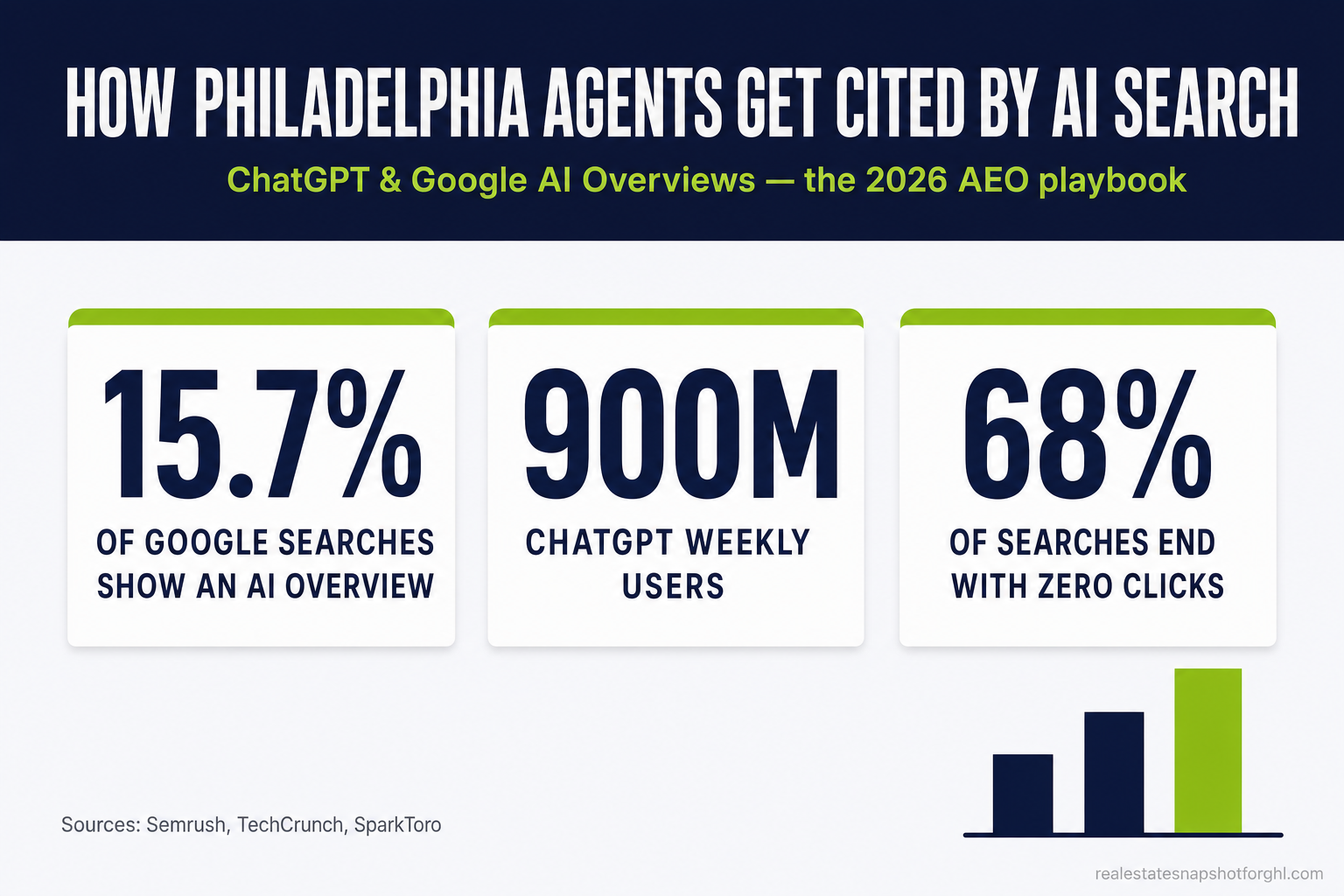
This matters more every quarter because the search your buyers actually do has changed. AI Overviews now appear on roughly 15.7% of Google searches (Semrush, via Search Engine Land, 2025), ChatGPT crossed 900 million weekly active users in early 2026 (TechCrunch, 2026), and 68% of U.S. Google searches now end without a single click to the open web (SparkToro / Similarweb, 2026). The old game — rank #1 and collect the click — is being replaced by a new one: be the source the answer is built from. This is the playbook for winning it in Philadelphia.
Table of contents
- Why AI search decides who a Philadelphia buyer calls
- AEO vs GEO vs SEO: what actually changed
- The click is collapsing — the data
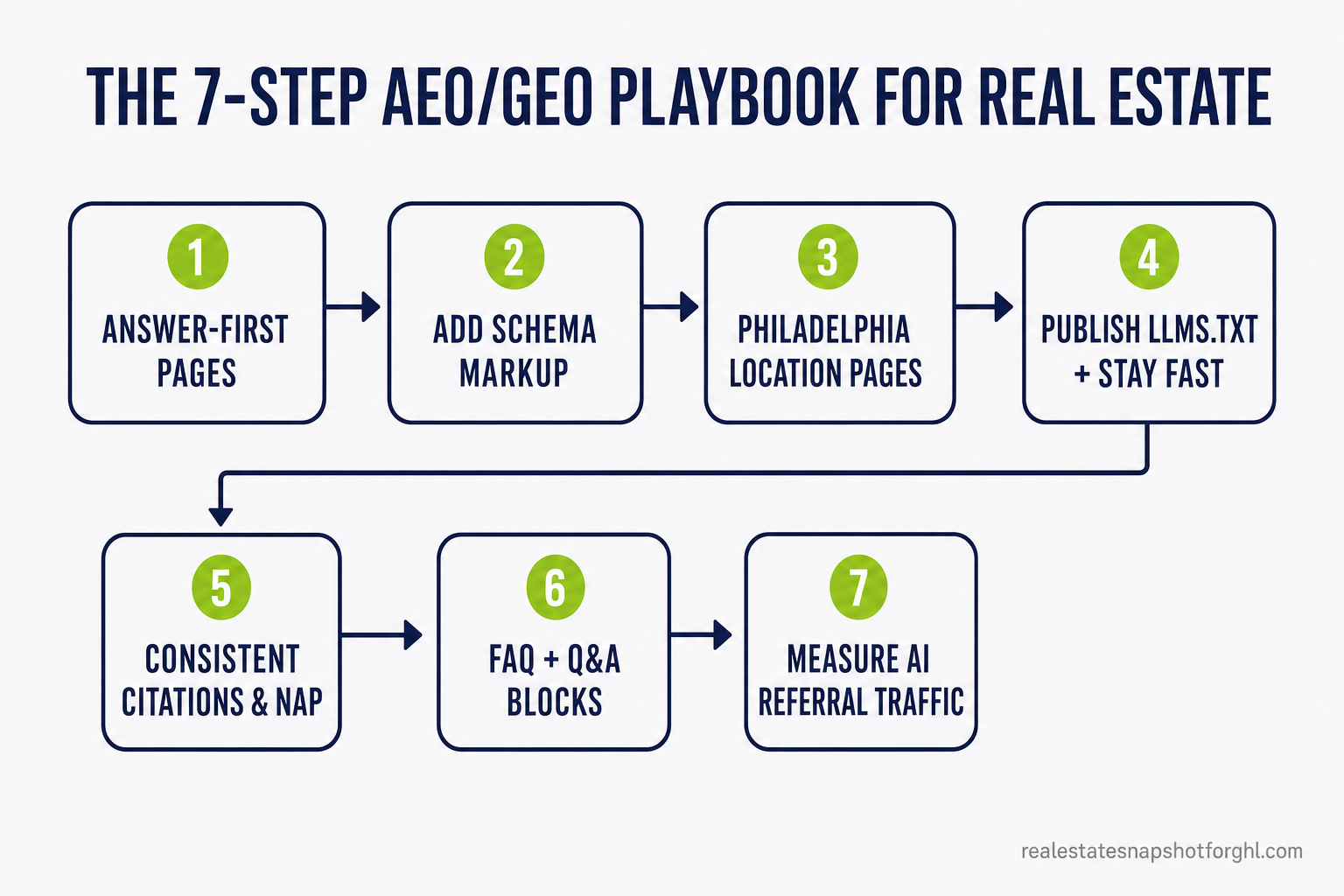
- The 7-step AEO/GEO playbook for Philadelphia agents
- Why structured data still wins the click, too
- What this looks like done-for-you
- Frequently asked questions
Why AI search decides who a Philadelphia buyer calls
Philadelphia is a search-first market. As of early 2026 the city’s median sale price sits near $275,000, homes take about 52 days to sell, and listings draw roughly two offers — a market Redfin rates “somewhat competitive” (Redfin, 2026). In a market that measured, buyers and sellers do their homework online long before they dial. NAR’s data has been consistent for years: 97% of buyers use the internet in their home search, and 52% found the home they purchased online (NAR, 2025).
What’s new is where that online research happens. A growing share of it never reaches a blue link. Instead a buyer types “best neighborhoods in Philadelphia for first-time buyers” or “how much is my Fishtown rowhome worth” into Google or ChatGPT and reads the answer the machine assembles. That answer is stitched together from a handful of sources the engine trusts — and being one of them is the whole game.
Here’s the reassuring part, and it’s important for a busy agent to hear: AI search does not replace you — it front-loads the shortlist. NAR still finds agents are the resource buyers rate most useful in the whole process (~85%) (NAR, 2025). The human work — the showing, the negotiation, the read on a block — is exactly what automation can’t touch. What AI search decides is a narrower, earlier thing: whose name is in the answer when the buyer asks the machine who to trust. That is a content-and-structure problem, and it is fixable.
AEO vs GEO vs SEO: what actually changed
Three acronyms, one goal — get found. The differences are worth 60 seconds because they change how you write a page.
SEO vs AEO vs GEO — the practical difference
| What it optimizes for | What you actually do | |
|---|---|---|
| SEO (Search Engine Optimization) | Ranking a page in the classic blue-link results | Keywords, backlinks, page speed, titles & meta |
| AEO (Answer Engine Optimization) | Being the source a direct answer is lifted from — AI Overviews, featured snippets, voice | Answer-first passages, FAQ schema, clean Q&A blocks |
| GEO (Generative Engine Optimization) | Being cited inside ChatGPT / Perplexity / Gemini answers | Cite sources, add statistics & quotes, entity clarity, llms.txt |
They stack rather than compete. A page built the right way ranks in classic search (SEO), earns the AI Overview citation (AEO), and gets pulled into a ChatGPT answer (GEO) — because all three engines reward the same underlying thing: a page that states a clear answer, proves it, and is easy for a machine to parse. The rest of this playbook is how to build that page for a Philadelphia audience.
The click is collapsing — the data
Before the how-to, look at why this is urgent. The share of searches that end without a click has climbed for years, and AI summaries accelerated it. In 2019 roughly half of U.S. Google searches ended without a click; by 2026 it’s more than two-thirds.
The AI Overview is the sharp edge of that trend. Pew watched the real browsing of 900 U.S. adults and found that when an AI summary appeared, people clicked a traditional search result on only 8% of those pages, versus 15% when no summary was shown — and a mere 1% clicked a link inside the summary itself (Pew Research, 2025). Seer Interactive measured the same collapse from the SEO side: organic click-through on queries with an AI Overview fell about 61%, from 1.76% to 0.61% (Seer, 2025).
If your traffic strategy is “rank and wait for the click,” that strategy is shrinking every quarter. The counter-move is to be inside the answer — and there’s an upside: AI engines send real, high-intent traffic when they do cite you. AI referral sessions to the web grew roughly 527% between January and May 2025 (Similarweb, via Digiday, 2025), with ChatGPT driving the large majority of trackable LLM referrals (Semrush, via Search Engine Land, 2025). A citation in an AI answer is the new front-page ranking.
The 7-step AEO/GEO playbook for Philadelphia agents
Here is the exact sequence we use to make a real estate site quotable by AI engines. Work it top to bottom — each step compounds the last.
Step 1 — Lead every page with the answer
AI engines lift the first self-contained sentence that directly answers the query. So write it for them. Open each page with a one- or two-sentence direct answer in plain language, then support it. A Fishtown valuation page should start with “As of early 2026, Fishtown homes sell for a median of roughly $X in about Y days,” not three paragraphs of scene-setting. Princeton’s GEO research is blunt about why this works: pages that cite sources, add statistics, and include quotations saw visibility in generative answers rise by up to ~40% (Aggarwal et al., 2024). Answer first, prove it with a number, name your source.
Step 2 — Mark it up with the right schema
Structured data is how you hand a machine the facts in a format it can’t misread. For a real estate site, the load-bearing types are RealEstateAgent / LocalBusiness (your name, service area, phone, hours), FAQPage (your Q&A blocks), Article / BlogPosting (your guides), and BreadcrumbList. This isn’t optional polish — Google’s own case studies credit structured data with +25% CTR for Rotten Tomatoes and +82% CTR for Nestlé (Google Search Central). Our prebuilt real estate website ships this schema on every page by default, which is the fastest way to get it right without hand-coding JSON-LD.
Step 3 — Build real Philadelphia location & neighborhood pages
Generic “we serve Philadelphia” copy gives an AI engine nothing to quote. Specific pages do. Build a page for each area you actually work — Fishtown, Passyunk Square, Northern Liberties, Manayunk, Roxborough, Point Breeze, Chestnut Hill — each answering the questions a local buyer or seller actually asks: price trends, days on market, school notes, the commute, the vibe. This is classic local SEO turned toward AI: the same signals that rank you also make you citable for “best agent in [neighborhood]” prompts. (For the fundamentals, see our guide to local SEO for real estate agents.)
Step 4 — Publish an llms.txt and keep the site fast & crawlable
AI crawlers have to be able to read you. Two mechanics matter: an llms.txt file that lists your key pages in a clean, machine-readable index, and a genuinely fast, static-first site so crawlers (and buyers) aren’t waiting on heavy JavaScript. Page speed is doing double duty here — it’s a Google ranking factor and a crawl-budget factor. This is exactly where a static Astro build pulls ahead of a plugin-heavy WordPress or Wix site; we broke down the speed gap in Astro vs WordPress, Wix & GoHighLevel. Fast, crawlable, and indexed is the price of admission to being cited at all.
Step 5 — Earn consistent citations and keep your NAP identical everywhere
Generative engines cross-check entities. If your Name, Address, Phone (NAP) is identical across your site, Google Business Profile, Zillow, Realtor.com, and Bright MLS, the model gains confidence you’re a real, consistent Philadelphia agent — and confident entities get recommended. Inconsistent listings do the opposite: they introduce doubt, and doubt loses the citation. Claim and complete every profile, match the details exactly, and keep your Google Business Profile active with fresh posts and reviews.
Step 6 — Add FAQ and Q&A blocks to every important page
The question-and-answer format is the native shape of an AI answer, which makes FAQ content disproportionately citable. Add a real FAQ to your neighborhood pages, your listing pages, and your service pages — genuine questions (“Do I need a 20% down payment to buy in Philadelphia?”), answered in two to four tight sentences, marked up with FAQPage schema. A site-wide AI chat widget does the same job in real time, answering buyer questions on the page and capturing the lead; ours is covered in the real estate chatbot playbook.
Step 7 — Measure AI referral traffic, then double down
You can’t improve what you don’t watch. In Google Analytics, build a segment for referrals from chatgpt.com, perplexity.ai, gemini.google.com, and Bing Copilot, and track which pages earn AI citations. Then feed the winners: the page formats that get cited are the templates for your next neighborhood pages. AEO/GEO isn’t a one-time setup — it’s a loop, and the agents who run the loop pull further ahead every month.
Why structured data still wins the click, too
Worried this is all upside for the machines and none for you? It isn’t. Even setting AI aside, the same structure that earns citations earns clicks in classic search — because rich results stand out. Google’s published case studies make the dollars-and-cents case plainly.
Add it up and the strategy is refreshingly non-speculative: the exact same work — answer-first pages, schema, FAQs, a fast site — earns you AI citations, richer classic-search listings, and a higher click-through when a click is available. You are not betting on one channel. You are building the one asset every channel rewards.
What this looks like done-for-you
None of these seven steps is exotic, but together they are a build project: JSON-LD schema across every template, a fast static site, an llms.txt, and a set of genuine Philadelphia neighborhood pages that answer real questions. Most agents don’t have the hours — and shouldn’t. Your edge is showings and negotiation, not hand-writing structured data.
That’s what our Get a Real Estate Website service is built for: a blazing-fast Astro site with a guaranteed 90+ PageSpeed, schema/AEO/GEO baked into every page, location pages, a built-in AI chat widget, free domain, and managed hosting — $497 one-time + $97/month, live in about 10 working days. Add automatic blogging for $197/month total and we publish two AI-search-optimized posts a week around your Philadelphia market, keeping the citation engine fed. It’s the whole playbook above, installed and maintained for you.
Prefer the full automation system behind it — CRM, speed-to-lead, sphere nurture, and the AI chatbot together? That’s the Real Estate Snapshot, and it starts on the pricing page. Either way, the point is the same: in 2026, the agent the machine recommends is the one whose site was built to be quoted.
Frequently asked questions
Philadelphia real estate AEO & GEO — FAQ
What is AEO, and how is it different from SEO?
AEO (Answer Engine Optimization) is the practice of structuring content so an AI answer engine — Google's AI Overview, ChatGPT, Perplexity — can lift a clean, direct answer from your page and cite you. Classic SEO optimizes to rank a blue link; AEO optimizes to be the source the answer is built from. In 2026 both matter, because AI Overviews now appear on roughly 15.7% of Google searches and most searches end without a click.
How do I get my Philadelphia real estate website cited by ChatGPT?
Lead each page with a direct, self-contained answer; back claims with cited statistics and quotations (Princeton's GEO study found this can lift AI visibility by up to ~40%); add RealEstateAgent, FAQPage, and Article schema; build specific Philadelphia neighborhood pages; publish an llms.txt; keep your NAP identical across Google Business Profile, Zillow and Bright MLS; and keep the site fast and crawlable. Consistency and structure are what earn the citation.
Does schema markup really help with AI search?
Yes — structured data hands machines your facts in a format they can't misread, which helps both AI engines and classic rich results. Google's own case studies credit structured data with 25% higher CTR for Rotten Tomatoes and 82% higher CTR for Nestlé. For a real estate site, RealEstateAgent/LocalBusiness, FAQPage, Article and BreadcrumbList are the types that matter most.
Is AI search going to replace real estate agents?
No. AI search changes where the shortlist forms, not who closes the deal. NAR's 2025 data still finds agents are the resource buyers rate most useful in the entire process (~85%), even though 97% of buyers research online first. AI decides whose name is in the answer; the agent still does the showing, the negotiation, and the local read a model can't.
What is an llms.txt file and do I need one?
An llms.txt is a plain-text file at the root of your site that gives AI crawlers a clean, machine-readable index of your most important pages — think of it as a sitemap written for language models. It doesn't guarantee citations, but it makes your best content easy for AI engines to find and parse, which removes friction from the process. Sites we build include one automatically.
How much does an AEO-ready real estate website cost?
Our Get a Website service is $497 one-time plus $97/month, which includes a 90+ PageSpeed Astro build, schema/AEO/GEO on every page, Philadelphia location pages, an AI chat widget, free domain, and managed hosting. Adding automatic AI-search-optimized blogging is $197/month total. You pay only the monthly up front; the one-time fee is charged after the site is live and you're happy.
About the author: Devin Callahan is the GHL Implementation Lead behind Real Estate Snapshot. He has installed automation and website systems for solo agents and 40-seat brokerages alike, and cares most about the parts clients never see — clean schema, sane structure, and sites fast enough for both buyers and AI crawlers. Devin is a fictional editorial persona created for Real Estate Snapshot; his playbooks reflect real implementation practice, not the record of a specific individual.