

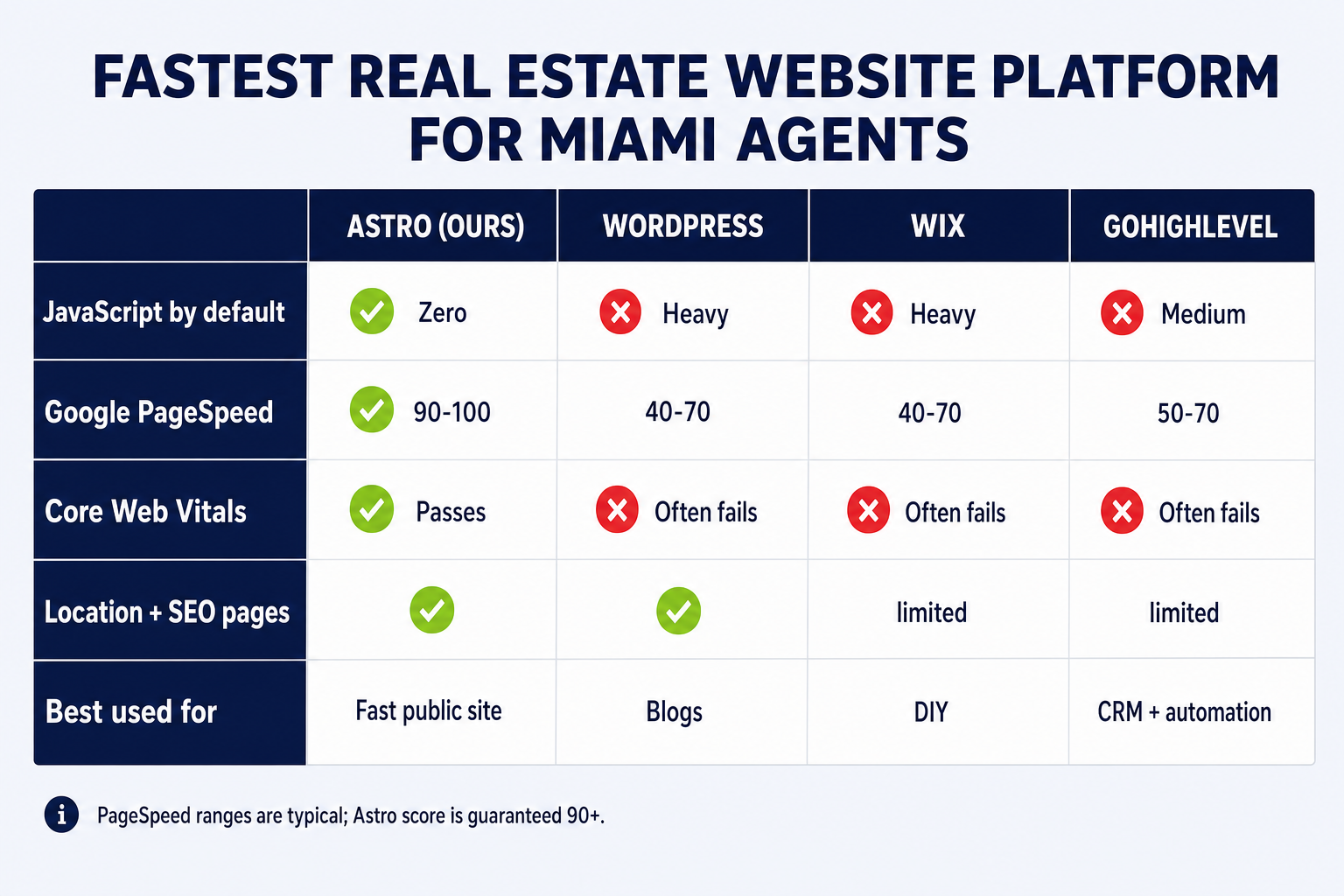
For a Miami real estate agent, the fastest, most SEO-ready website platform is a static-first build on the Astro framework — it ships virtually no JavaScript by default, so pages open in a blink on the phones your buyers actually use. WordPress, Wix, and GoHighLevel-built sites all carry more overhead — plugins, page-builder code, and a heavier runtime — which is why they typically land in the 40–70 range on Google PageSpeed while a well-built Astro site scores 90–100. That gap is not cosmetic. In a market where 53% of mobile visitors abandon a page that takes longer than three seconds to load (Google/DoubleClick, 2016), the platform under your site quietly decides how many searches turn into a phone call.
That said, “fastest” is not the whole story, and this is not a case of one platform being good and the rest being bad. GoHighLevel is excellent at what it’s built for — CRM, pipelines, and automation — and it powers the Real Estate Snapshot we install for agents. The distinction this article draws is narrower and more useful: for the public marketing website that a Miami buyer or seller lands on from Google, page speed and Core Web Vitals matter enormously, and that is where a static-first Astro build pulls ahead. Below we compare all four platforms on the metrics that decide it.
Table of contents
- Why website speed decides who a Miami buyer calls
- What “fast” actually means: Core Web Vitals in plain English
- The four platforms Miami agents actually use
- Astro vs WordPress vs Wix vs GoHighLevel: the speed comparison
- Why Astro is faster — the one design choice that matters
- The honest take: where each platform still wins
- What a fast site is worth in dollars
- What we build for Miami agents
- Frequently asked questions
Why website speed decides who a Miami buyer calls
Almost every Miami home search starts online. NAR’s 2024 data found that essentially all home buyers used the internet during their search, and that 43% of buyers’ very first step was looking at properties online — well ahead of the 21% who started by contacting an agent (NAR, 2024). The first impression a buyer forms of you is not a handshake. It’s how fast your listing page paints on their phone while they’re standing in a Brickell condo lobby or scrolling in a Coral Gables driveway.
That first few seconds is brutal. Google’s mobile research is the most-cited benchmark for a reason: 53% of mobile site visits are abandoned if a page takes longer than three seconds to load (Google/DoubleClick, 2016). And it gets worse on a curve, not a line. A later Google/SOASTA machine-learning analysis modeled how the probability a visitor bounces climbs as pages slow down:
Read the lime bar against the navy ones. Shaving a page from five seconds down to one doesn’t make a small difference — it nearly halves the odds that the visitor leaves before they ever see your listing or your contact form. In a market as competitive as Miami — 60,000+ agents in the local association alone (MIAMI REALTORS®) and buyers who routinely comparison-shop three or four agents — the one whose page loads first and cleanest is disproportionately the one who gets the call. Speed isn’t a technical nicety here. It’s table stakes for being found and chosen.
What “fast” actually means: Core Web Vitals in plain English
“Fast” got a precise, Google-owned definition a few years ago: Core Web Vitals. These are three measurable thresholds Google uses to score real-world page experience, and they’re the yardstick to hold any platform against:
- LCP (Largest Contentful Paint) — should be ≤ 2.5 seconds. How long until the biggest thing on screen (usually your hero image or listing photo) actually appears. On image-heavy real estate pages this is the one that most often fails.
- INP (Interaction to Next Paint) — should be ≤ 200 milliseconds. How quickly the page responds when a buyer taps a filter, a photo gallery, or “Book a showing.” INP replaced FID as an official Core Web Vital in March 2024.
- CLS (Cumulative Layout Shift) — should be ≤ 0.1. How much the page jumps around as it loads — the maddening effect where you go to tap a listing and an ad shoves it down.
These thresholds are Google’s own, published on web.dev. Two facts make them matter for an agent. First, Core Web Vitals are a confirmed Google Search ranking signal — part of the page-experience system announced in 2020 and rolled out in 2021 (Google Search Central). Google is careful to call it one signal among many (great content still wins), but all else equal, a faster page ranks better and holds visitors longer. Second, most sites simply fail: only about 44% of sites pass all three Core Web Vitals on mobile (roughly 55% on desktop) (HTTP Archive Web Almanac, 2024). Passing them is not the norm — which means doing so is an edge.
The four platforms Miami agents actually use
Nearly every agent site in Miami runs on one of four things:
- WordPress — the veteran. Endlessly flexible via themes and plugins, and great for blogging. The same plugin ecosystem that makes it flexible also makes it heavy: each plugin can add its own CSS and JavaScript, and a typical real estate theme layers a page builder (Elementor, Divi) on top.
- Wix — the DIY drag-and-drop builder. Easy to start, genuinely convenient, but you inherit Wix’s rendering model and page weight, and you’re limited on technical SEO controls, schema, and page structure.
- GoHighLevel (GHL) sites — many agents build a site inside the same GHL account that runs their CRM. Convenient for funnels and forms, and unbeatable for tying a page straight into automation and pipelines. As a public, SEO-first marketing site, though, the page-builder output is heavier and the SEO/structure controls are thinner than a purpose-built site.
- Astro — a modern static-first framework. It renders your pages to plain HTML at build time and ships them from a global edge (Cloudflare), sending almost no JavaScript unless a specific widget needs it. It’s what this very site is built on, and what we build for agents through Get a Website.
None of these is “wrong.” They’re optimized for different jobs. The mistake is assuming the tool that runs your CRM or your first drag-and-drop page is automatically the right engine for the fast, rankable public website that has to win a cold Google searcher.
Astro vs WordPress vs Wix vs GoHighLevel: the speed comparison
Here’s the honest, side-by-side on the metrics that decide whether a Miami buyer sticks around. PageSpeed ranges are typical real-world outcomes, not guarantees for any one site (except where we guarantee ours):
| Metric | Astro (ours) | WordPress | Wix | GoHighLevel |
|---|---|---|---|---|
| JavaScript shipped by default | ~0 KB | Heavy (theme + plugins) | Heavy (builder runtime) | Medium–heavy (builder) |
| Typical Google PageSpeed (mobile) | 90–100 | 40–70 | 40–70 | 50–70 |
| Core Web Vitals | Built to pass | Often fails without tuning | Often fails | Mixed |
| Image handling | Auto-optimized, edge-served | Plugin-dependent | Platform-controlled | Basic |
| Technical SEO (meta, schema, structure) | Full control | Full (via plugins) | Limited | Limited |
| Location / neighborhood pages | Unlimited, optimized | Manual | Limited | Limited |
llms.txt / AEO for AI search |
Shipped | Manual/none | None | None |
| Hosting cost | Included ($97/mo) | $10–40/mo + fees | $16–45/mo | Inside GHL plan |
| Best used for | Fast public marketing site | Content-heavy blogs | Simple DIY sites | CRM + automation + funnels |
The pattern is consistent: WordPress and Wix and GHL can all make a real estate website, and each has a genuine strength, but none of them starts fast. They start heavy and require ongoing work to claw back speed. Astro starts fast because of a single architectural decision — which is worth understanding, because it’s the whole ballgame.
Why Astro is faster — the one design choice that matters
Most website slowness comes from one thing: JavaScript. Every plugin, tracker, page-builder, and interactive widget ships code that the buyer’s phone has to download, parse, and run before the page feels ready. The scale of the problem is well documented — across the web, the median page ships roughly 570 KB of JavaScript to mobile devices, and about 44% of those bytes go unused at the median (HTTP Archive Web Almanac, 2024). That’s a lot of work you’re handing a buyer’s phone for code it never even uses.
Astro’s answer is its “islands” architecture: it ships zero JavaScript by default and only sends the small amount needed for a specific interactive element (like a mortgage calculator or a chat widget), leaving the rest as static HTML (Astro docs). Compare the starting lines:
This is why our Get a Website builds carry a guaranteed 90+ Google PageSpeed score — often a perfect 100 — on both mobile and desktop. It isn’t a tuning trick or a caching plugin bolted onto a slow foundation; the foundation is fast. And because the pages are static HTML served from Cloudflare’s edge, they stay fast under traffic, which is what you want when a listing goes viral on a Saturday.
The honest take: where each platform still wins
A comparison that pretends one tool wins everything isn’t useful. Here’s the fair read:
- GoHighLevel wins on CRM and automation — decisively. It’s built to capture a lead, fire a 30-second SMS, run pipelines, and book showings. That’s exactly why the Real Estate Snapshot lives inside GHL, and why we often run both: a fast Astro site as the public front door, feeding leads into GHL where the automation lives. You don’t have to choose speed or automation — the right setup uses each tool for its strength. Our GoHighLevel for real estate breakdown goes deep on the automation side.
- WordPress wins on deep content and total control — if you have (or hire) someone to maintain it, keep plugins updated, and manage performance. For a heavy blog it’s a fine choice; for a low-maintenance, fast agent site it’s more upkeep than most agents want.
- Wix wins on truly DIY simplicity. If you want to click something together yourself this weekend and speed/SEO aren’t priorities, it’s the least-friction start. The ceiling is low, but the floor is easy.
- Astro wins on the thing this article is about: raw page speed, Core Web Vitals, and technical SEO/AEO for the public website that has to convert a cold Miami searcher. It needs a builder (it’s a developer framework, not a drag-and-drop tool), which is precisely the gap a done-for-you service fills.
The takeaway isn’t “everyone should use Astro for everything.” It’s: match the tool to the job. Automation → GoHighLevel. Fast, rankable public site → a static-first Astro build. Trying to make one tool do both jobs well is where agents lose either speed or automation.
What a fast site is worth in dollars
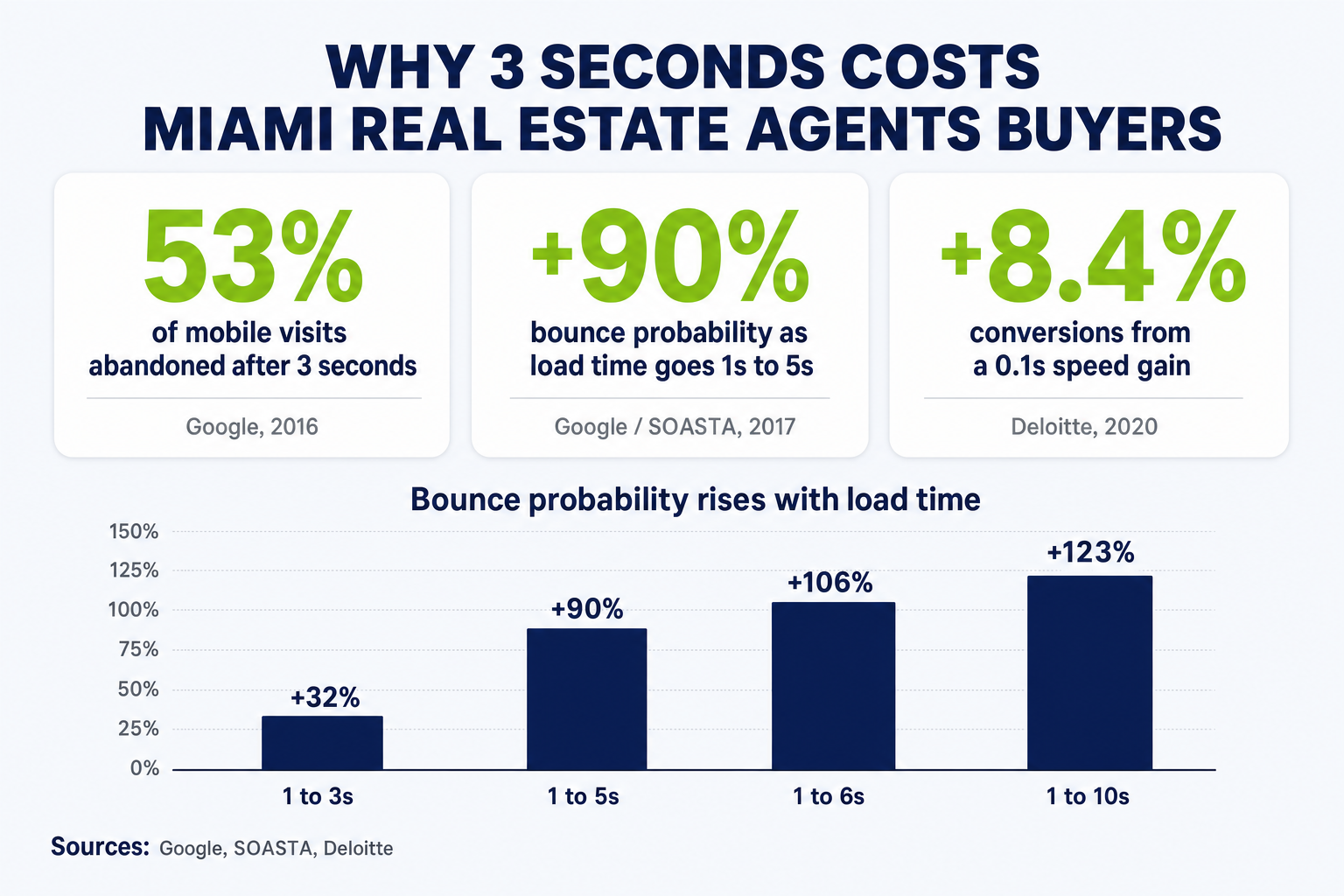
Speed pays, and the research puts numbers on it. Deloitte, working with Google, studied four weeks of mobile data across 37 brands and found that a mere 0.1-second improvement in load time lifted retail conversions by 8.4% and average order value by 9.2%, with travel conversions up 10.1% (Deloitte/Google, 2020). Portent’s analysis of tens of thousands of landing pages found the same shape: a site that loads in one second converts about 2.5× as well as one that loads in five, with the ideal conversion window sitting in the 0–4 second range (Portent, 2019).
Translate that to a real estate practice. A buyer lead in a competitive metro is expensive and hard-won, and a listing appointment is worth thousands in commission. If a slow site turns away even one in ten of the searchers who reach it, that’s not a rounding error — it’s listings walking to the next agent, invisibly, every month. You already paid (in ads, in SEO, in referrals) to get that visitor to your page. A fast site is how you stop losing them at the door. It’s the same leak we write about across the site — from IDX lead capture that actually converts to local SEO for real estate agents — except this one happens before the visitor ever becomes a lead.
What we build for Miami agents
If you want the speed without becoming a developer, that’s exactly what our Get a Website service is for. Every build is a static-first Astro site engineered to win the metrics above:
- Guaranteed 90+ PageSpeed on mobile and desktop — often a perfect 100 — so you pass Core Web Vitals instead of failing them like ~56% of sites.
- Up to 60 pages, including real, individually-optimized location and neighborhood pages for your Miami farm areas (Brickell, Coral Gables, Doral, Wynwood, Aventura) — the single biggest lever for local search.
- Proper technical SEO and AEO/GEO — clean meta, schema, sitemap, robots, and a shipped
llms.txtso both Google and AI answer engines (ChatGPT, Perplexity, Google AI Overviews) can read and cite you. - An AI chat widget that answers listing questions and books showings, plus review-collection automation to build the reputation that wins referrals.
- Free domain + managed Cloudflare hosting — no separate hosting, SSL, or maintenance bills, and updates handled by our team.
And because the fast public site is only half of a complete system, we can wire it straight into the Real Estate Snapshot so the leads your speedy new site captures drop into GoHighLevel and get worked automatically — the front door and the follow-through, built to fit together. Prefer to keep your current site and just add the automation? A dedicated GHL VA can run that side for you.
Frequently asked questions
Real estate website speed — common questions
What is the fastest website platform for a real estate agent?
For a public marketing website, a static-first build on the Astro framework is the fastest common option, because it ships virtually no JavaScript by default and serves plain HTML from a global edge network (Astro docs). That's why well-built Astro sites routinely score 90–100 on Google PageSpeed while typical WordPress, Wix, and GoHighLevel-built sites land in the 40–70 range. Speed matters because 53% of mobile visitors abandon a page that takes over 3 seconds to load (Google, 2016).
Is a GoHighLevel website bad for real estate?
No — it's just optimized for a different job. GoHighLevel is outstanding for CRM, pipelines, funnels, and automation, which is why the Real Estate Snapshot runs inside it. As a fast, SEO-first public website, a GHL-built site is heavier and has thinner technical-SEO controls than a purpose-built static site. The best setup often uses both: a fast Astro site as the public front door feeding leads into GoHighLevel for follow-up.
Does website speed actually affect Google rankings?
Yes. Google confirmed page experience — including Core Web Vitals (LCP, INP, CLS) — as a Search ranking signal, announced in 2020 and rolled out in 2021 (Google Search Central). Google frames it as one signal among many and says great content still wins, but all else equal a faster page that passes Core Web Vitals ranks better and keeps visitors longer. Only about 44% of sites pass Core Web Vitals on mobile (HTTP Archive, 2024), so passing them is a genuine edge.
What are Core Web Vitals and what scores should I aim for?
They're Google's three real-world page-experience metrics: LCP ≤ 2.5s (how fast the main content appears), INP ≤ 200ms (how fast the page responds to taps), and CLS ≤ 0.1 (how little the layout shifts as it loads) (web.dev). On image-heavy real estate pages, LCP is usually the one that fails, because full-size listing photos are slow to paint — which is why image optimization and edge hosting matter so much.
How much does a fast real estate website cost in Miami?
Our Get a Website service is $497 one-time plus $97/month for a single agent site — and you only pay the one-time build fee after the site is live and you're happy. That includes up to 60 pages, Miami location pages, schema/AEO/GEO, an AI chat widget, a free domain, and managed Cloudflare hosting with no separate hosting, SSL, or maintenance fees. Teams and multi-brand brokerages have a bulk option. See the full breakdown on the Get a Website page.
Can I keep GoHighLevel and still get a fast website?
Absolutely — that's the setup we recommend most. You keep GoHighLevel (or the Real Estate Snapshot) for CRM and automation, and we build a fast Astro marketing site in front of it. Website forms push leads into GHL via webhook, so your speedy public site captures the buyer and GoHighLevel works the follow-up automatically. You can book a quick call to map out how the two fit together for your business.
Sources
- Google/DoubleClick — The Need for Mobile Speed (2016)
- Think with Google / SOASTA — Mobile page speed benchmarks (2017)
- Deloitte & Google — Milliseconds Make Millions (2020)
- Portent — Site Speed Is (Still) Impacting Your Conversion Rate (2019)
- web.dev — Web Vitals (LCP / INP / CLS thresholds)
- Google Search Central — Evaluating page experience for a better web
- HTTP Archive — Web Almanac 2024, Performance
- HTTP Archive — Web Almanac 2024, JavaScript
- Astro docs — Why Astro (zero JS by default)
- NAR — 2024 Profile of Home Buyers and Sellers (Top 10 Highlights)
- MIAMI Association of REALTORS® — Membership
Related reading
- GoHighLevel for Real Estate: The Complete Automation Playbook
- Local SEO for Real Estate Agents: The 2026 Google Business Profile Playbook
- IDX Lead Capture That Actually Converts (Not Just Captures)
- Real Estate Chatbots: Turning Website Visitors Into Booked Showings
About the author
Devin Callahan is a GHL Implementation Lead based in Tampa, FL. He’s installed GoHighLevel snapshots and built websites for solo agents and 40-seat brokerages alike, and cares most about the parts clients never see: fast pages, clean schema, and systems that actually work in production. He writes about implementation, page speed, and keeping a real estate web presence from turning into a slow, unmaintained junk drawer. Devin is a fictional editorial persona created for this site’s content.
Illustrative note: the statistics above are from the cited third-party research (Google, Deloitte, Portent, HTTP Archive, NAR, and the MIAMI Association of REALTORS®) and reflect general web and real estate benchmarks, not promises of results for any specific site. PageSpeed ranges for WordPress, Wix, and GoHighLevel are typical real-world outcomes and vary by build; the “typical WordPress build” JavaScript figure is directional. Our guaranteed 90+ PageSpeed applies to sites we build through the Get a Website service. Real Estate Snapshot is a GoHighLevel automation product, not a brokerage, and does not provide real estate, legal, tax, or investment advice.