

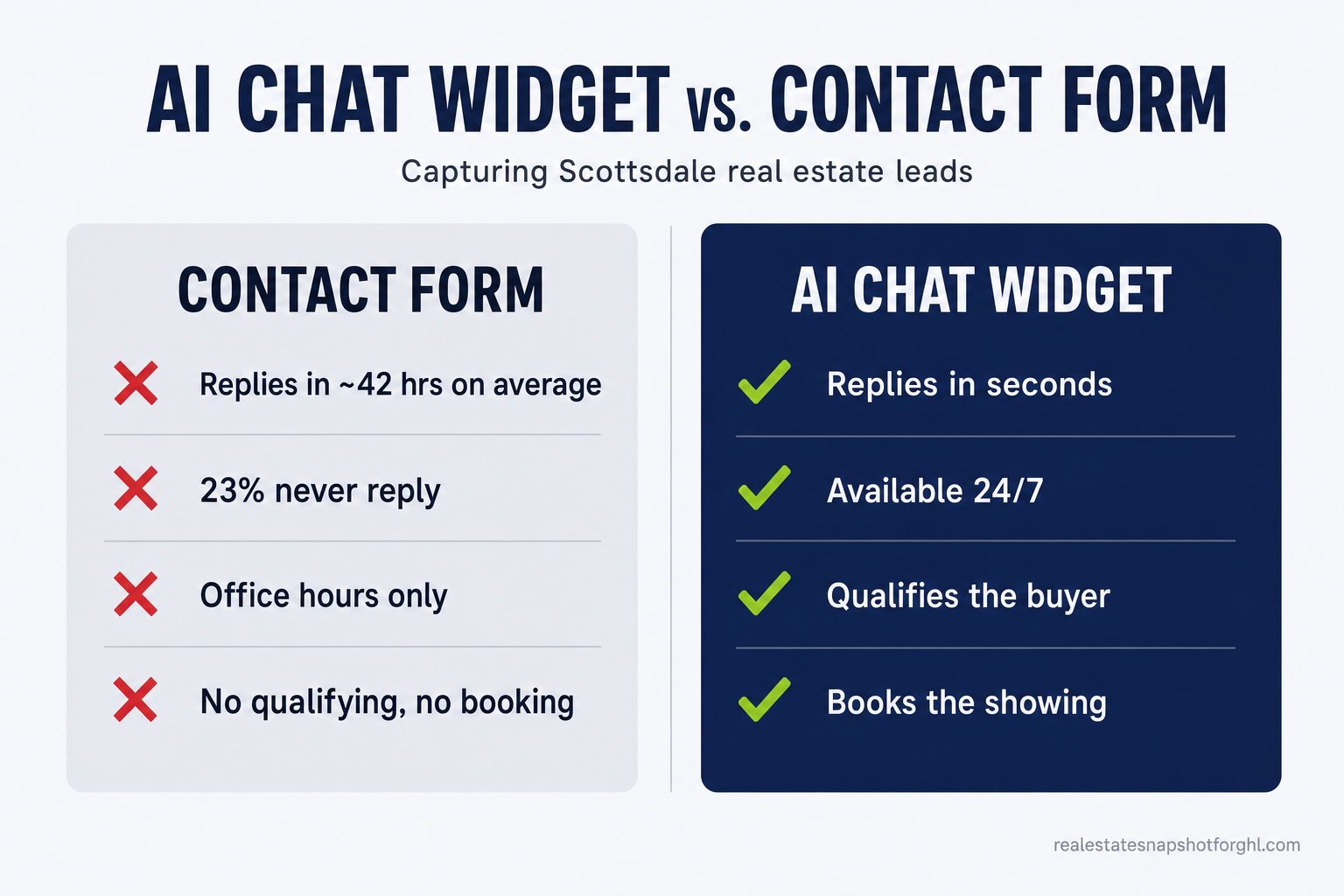
For a Scottsdale real estate lead-capture page, an AI chat widget beats a static contact form on the two things that decide whether an inquiry turns into a showing: speed and availability. A form waits silently until someone checks the inbox — and among firms that reply to web leads at all, the average first response takes 42 hours, while 23% never respond (Harvard Business Review, 2011). An AI chat widget answers in seconds, at 2 a.m., qualifies the buyer, and books the showing while their interest is still hot. In a market where the median home sells for $944,527 (Redfin, July 2026), one lead lost to a slow reply is an expensive miss.
This is a straight head-to-head, not a pitch to rip out every form you own. Forms still have a job. But if your Scottsdale listing pages, IDX site, or landing pages depend on a “Contact Us” box as the only way to catch a lead, you are leaking pipeline — and this post shows exactly where.
Table of contents
- The two ways a Scottsdale listing page catches a lead
- Why the contact form leaks
- Why the AI chat widget converts
- Head-to-head: form vs. AI chat widget
- The speed-to-lead math
- What this means in the Scottsdale market
- When a plain contact form is still fine
- What we actually install
- Frequently asked questions
The two ways a Scottsdale listing page catches a lead
Picture a buyer relocating to North Scottsdale. It’s 9:40 p.m. They’re on your IDX site looking at a $1.2M listing, and they want one thing: to know if it’s still available and whether they can see it Saturday. There are two ways your page can respond.
Option A — the contact form. They scroll to a box, type their name, email, phone, and a message, hit submit, and get a “Thanks, we’ll be in touch.” Then… nothing, until someone opens the inbox tomorrow. By then they’ve filled out the same form on three other listings.
Option B — the AI chat widget. A chat bubble greets them, answers “yes, still available,” asks two qualifying questions (“buying or selling? / timeline?”), offers three Saturday slots, and books one — all before they close the tab. The lead lands in your CRM tagged, qualified, and with an appointment attached.
Same visitor, same intent. The difference in outcome is entirely about how fast and how available the capture method is. That’s the whole comparison — everything below is evidence for why Option B wins more often, and where Option A still earns its keep.
Why the contact form leaks
A static form isn’t broken. It’s just passive — it collects, it doesn’t respond. Three things leak through it.
1. It creates friction, and friction kills submissions. Every extra field is another reason to bail. Across e-commerce, the average online form/checkout is abandoned about 70% of the time (Baymard Institute, 2025) — and while that benchmark is a shopping-cart figure, the mechanism is identical on a real estate lead form: too many fields, too much effort, too little immediate payoff. A buyer who won’t finish a 9-field form will answer “Saturday or Sunday?” in a chat.
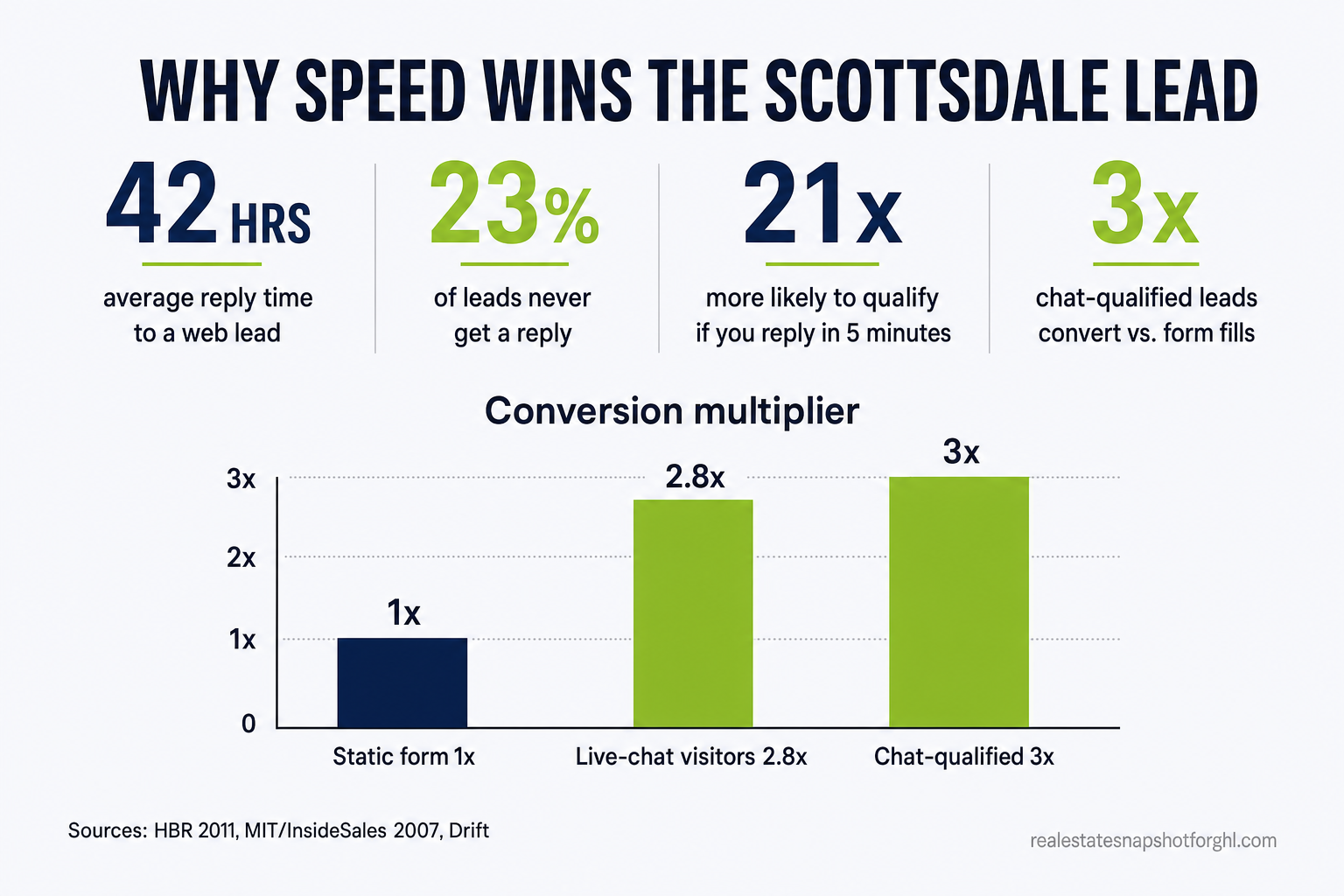
2. It replies on office-hours time, not buyer time. Home shoppers browse late at night and on weekends, when a form’s “we’ll get back to you” is worthless for hours. And the response gap is brutal: in Harvard Business Review’s audit of 2,241 U.S. companies, the average first response to a web lead was 42 hours, only about 37% replied within an hour, and 23% never responded at all (HBR, 2011). A form is the single easiest place for that 42-hour gap to open up.
3. It doesn’t qualify or route. A form dumps a raw name into an inbox. Nobody knows if it’s a serious $1.5M buyer or a neighbor checking their own home’s value. So the follow-up is either too slow, too generic, or never happens.
Why the AI chat widget converts
An AI chat widget flips every one of those leaks. It’s active — it starts the conversation, answers instantly, qualifies, and books.
The conversion evidence is consistent across studies (vendor-sourced, so treat the exact figures as directional, but the direction is unmistakable):
Why does chat outperform a form so consistently? Because it removes the wait and the effort at the same time:
- It answers in seconds, not hours — closing the 42-hour gap that HBR measured.
- It works while you sleep or show property — an AI widget doesn’t clock out, so the 9:40 p.m. North Scottsdale buyer gets a real answer at 9:40 p.m.
- It qualifies conversationally — a two-question exchange feels lighter than a form yet captures more usable intent (buying vs. selling, timeline, price band).
- It books the showing itself — connecting straight to your calendar so interest converts to a confirmed appointment before it cools.
This is the same speed-to-lead engine behind our AI voice agents and missed-call text-back — the chat widget is simply the version that lives on your website and IDX pages. (For the phone-call side of the same problem, see how an AI receptionist works for Phoenix agents.)
Head-to-head: form vs. AI chat widget
Same visitor, same page — here’s how the two capture methods stack up on the dimensions that decide the outcome.
Static contact form vs. AI chat widget
| Plan | Static contact form | AI chat widget (in the Snapshot) recommended |
|---|---|---|
| Price | The default | Done-for-you |
| Feature 1 | Reply speed: whenever someone checks the inbox (avg 42 hrs across firms that reply) | Reply speed: instant — seconds, not hours |
| Feature 2 | Availability: effectively office hours only | Availability: 24/7, including 2 a.m. and Sundays |
| Feature 3 | Qualifies the lead: no — dumps a raw name into an inbox | Qualifies the lead: yes — conversational buying/selling + timeline |
| Feature 4 | Books the showing: no — a human has to follow up | Books the showing: yes — connects to your calendar |
| Feature 5 | Handles after-hours + weekend traffic: no | Handles after-hours + weekend traffic: yes |
| Feature 6 | Effort for the buyer: high — multi-field form | Effort for the buyer: low — a two-question chat |
| See how IDX capture should work | Get the snapshot |
The pattern is clear: the form is a bucket, the chat widget is a closer. A bucket catches what falls in during business hours; a closer works every lead the moment it arrives.
The speed-to-lead math
Everything above rests on one well-established finding: in lead conversion, minutes matter more than almost anything else you do. The canonical MIT / InsideSales study found that contacting a web lead within 5 minutes versus 30 minutes made a rep about 21x more likely to qualify the lead (MIT / InsideSales, 2007). Velocify’s later analysis put a number on the extreme end: responding within the first minute was tied to a 391% lift in conversions (via Chili Piper).
Here’s the problem: no human team hits 5 minutes consistently. Agents are at showings, in closings, asleep. That’s exactly the gap the HBR study measured as a 42-hour average. The only reliable way to answer every lead in seconds, around the clock, is to let software take the first touch — which is precisely what an AI chat widget does. It’s not about replacing the agent’s relationship-building; it’s about making sure the buyer is engaged and booked by the time the agent picks up the conversation. For the deeper playbook, see speed-to-lead for realtors and how to convert Zillow leads.
What this means in the Scottsdale market
Scottsdale sharpens every point above, because the stakes and the competition are both high.
Three things follow from those numbers:
- Each lead is worth more. At a ~$945K median — and North Scottsdale running to a $1.2M median (Redfin) — a single converted buyer or seller is a large commission. A form that lets one serious lead go cold is not a rounding error.
- The competition is fierce. With nearly 9,000 REALTORS in the Scottsdale association (Scottsdale REALTORS®), a relocating buyer inquires with several agents. The one who answers first — at 9:40 p.m., instantly — is disproportionately the one who gets the showing.
- Buyers still want an agent. Automation isn’t replacing you: 88% of 2025 buyers purchased through an agent or broker, and 91% of sellers used one — an all-time high (NAR, 2025). The chat widget handles the instant admin — answer, qualify, book — so you show up to a warm, scheduled appointment instead of chasing a cold form fill.
When a plain contact form is still fine
To be fair to the humble form: it isn’t always the wrong tool.
- Low-intent, non-urgent asks — a newsletter signup, a “download the neighborhood guide” lead magnet, or a general contact page — are fine as forms. Nobody expects a 2 a.m. reply to a PDF download.
- When you genuinely can’t staff any follow-up and don’t yet have automation, a form at least captures the contact for later (just know that “later” is where most of the value evaporates).
- As a fallback underneath the chat widget, for the minority of visitors who prefer to type an email and move on.
The mistake isn’t having a form. It’s making a passive form the only way a high-intent buyer can reach you on a listing page. Pair it with a chat widget and you catch both the browsers and the buyers.
What we actually install
Real Estate Snapshot installs the AI chat widget as part of a complete GoHighLevel system — not a bolt-on bubble that just emails you a transcript. The widget greets the visitor, answers listing questions, qualifies buying vs. selling and timeline, books the showing on your calendar, and drops the lead into your CRM tagged and routed — then hands off to the sphere and follow-up sequences that keep it warm. It rides on the same IDX lead capture and appointment automation the snapshot ships with, so speed-to-lead is wired end to end.
Want a fully custom widget wired into a proprietary IDX feed or CRM? That’s a custom GoHighLevel development engagement — AI chatbots and voice bridges are scoped as fixed-price builds. Not sure which fits? Book a call and we’ll tell you straight.
Frequently asked questions
Does an AI chat widget replace my real estate agents?
No. It handles the instant, repetitive first touch — answering, qualifying, and booking — so your agents show up to warm, scheduled appointments. Buyers still overwhelmingly want a human agent: 88% of 2025 buyers purchased through an agent. The widget protects the relationship by making sure no lead goes cold before the agent can engage.
Why is an AI chat widget better than a contact form for Scottsdale listings?
Speed and availability. A form waits for someone to check the inbox — across firms that reply at all, the average first response is 42 hours, and 23% never reply. An AI chat widget answers in seconds, 24/7, and books the showing. In a competitive market with nearly 9,000 local REALTORS, answering first is decisive.
Is the chat widget actually AI, or just canned buttons?
It's a conversational AI widget that understands free-text questions (availability, price, timeline, showings), qualifies the lead, and books to your calendar — not a rigid button tree. It follows the niche-specific prompts we ship for real estate so it stays on-topic and hands off cleanly to a human.
Do I still need a contact form at all?
For low-intent asks — newsletter signups, guide downloads, a general contact page — a form is fine. The mistake is making a passive form the only way a high-intent buyer can reach you on a listing page. Run the chat widget as the primary capture and keep a form as a fallback.
How fast can you get the AI chat widget live?
The done-for-you snapshot installs into your GoHighLevel account — chat widget, IDX capture, calendar, and follow-up — typically in about 24 hours once we have sub-account access. A fully custom build wired to a proprietary feed is scoped separately as custom development.
Related posts