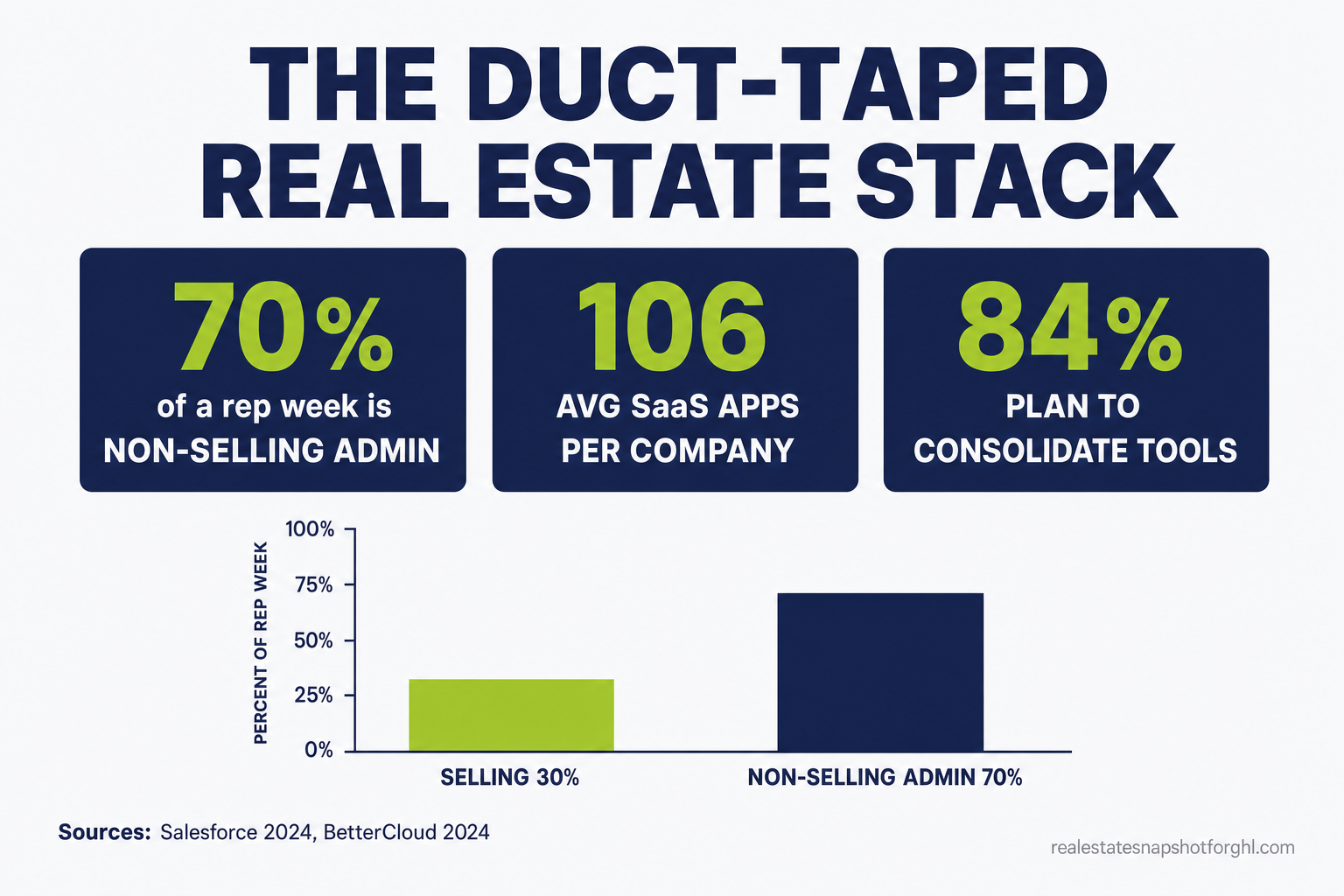
A San Antonio real estate team outgrows off-the-shelf tools the moment its leads live in five systems that don’t talk to each other — IDX portal, a CRM, a dialer, a transaction manager, and a spreadsheet — and someone is re-keying every lead by hand. Custom GoHighLevel development pays off when the cost of that manual glue work (missed follow-ups, double entry, no single source of truth) is higher than the cost of building the connectors once. In practice that break-even arrives earlier than most teams think: reps already spend roughly 70% of their week on non-selling work like admin and data entry (Salesforce State of Sales, 2024), and every disconnected tool adds to that pile.
This is a pain-points playbook, not a sales pitch for more software. The goal is to help a San Antonio agent, team lead, or broker figure out whether they have a tool problem or a plumbing problem — because those two problems have very different fixes. Add another app and you usually make the plumbing worse. Wire the apps you already run into one system and the leaks close.
Table of contents
- The duct-taped stack: how San Antonio teams hit the wall
- What the fragmentation actually costs you
- Six walls off-the-shelf GoHighLevel hits for real estate
- Speed-to-lead: what the gaps cost at the point of contact
- Duct tape vs. Zapier vs. custom development
- What custom GoHighLevel development actually looks like
- When it pays off — and when it doesn’t
- The San Antonio market context
- Frequently asked questions
The duct-taped stack: how San Antonio teams hit the wall
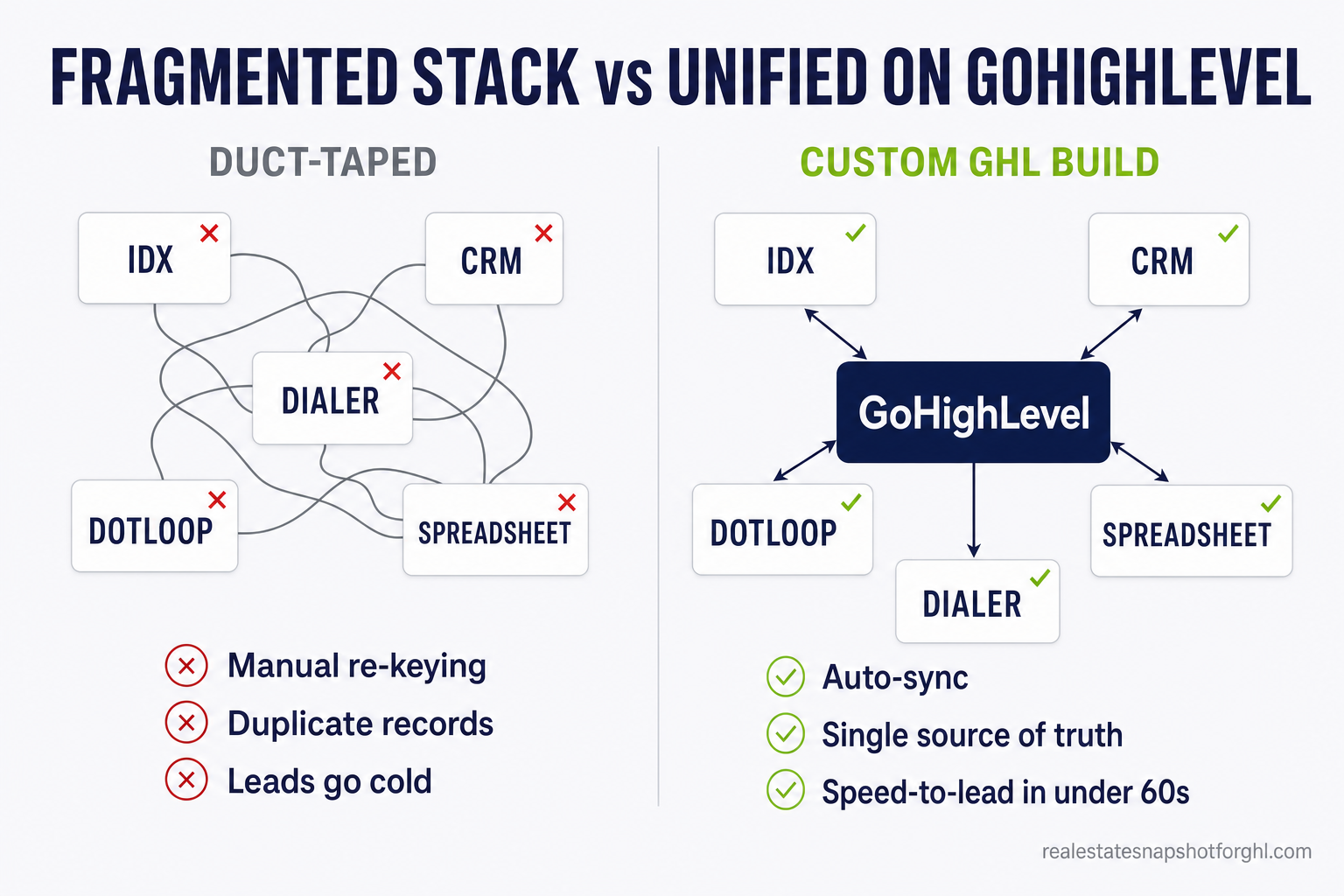
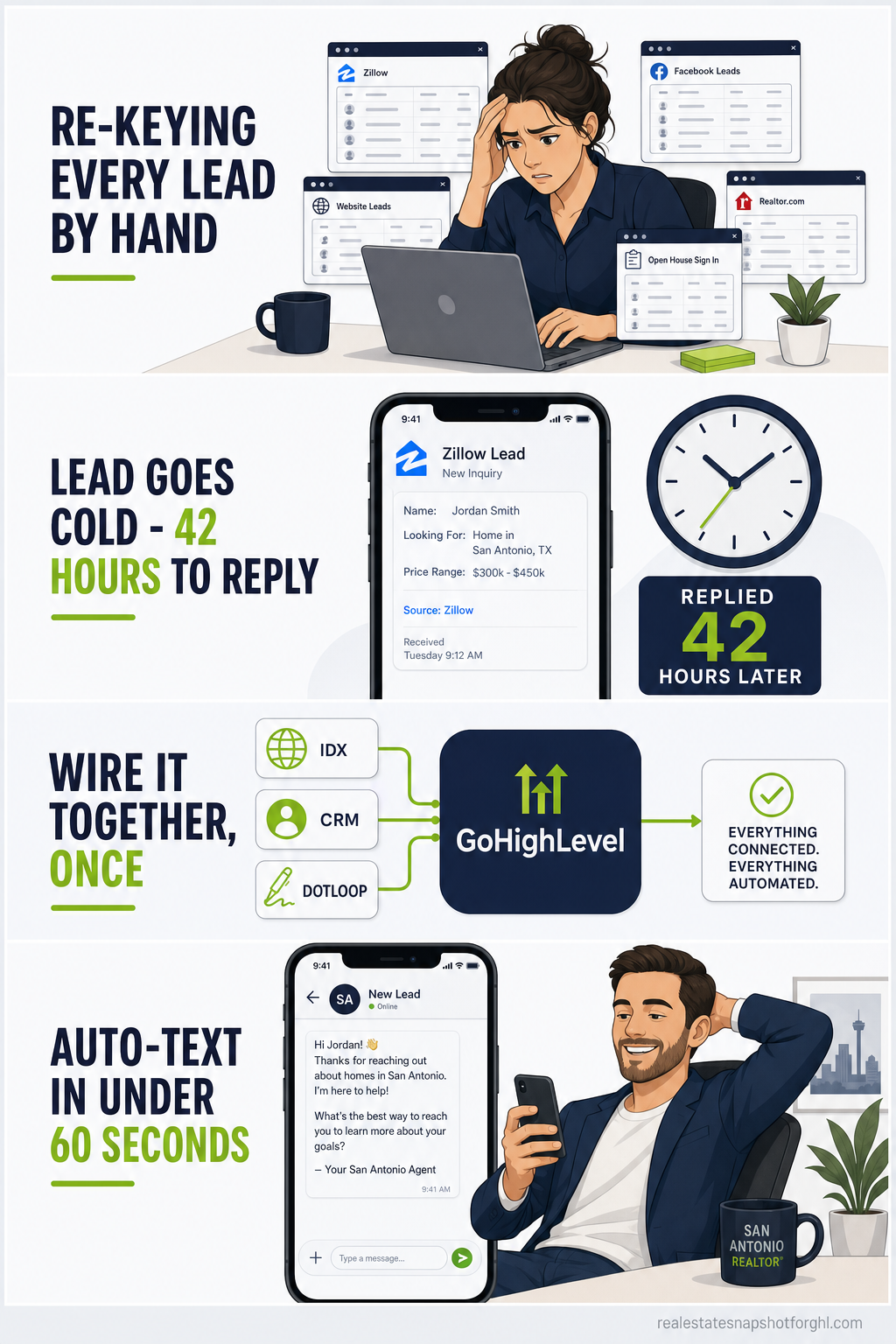
Picture a growing team on the North Side. Leads come from a Zillow feed, an IDX website, Facebook lead forms, and an open-house sign-in app. Contacts live in a CRM. Showings sit in a separate calendar tool. Contracts run through dotloop. Commissions get tracked in a spreadsheet. Nothing is broken — every tool works fine on its own. But no tool knows what the others know, so a coordinator spends the morning copying leads from one screen into another.
That’s the wall. It isn’t a missing feature; it’s the space between the features. San Antonio is a competitive field — the San Antonio Board of REALTORS represents more than 14,000 members across 13 South Texas counties, part of roughly 150,000 REALTORS statewide — and in a competitive field the team that answers first and follows up cleanly wins. Manual glue work makes both of those slow.
Here’s the uncomfortable data point: adding tools rarely helps, because the average business is already drowning in them. Organizations now run around 106 SaaS applications on average (BetterCloud, 2024), and the human cost shows up in the switching — knowledge workers toggle between apps about 25 times a day, and it takes roughly 9.5 minutes to fully refocus after each toggle (Asana Anatomy of Work, 2023). For a real estate team, every one of those toggles is a chance to drop a lead.
That last number is the tell. 84% of sales teams without an all-in-one platform say they plan to consolidate their tech stack (Salesforce State of Sales, 2025). Consolidation is the direction of travel — the only question is whether you consolidate onto a platform you already pay for (GoHighLevel) or keep paying the manual tax.
What the fragmentation actually costs you
The cost isn’t a line item, which is exactly why teams tolerate it for years. It hides inside your calendar. When reps spend about 70% of their time on non-selling work — admin, updating records, hunting for information across systems (Salesforce, 2024) — the selling, the showings, and the relationship work get squeezed into the leftover third.
Share of a sales rep’s typical week. Only about 30% goes to selling and client work; ~70% goes to admin, data entry, and internal tasks. Source: Salesforce State of Sales, 2024.
Then there’s the data itself. When the same buyer exists as three slightly different records in three tools, your follow-up cadence breaks, your reporting lies, and your marketing double-texts people. That’s not a rounding error at scale: Gartner has estimated poor data quality costs the average organization about $12.9 million a year (Gartner, 2021). A single agent won’t feel a number that large, but a brokerage running duplicate-riddled pipelines absolutely feels the smaller version — leads worked twice, or not at all.
And it compounds. 51% of sales leaders say disconnected systems are actively slowing their AI initiatives, and 74% are prioritizing data cleansing to fix duplicates and errors across siloed tools (Salesforce State of Sales, 2025). In other words: you can’t layer an AI caller or chatbot on top of a fragmented stack and expect it to work — the AI inherits the mess. Clean plumbing is the prerequisite, which is the whole argument for connecting your lead sources into one system before you automate anything.
Six walls off-the-shelf GoHighLevel hits for real estate
To be clear: GoHighLevel is an excellent core, and for most solo agents the standard real estate snapshot does everything they need out of the box. But GHL was built as a general marketing-and-CRM platform, not a real estate operating system. Teams that scale run into predictable walls — and each one is a candidate for custom development rather than another subscription.
- Wall 1 — MLS/IDX data. GHL doesn’t natively ingest MLS listings, saved-search activity, or IDX registrations. Leads get re-keyed by hand or lost. Fix: a custom IDX ↔ GHL connector that pushes every registration in as a tagged contact and fires a speed-to-lead text in under a minute.
- Wall 2 — Real estate tools that don’t sync. kvCORE, Follow Up Boss, BoomTown, dotloop, SkySlope, Zillow, and Realtor.com all live in silos. Fix: two-way integrations so a contact, stage, or note updated in one place updates everywhere.
- Wall 3 — Transaction timelines. Inspection, appraisal, and financing contingencies, closing dates, document checklists — GHL pipelines weren’t designed for contract-to-close. Fix: a custom transaction dashboard on top of GHL.
- Wall 4 — The feature that doesn’t exist. A client/transaction portal, a listing dashboard, a commission tracker — no plugin quite fits. Fix: build it on the GHL API.
- Wall 5 — Generic AI. Off-the-shelf bots don’t understand buyers, sellers, or your listings. Fix: a custom AI agent trained on your process and wired into your data.
- Wall 6 — You’re trapped on another platform. Your history is stuck in kvCORE, Chime, or Sierra Interactive and switching feels risky. Fix: a clean migration to GHL that brings contacts, pipelines, and history across intact.
If two or more of those walls sound familiar, you don’t have a tool problem — you have an integration problem, and that’s what custom GoHighLevel development is for.
Speed-to-lead: what the gaps cost at the point of contact
Every manual step between a lead arriving and a human responding is time on the clock — and in real estate that clock is brutal. The classic MIT/InsideSales lead-response study found that contacting a web lead within 5 minutes instead of 30 makes you about 21x more likely to qualify it, and roughly 100x more likely to even reach them (MIT/InsideSales, 2007). Yet the average company still takes 42 hours to respond, and 23% never respond at all (Harvard Business Review, 2011).
Now overlay your stack. A Zillow lead lands in one inbox, a coordinator sees it 40 minutes later, copies it into the CRM, tags it, and then someone texts. You’ve spent your 5-minute window on data entry. Integration collapses that to zero: the lead hits GHL the instant it’s created and the first touch fires automatically. This is the same discipline behind speed-to-lead automation for realtors — it just has to start with clean plumbing.
The reason this matters so much for a team is that your highest-quality leads come from exactly the sources that don’t share a database by default.
Share of agents naming each tool a top source of quality leads. Source: NAR REALTORS Technology Survey, 2025.
Social, CRM, and MLS are your top three lead engines — and in most San Antonio stacks, they’re three separate logins. Wire them together and every lead lands in one place, tagged by source, with the first touch already moving. That’s the entire point of custom integration work.
Duct tape vs. Zapier vs. custom development
There are three honest ways to connect a real estate stack. Each has a right time to use it.
How to connect a fragmented real estate stack
| Custom GHL development | Duct tape (manual + Zapier) | |
|---|---|---|
| Setup | Built once to your exact workflow | Quick to wire, brittle to maintain |
| Two-way MLS/IDX sync | Yes — real, tagged, real-time | Rarely possible; usually one-way or manual |
| Data integrity | Single source of truth, de-duped | Duplicates and drift across tools |
| Speed-to-lead | Instant, automatic first touch | Delayed by manual steps or task queues |
| Breaks when a tool updates | Monitored and maintained | Silent failures you find weeks later |
| Custom features (portals, dashboards) | Built on the GHL API | Not possible |
| You own the code | 100% IP transfer | You rent the connection monthly |
| Best for | Teams past the manual-glue wall | Solo agents, simple one-off triggers |
Duct tape and Zapier are genuinely fine for a solo agent with one or two simple triggers — don’t over-engineer a problem you don’t have. But the moment a person’s job is moving data between tools, that person’s salary is the real cost of not building the integration. Custom development turns a recurring manual expense into a one-time build you own outright.
What custom GoHighLevel development actually looks like
“Custom development” sounds expensive and open-ended. In practice it’s a small set of well-understood real estate builds with fixed scopes and timelines. The most common ones:
- IDX / MLS ↔ GHL sync — every registration and saved search becomes a tagged GHL contact; listing status stays in sync. Typical build: 2–3 weeks.
- AI buyer/seller chatbot — branded conversational AI on your site or IDX, wired into GHL, qualifies and books showings. Typical build: 3–4 weeks.
- Contract-to-close dashboard — transaction fields, contingencies, closing timelines, and commission splits on top of GHL. Typical build: 6–10 weeks.
- GHL ↔ anything sync — two-way sync with Follow Up Boss, kvCORE, BoomTown, dotloop, QuickBooks, or Stripe. Scoped to the integration.
- Full migration to GHL — contacts, tags, pipelines, notes, and history moved cleanly off kvCORE/Chime/Sierra, automations rebuilt natively. Typical build: 1–4 weeks by data volume.
On cost: fixed-price quotes generally start around $3K for IDX plugins and syncs, $5–15K for AI chatbots and voice bridges, and $15–40K for full transaction dashboards, with an hourly retainer available if you’d rather go pay-as-you-go. Every project includes 100% IP transfer — the code lives in your repo and runs under your accounts. (Full details and a scoping call are on the GHL development page; if your build won’t touch GHL at all, that’s the custom software track instead.)
One caveat worth stating plainly, because the NAR data backs it up: automation is not magic. Even with 68% of agents now using AI, only 17% say it has had a significant positive impact and 46% see no noticeable difference (NAR, 2025). The difference between the 17% and the 46% is almost always the plumbing underneath. AI bolted onto a fragmented stack inherits the fragmentation; AI built on clean, connected data actually moves numbers.
When it pays off — and when it doesn’t
Custom GoHighLevel development pays off when the recurring cost of manual glue work exceeds the one-time cost of building the connector. A practical test: if a coordinator (or you) spends 5+ hours a week moving data between tools, or if leads are demonstrably going cold in the handoff, the math almost always favors building it. Given that CRM investment has historically returned around $8.71 for every dollar spent (Nucleus Research, 2014), the returns concentrate in the teams whose CRM is actually connected to everything else.
It does not pay off — yet — if you’re a solo agent with a simple funnel, low lead volume, and no second tool to sync. In that case, run the standard snapshot, keep it clean, and revisit custom work when you hit a real wall. The honest advice is the smallest thing that fixes the problem, even if that’s nothing at all. That’s also why some teams start by weighing a custom CRM against GHL before committing to a build.
The San Antonio market context
Why does this matter in San Antonio specifically right now? Because the market has shifted toward balance, and a balanced market rewards operational discipline over hustle. Through 2025, San Antonio’s median home price held roughly flat near $306,000, homes averaged about 83 days on market (up meaningfully year over year), and inventory climbed past five months of supply — close to a balanced market (SABOR, 2025).
When homes take longer to sell and buyers have options, follow-through is the differentiator — not ad spend. The team whose leads route instantly, whose pipeline is clean, and whose transaction status is visible at a glance simply operates better than the team copying rows between spreadsheets. In a hustle market you can outwork a broken stack. In a balanced San Antonio market, the broken stack quietly costs you deals.
Frequently asked questions
What is custom GoHighLevel development for real estate?
It's software built on the GoHighLevel API to do what GHL can't do out of the box for real estate — sync MLS/IDX leads, connect kvCORE, Follow Up Boss, dotloop or Zillow with two-way sync, build transaction dashboards and client portals, add custom AI agents, or migrate your whole stack into GHL. The goal is one connected system instead of five disconnected tools.
How do I know if my San Antonio team has outgrown off-the-shelf tools?
The clearest signal is manual glue work: if someone spends hours a week copying leads between an IDX feed, a CRM, a dialer, and a transaction tool, or if leads go cold in the handoff, you've hit the wall. Sales reps already spend about 70% of their week on non-selling admin (Salesforce, 2024); disconnected tools make that worse. That's an integration problem, not a tool problem.
Isn't Zapier or a manual process good enough?
For a solo agent with one or two simple triggers, yes — don't over-engineer it. But Zapier and manual steps are brittle: they break silently when a tool updates, rarely do real two-way MLS/IDX sync, and can't build features like portals or dashboards. Once a person's job is moving data, custom development turns that recurring salary cost into a one-time build you own.
How much does custom GHL development cost, and do I own the code?
Fixed-price quotes generally start around $3K for IDX plugins and syncs, $5–15K for AI chatbots and voice bridges, and $15–40K for full transaction dashboards, with an hourly retainer available. Full IP transfer is included by default — the code lives in your repo and runs under your accounts. The fastest way to a real number is to book a scoping call.
Can you migrate my team off kvCORE or Chime into GoHighLevel?
Yes — migration is one of the most common projects. Contacts, tags, pipelines, notes, and email history move into GHL and automations get rebuilt natively, scoped so nothing is lost and your team doesn't lose a day of production. Typical migrations run 1–4 weeks depending on data volume.
Will custom development make my AI caller or chatbot actually work?
It's usually the prerequisite. Only 17% of agents say AI has had a significant positive impact and 46% see no difference (NAR, 2025) — largely because AI bolted onto a fragmented stack inherits the mess. Clean, connected data is what lets an AI agent qualify leads and book showings reliably.
About the author. Devin Callahan is a GoHighLevel Implementation Lead based in Tampa, FL. He builds and installs GHL snapshots and custom integrations for solo agents and multi-seat brokerages, and cares most about the parts a client never sees — clean tagging, pipeline stages that match how deals actually move, and automations that don’t double-text a buyer at 2 a.m. He is a fictional editorial persona created for voice; nothing here is real estate, legal, or investment advice.