

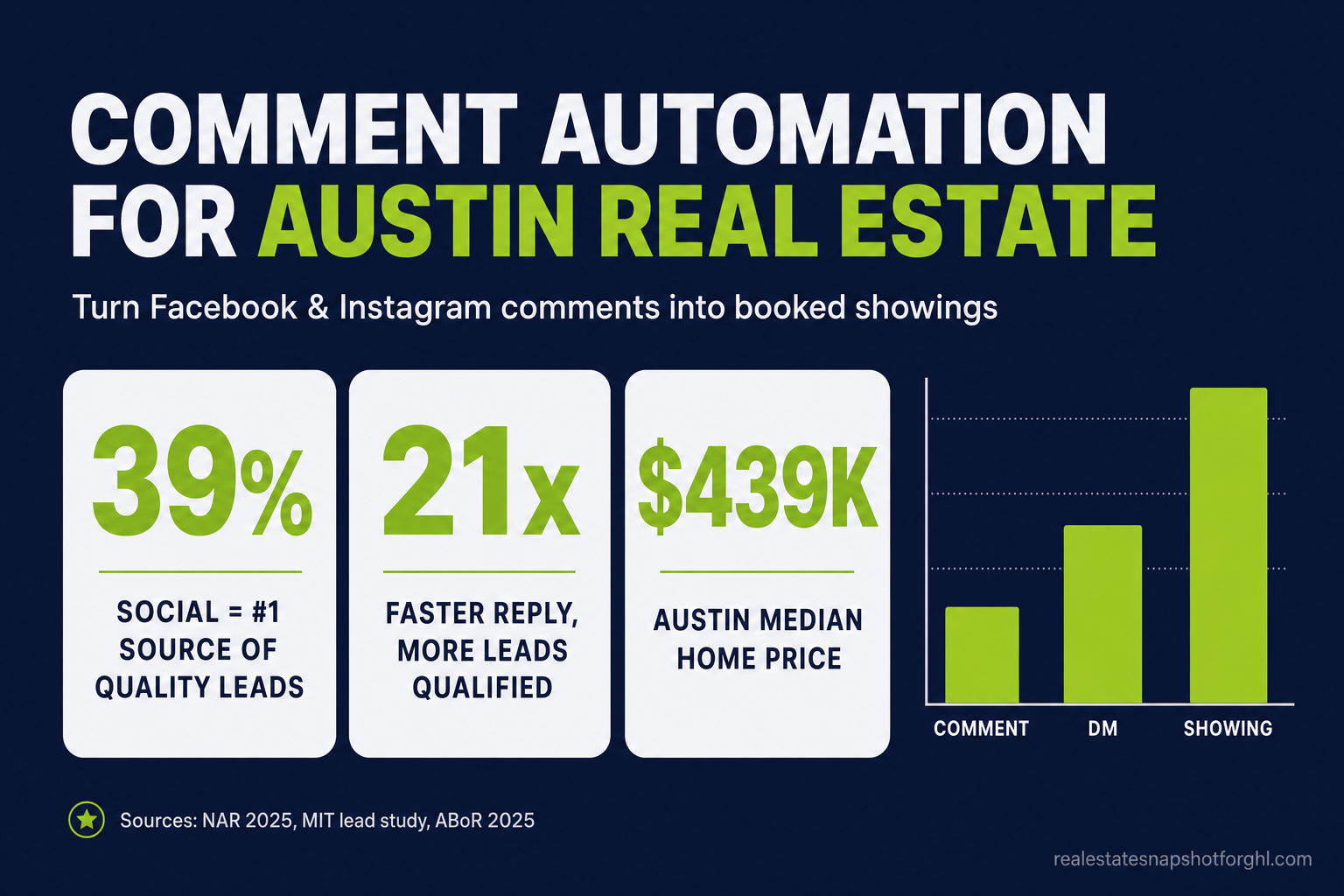
Comment automation for an Austin real estate agent means using an AI-driven system to instantly reply to every comment on your Facebook and Instagram listing posts and ads — publicly answering, then moving the person into a private DM that qualifies them, sends the listing details, and books a showing to your calendar, 24/7. When a buyer scrolling at 10 p.m. types “Is this still available?” under your listing reel, that comment is the lead — and in a cooling Austin market where the median home now sells around $439,000 and homes are sitting 50–60 days (Austin American-Statesman, 2025), the agent who answers it first is the one who gets the tour.
Here’s the problem it solves. Social media is now the #1 source of high-quality leads for agents — 39% named it their top source, ahead of their CRM (23%) and the MLS (17%) (NAR, 2025). But those leads don’t arrive as tidy form fills. They arrive as comments and DMs, at odd hours, while you’re at a showing off South Congress or asleep. Miss the window and the buyer comments on the next agent’s post instead. This is the step-by-step playbook to build a system that catches every one.
Table of contents
- Why Austin agents lose deals in the comments
- What comment automation actually does
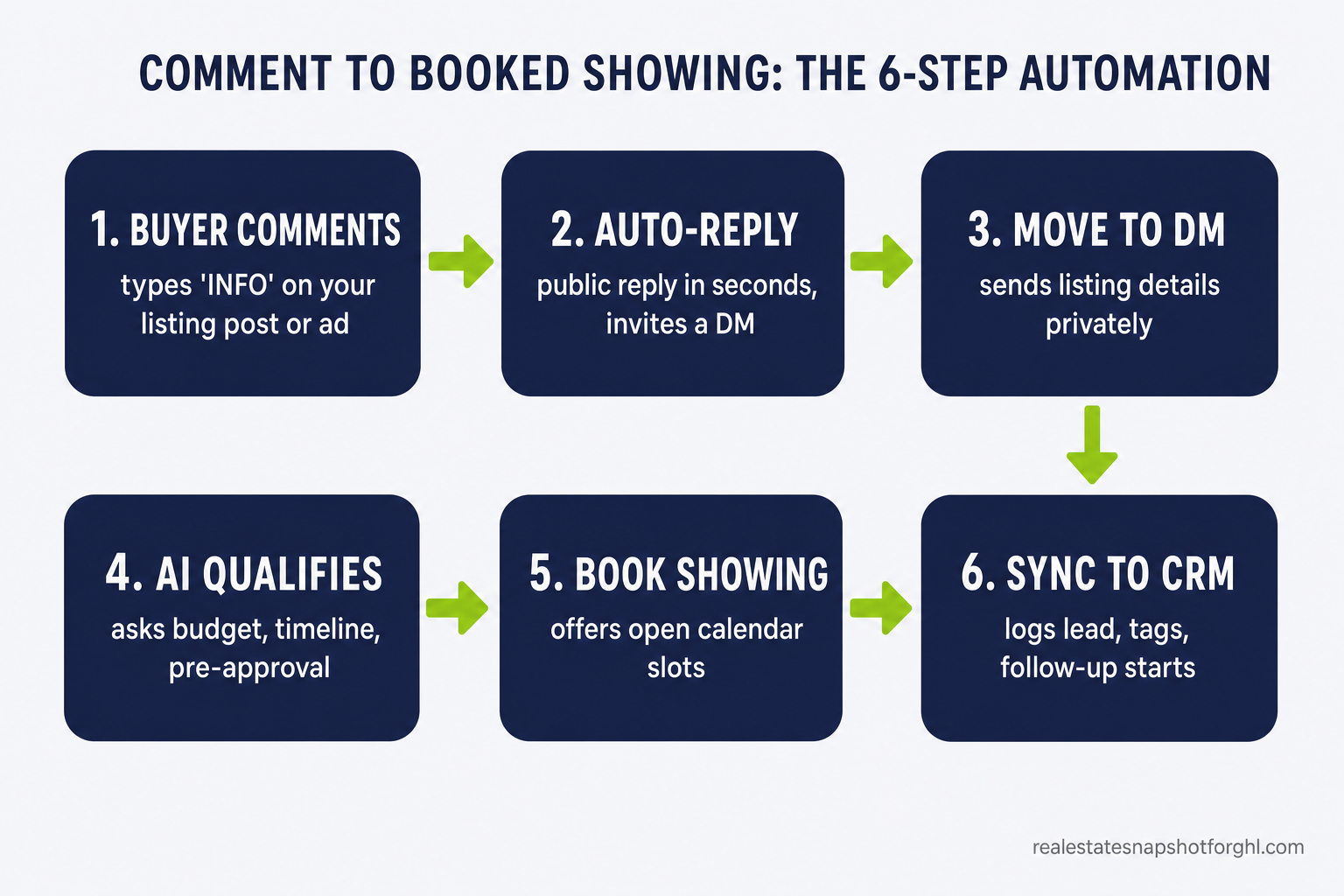
- The 6-step playbook: comment to booked showing
- Why speed-to-lead is the whole game
- Where social sits in your lead mix
- DIY vs done-for-you comment automation
- The Austin market context
- Frequently asked questions
Why Austin agents lose deals in the comments
Austin is one of the most crowded agent fields in the country. Texas licenses more than 140,000 active real estate sales agents (Texas REALTORS, 2025), and a huge share of them compete for the same metro buyers. Meanwhile the market has cooled: sales in the Austin–Round Rock–San Marcos metro were down roughly 9.6% year-over-year in October 2025, inventory hit its highest level since 2022, and homes now take 50–60 days to sell (Austin American-Statesman, 2025). When buyers have leverage and time, they shop multiple agents — and they do it in the comments.
That’s the leak. You shoot a beautiful listing reel that reaches thousands, and the “What’s the HOA?” and “Still available?” comments pile up while you’re at an open house. Every one you don’t answer in minutes is a warm buyer handed to whoever replied first. The content isn’t the problem — the response is.
And buyers overwhelmingly still transact through an agent even though they start online — they scroll first, then reach out. Your Facebook and Instagram are the top of that funnel, and the comment is the moment intent becomes a lead. Leave it sitting and you’ve donated a buyer to a competitor. That’s the exact gap speed-to-lead automation is built to close, and on social it starts with the comment.
What comment automation actually does
Comment automation is a set of rules and AI agents that watch your Facebook and Instagram posts, ads, and reels, then act the instant someone engages. It’s the same speed-to-lead discipline behind a good missed-call text-back system — just pointed at social instead of your phone.
A well-built system does five things a human can’t do reliably at 11 p.m.:
- Replies publicly in seconds. A short, on-brand comment reply (“Sent you the details in your DMs! 🏡”) so other scrollers see you’re responsive — which lifts the post’s engagement, too.
- Moves the person to a private DM. It sends the price, address, and a link privately, keeping negotiation and contact details off the public thread.
- Qualifies the lead. The AI agent asks budget, timeline, financing, and whether they’re working with an agent — the same questions you’d ask, minus the 3 a.m. shift.
- Books the showing. It offers real open slots from your calendar and confirms, so a comment becomes a calendar event without you touching it.
- Logs everything to your CRM. Name, number, tags, and a follow-up sequence fire automatically, so nothing leaks between “interested” and “under contract.”
Done right, it turns a noisy comment section into a tidy, qualified pipeline. This is exactly what our Instagram DM automation and Facebook Messenger automation features are built to run.
The 6-step playbook: comment to booked showing
Here’s the exact flow to build — whether you wire it yourself or have it installed for you.
-
Set the trigger. Add a clear call-to-action to every listing post, reel, and ad: “Comment INFO for the full details and price.” A keyword like
INFO(orTOUR) is the cleanest trigger for an automation to detect, and it trains your audience to engage. -
Auto-reply in the thread — instantly. The moment someone comments the keyword, the system posts a friendly public reply and lets them know a DM is coming. Public responsiveness is social proof; it tells the next 200 scrollers you actually answer.
-
Open the DM with real value. The private message leads with what they asked for — price, address, a link to the listing or an IDX capture page — not a wall of qualifying questions. Give first, ask second.
-
Qualify conversationally. The AI agent asks a short sequence: buying or selling, timeline, budget or pre-approval, and whether they already have an agent. In Austin’s buyer-friendly market, timeline and financing are the two answers that tell you who’s real.
-
Offer the showing. Once qualified, it presents open calendar slots and books the tour directly. A booked showing — not a “thanks, I’ll follow up” — is the whole point.
-
Sync to the CRM and start follow-up. The contact, tags, and conversation history land in your database, and a multi-touch follow-up sequence begins so a “not yet” becomes a “let’s go” in 30 days instead of never.
Why speed-to-lead is the whole game
Every step above exists to compress one number: the minutes between a buyer engaging and you responding. The research on this is brutal and consistent.
The MIT/InsideSales lead-response study found that contacting a web lead within 5 minutes versus 30 minutes makes you about 21 times more likely to qualify it (MIT Lead Response Study). Harvard Business Review’s audit of 2,241 U.S. companies found firms that responded within an hour were 7 times more likely to have a meaningful conversation with a decision-maker — and that 23% never responded at all (HBR, 2011).
Relative odds of qualifying/reaching a lead by response speed. Source: MIT Lead Response Study; HBR, 2011.
No solo agent — and no team without a night desk — hits a 5-minute response on a comment left at midnight. Automation is the only thing that does it every time, which is why it consistently beats “I’ll get to the DMs tomorrow.”
Where social sits in your lead mix
If you’re deciding where to spend attention, the data is clear about where the good leads come from. In NAR’s 2025 survey, agents ranked their best-quality lead sources like this:
Share of Realtors naming each their #1 source of quality leads. Source: NAR 2025 Technology Survey.
Social media didn’t just make the list — it topped it. And it’s where buyers already are: Instagram reaches about 50% of U.S. adults (Pew Research, 2025), while Facebook and its Marketplace remain a top channel agents use to reach local buyers (Florida Realtors, 2025). The leverage isn’t posting more — most Austin agents already post. It’s answering everything the posts generate. That’s what a done-for-you social program is built to do at scale.
DIY vs done-for-you comment automation
You can absolutely build this yourself with a CRM, a chatbot builder, and time. The question is whether that’s the best use of your hours during a slower market. Here’s the honest trade-off.
| Done-for-you (Real Estate Snapshot) | DIY / build it yourself | |
|---|---|---|
| Time to live | Installed and running in days | Weeks of building, testing, fixing |
| Coverage | Comments + DMs across FB & IG, 24/7 | Whatever you have time to wire and watch |
| AI qualifying + booking | Prebuilt agents + calendar sync | You design the flows and prompts |
| CRM + follow-up | Tagging + sequences included | You build and maintain each one |
| Compliance guardrails | Opt-in, STOP handling baked in | Your responsibility to configure |
| Ongoing upkeep | Managed for you | You own every break and update |
| Cost | From $397/mo, all channels | Tool stack + your time (the expensive part) |
For an agent whose real job is showings, negotiation, and relationships, the math usually favors handing the plumbing to someone who builds it every day. For a tech-comfortable agent with spare evenings, DIY is a legitimate path — as long as you actually finish it.
The Austin market context
Why does this matter more in Austin right now than it did two years ago? Because leverage moved to buyers, and buyers with leverage shop around. With the median metro sale price near $439,000, inventory at its highest since 2022, and homes averaging 50–60 days on market (Austin American-Statesman, 2025), a buyer commenting on your reel is very likely commenting on three other agents’ reels too. Speed and responsiveness are no longer a nice-to-have — they’re the tiebreaker.
Layer on the competition — 140,000-plus active sales agents statewide (Texas REALTORS, 2025) — and the picture is simple: attention is cheap, but converted attention is rare. The Austin agents who win the next 12 months won’t necessarily be the ones with the biggest ad budgets. They’ll be the ones whose DMs were answered in seconds while everyone else’s comment section went quiet overnight.
Frequently asked questions
What is comment automation for real estate?
It's a system that instantly replies to comments on your Facebook and Instagram listing posts, reels, and ads, then moves each person into a private DM that shares the listing, qualifies their budget and timeline, and books a showing to your calendar — running 24/7 without you monitoring notifications.
Is auto-replying to Instagram and Facebook comments allowed?
Yes. Meta supports approved messaging and comment-reply tools through its official APIs, and keyword-triggered comment-to-DM flows are a standard, permitted use. The key is staying within Meta's messaging rules, getting opt-in before ongoing texts, and honoring STOP requests — the same consent discipline covered in our real estate SMS compliance guide.
How fast does the system actually respond?
Within seconds. That speed is the entire point: replying to a lead within 5 minutes versus 30 makes you about 21 times more likely to qualify it (MIT Lead Response Study), and no human reliably answers a comment left at midnight. Automation does.
Will it sound robotic to Austin buyers?
Not when it's built well. The AI agents are scripted in your voice and lead with the value the person asked for — price, address, a link — before qualifying. Buyers overwhelmingly prefer messaging over calling, and 72.4% are more likely to buy from a brand that offers it (Meta/Kantar, 2025).
Do I need a big following for this to work?
No. It works on engagement, not follower count. A single listing reel that reaches a few hundred local buyers can generate a dozen comments — and automation makes sure every one gets answered and booked, which is where most agents leak deals today.
How much does done-for-you comment automation cost?
Our done-for-you social program starts at $397/month and runs comment, DM, and web-chat AI agents across Facebook and Instagram plus content across nine channels — typically less than the commission on a single missed Austin buyer. See the social media plans page for details.
About the author. Grant Whitlock is a Real Estate Automation Strategist based in Austin, TX. He spent nine years running operations for a residential sales team, watching warm buyer leads go cold in the gap between an inquiry and a confirmed showing, and now designs the speed-to-lead and social-response workflows behind Real Estate Snapshot. He is a fictional editorial persona created for voice; nothing here is real estate, legal, or investment advice.