

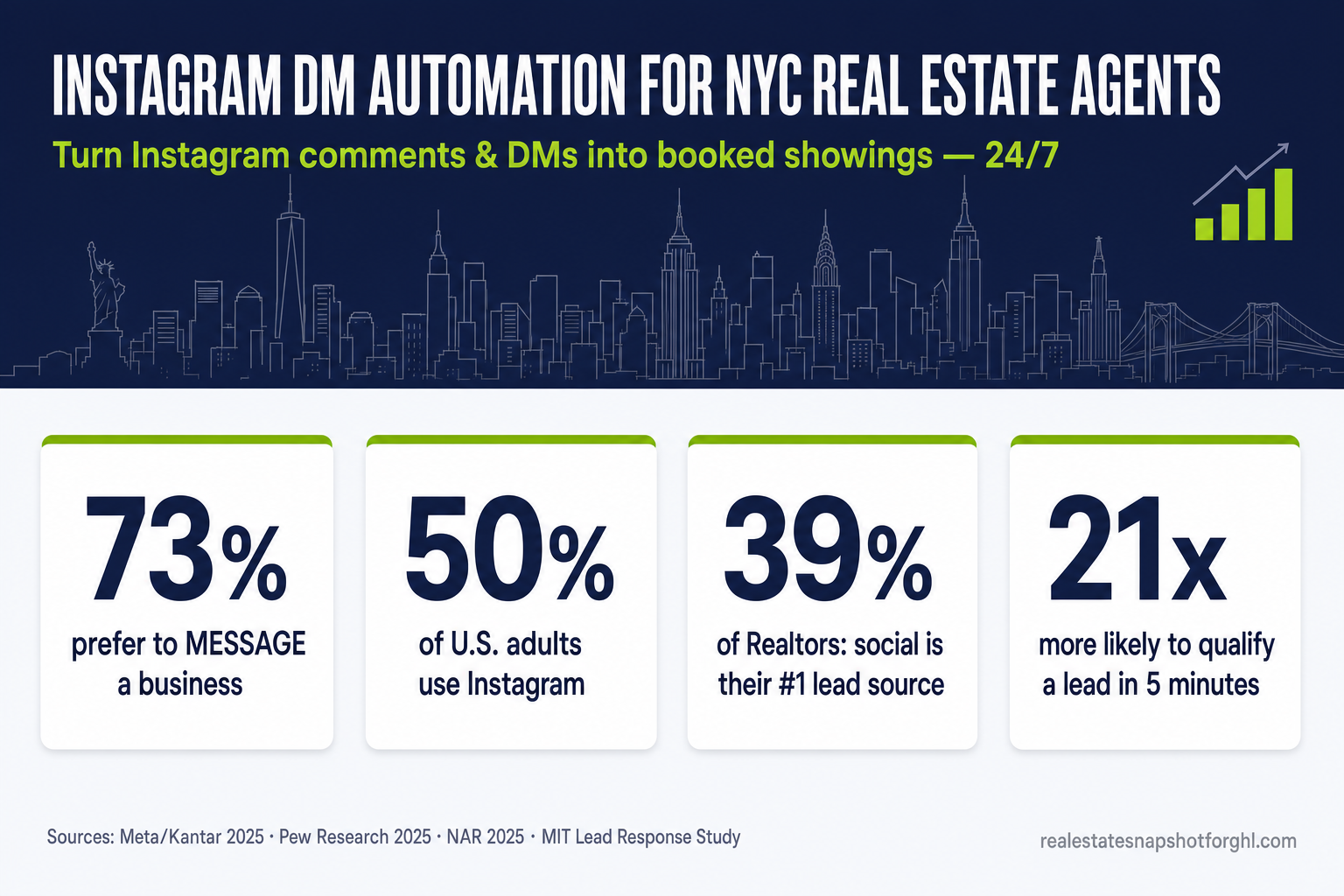
Instagram DM automation for a New York City real estate agent means using an AI agent to reply to every listing comment and direct message in seconds — qualifying the buyer or seller, capturing their name, phone, and goal, and booking the showing straight to your calendar, 24/7. In a market where 73.3% of consumers now prefer to message a business rather than call it (Meta/Kantar, 2025), the “Is this still available?” comment under your listing reel is the lead — and the agent who answers it first wins the tour. This is the step-by-step playbook to build that system for a New York City pipeline.
Here’s the problem it solves. Social media is now the #1 source of high-quality leads for agents — 39% named it their top source, ahead of their CRM (23%) and the MLS (17%) (NAR, 2025). But those leads don’t arrive as tidy form fills; they arrive as comments and DMs, at 11 p.m., while you’re in a co-op board meeting or showing a walk-up in Brooklyn. Miss the window and the buyer messages the next agent. Automating the DM is how a solo NYC agent finally answers all of them — without hiring a night-shift assistant.
Table of contents
- Why NYC agents lose deals in the DMs
- What Instagram DM automation actually does
- The 6-step playbook: comment to booked showing
- Why speed-to-lead is the whole game
- Why buyers would rather message than call
- DIY vs done-for-you DM automation
- The New York City context
- Frequently asked questions
Why NYC agents lose deals in the DMs
New York City is one of the most competitive agent fields in the country. New York State licenses more than 100,000 active real estate salespersons and brokers (NY Dept. of State), a huge share of them chasing the same five boroughs where the typical home value sits near $820,000 and Manhattan tops $1.2 million (Zillow, 2025). In that field, one signed buyer is a five-figure commission — and the difference between winning and losing them is often just who replied to the DM first.
And buyers overwhelmingly still transact through an agent: 88% of buyers purchased their home through an agent or broker, even though 46% start their search online and only 20% begin by contacting an agent (NAR, 2025). Read that sequence carefully: they scroll first, then reach out. Your Instagram is the top of that funnel, and the DM is the moment intent becomes a lead. Leave it unanswered and you’ve handed a warm buyer to whoever answered theirs.
The uncomfortable truth is that the leak isn’t your content — it’s your response. You can shoot a beautiful listing reel that reaches thousands, and still lose every commenter because “Is this still available?” sat unread for six hours. That’s the exact gap speed-to-lead automation is built to close, and on Instagram it starts with the comment.
What Instagram DM automation actually does
Instagram DM automation isn’t a spam bot blasting strangers. For a real estate agent it’s a tightly scoped AI agent that does four things, instantly and around the clock:
- Replies to comments on your posts and reels — “price?”, “is this available?”, “what neighborhood?” — publicly, in seconds, then invites the person to DM for details. High comment-response also signals engagement to the algorithm, which earns you more reach.
- Answers direct messages on Instagram and Facebook Messenger in your brand voice, handling the back-and-forth a buyer expects before they commit to a showing.
- Qualifies and captures the lead — budget, timeline, buying or selling, name, and phone — and drops it into your CRM so nothing lives only in an app you’ll forget to check.
- Books the appointment straight onto your calendar, then hands off to an automated nurture sequence if the person isn’t ready yet.
Two purpose-built agents cover the channels most NYC buyers use: an Instagram DM agent and a Facebook Messenger agent, with a web-chat agent catching the traffic your posts drive back to your site. Together they mean no message — comment, DM, or chat — ever goes cold.
The 6-step playbook: comment to booked showing
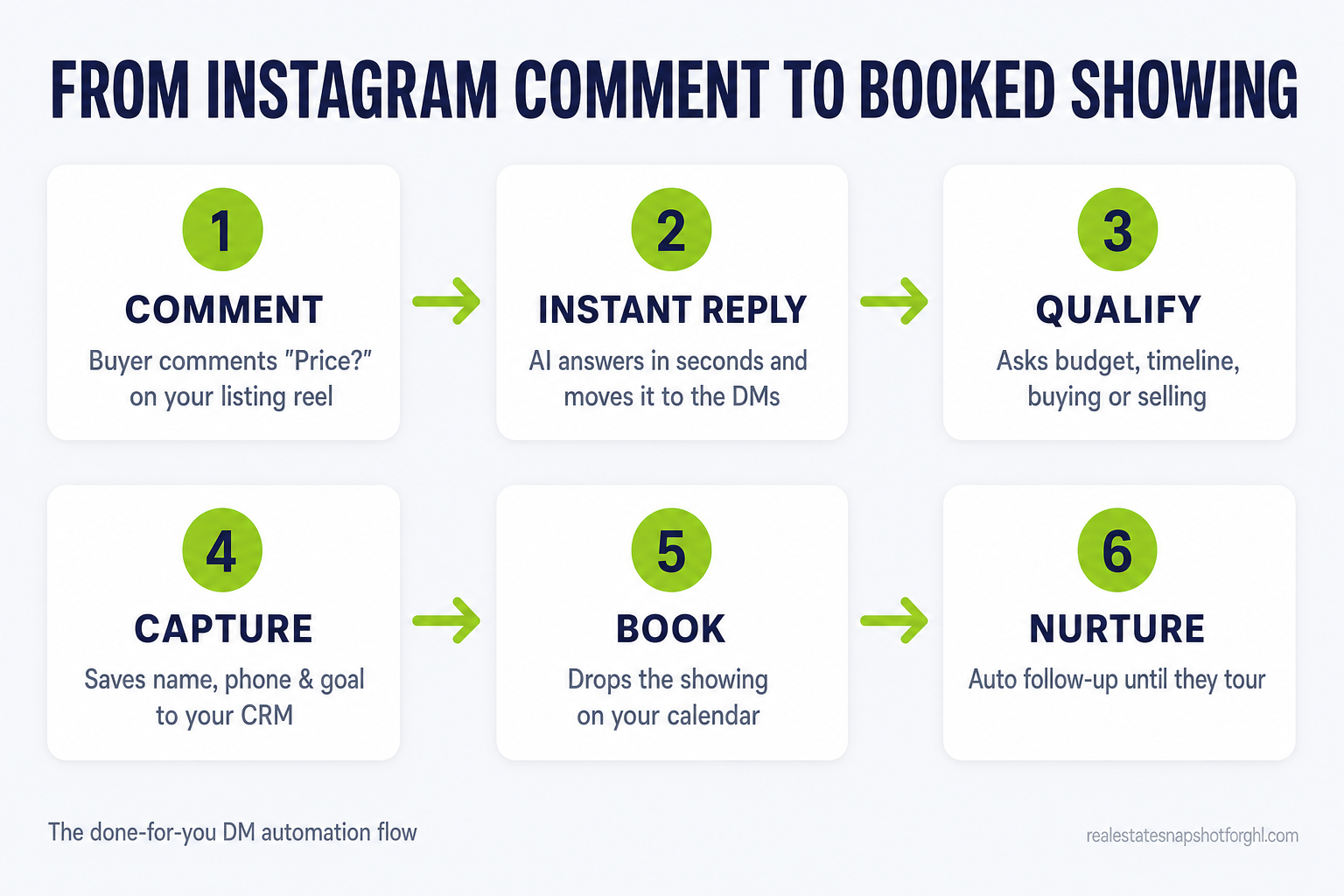
Here’s the exact flow to set up. Whether you build it yourself in GoHighLevel or have it installed for you, the mechanics are the same six steps.
Step 1 — Set your capture triggers
Decide what kicks off the automation. The highest-intent triggers on a real estate account are comments containing keywords (“price”, “available”, “info”, “showing”), story replies, and any new DM. Map each trigger to the right response path — a price question gets the listing details; a “how do I sell?” DM routes into a seller flow. This is the foundation, so keep it specific to the questions your NYC listings actually attract.
Step 2 — Auto-reply to every comment in seconds
When a matching comment lands, the agent posts a public reply immediately (“Just sent you the details in the DMs! 🏙️”) and opens a private message. Two things happen at once: the commenter feels instantly acknowledged, and Instagram sees fast, consistent engagement — which is exactly what it rewards with more reach. Speed here is not optional; it’s the whole point.
Step 3 — Move the conversation into the DM
Public comments can’t collect a phone number, and they invite competitors to swoop into the same thread. So the agent pulls the conversation into the DM, where it can have a real, private exchange. This “comment-to-DM” handoff is the single most important mechanic in the playbook — it turns a public one-liner into a qualified conversation you own.
Step 4 — Qualify with a short, scripted conversation
In the DM, the agent asks the three questions that separate a tire-kicker from a buyer: timeline (are you looking now or browsing?), goal (buying, selling, or both?), and budget or neighborhood. It’s conversational, not an interrogation — two or three quick questions in your voice. By the end you know whether this is a Tribeca buyer ready this month or a first-timer six months out.
Step 5 — Book the showing straight to your calendar
For qualified leads, the agent offers real time slots and books the showing or consult directly onto your connected calendar — no “let me check my availability and get back to you,” which is where most manual DMs die. The lead gets a confirmation and a reminder; you get a calendar invite with their name, phone, and everything they told you.
Step 6 — Hand off to nurture and measure
Not everyone books today, and that’s fine. Anyone who isn’t ready drops into an automated multi-touch follow-up sequence so they stay warm until they are — the same discipline behind a good missed-call text-back system. Then watch the numbers that matter: comments answered, DMs qualified, and showings booked per week. That’s your real ROI, not vanity likes.
Why speed-to-lead is the whole game
Every step above exists to shrink one number: the minutes between a buyer’s message and your reply. The research on this is old but foundational and unambiguous. Contacting an online lead within 5 minutes rather than 30 makes you roughly 21x more likely to qualify it (MIT Lead Response Study). Widen the window and the odds keep collapsing.
The same pattern shows up in Harvard Business Review’s audit of 2,241 U.S. companies: firms that responded within an hour were 7x more likely to have a meaningful conversation with a decision-maker than those who waited longer — and 23% of companies never responded to the lead at all, with an average response time of 42 hours (HBR, 2011). That 23% is the real opportunity. A human agent juggling showings across Manhattan and Queens will miss messages; an AI agent that never sleeps simply doesn’t. Automation isn’t about replacing your judgment — it’s about making sure the first 30 seconds always happen, so your judgment gets a lead to work at all.
Why buyers would rather message than call
There’s a second reason DM automation matters now: buyer behavior has shifted decisively toward messaging. Across 22 markets, 73.3% of consumers prefer messaging when they communicate with a business, 72.4% say they’re more likely to buy from a brand that offers messaging, and 74.6% trust a business more when they can message it (Meta/Kantar, 2025). A phone call feels like a commitment; a DM feels like browsing. For a nervous first-time buyer scrolling co-ops at midnight, that difference decides whether they reach out at all.
And the audience is genuinely there. Instagram reaches 50% of U.S. adults — one of only three platforms above that line, alongside YouTube (84%) and Facebook (71%) (Pew, 2025). It also skews toward prime first-time-buyer age: 78% of 18-to-29-year-olds use Instagram (Pew, 2024). Pair a channel that reaches half the country with a buyer preference for messaging, and the DM stops being a nice-to-have — it’s where the modern NYC buyer expects to meet you. The only question is whether you’re there in seconds or hours. (If you’re still building your organic presence, start with the Instagram lead playbook first, then automate the responses.)
DIY vs done-for-you DM automation
You can build this yourself, and for a tech-comfortable agent that’s a legitimate path. But it’s worth being honest about what “DIY” actually asks of you: configuring triggers, writing conversation flows, connecting a calendar, keeping the AI on-brand, and maintaining it as Instagram’s API and your listings change. Here’s the trade-off, side by side.
Two ways to automate your Instagram DMs
| Done-for-you ($397/mo) | Build it yourself | |
|---|---|---|
| Setup time | Live in days — configured for you on an onboarding call | Weeks of learning triggers, flows, and API quirks |
| Channels covered | Instagram + Messenger DMs, comments, and web chat | Whatever you have time to wire up and maintain |
| Response speed | Seconds, 24/7, in your brand voice | Only as reliable as the automation you built |
| Lead capture | Name, phone, goal + full thread saved to a CRM you own | You build the CRM connection and reporting |
| Calendar booking | Books straight to your synced calendar | Manual integration and testing |
| Ongoing upkeep | Handled — scripts and integrations maintained for you | Yours forever, every time something breaks |
| Monthly cost | $397 flat, all channels + content included | 'Free' but paid in your selling hours |
The DIY column isn’t wrong for everyone — if you have the time and enjoy the tooling, go for it. But most producing NYC agents find their hour is worth far more on a listing appointment than on debugging a comment trigger. That’s the entire case for handing it off: the done-for-you social service ships the three AI agents and the content that feeds them (1 text post, 1 image, 2 carousels, and a reel every week across all 9 channels), so the DMs you’re automating actually have something to respond to. It pairs naturally with the full Real Estate Snapshot if you want those captured leads flowing into deeper CRM nurture.
The New York City context
Nowhere does response speed matter more than in New York City, because nowhere is the competition denser or the stakes higher. With 100,000-plus licensed agents statewide (NY Dept. of State) and NYC home values around $820,000 — north of $1.2 million in Manhattan (Zillow, 2025), the margin between the agent who answered the DM and the one who didn’t is enormous. Even Brooklyn’s median sale price crossed $1 million for the first time in 2025 (StreetEasy, 2025). One recovered buyer pays for a year of automation many times over.
New York buyers and sellers also move fast and expect the same from you. A Long Island City investor comparing three listings, an Astoria first-timer messaging at midnight, an Upper West Side seller quietly DMing about a valuation — they’re all raising a hand on Instagram, and they’ll book with whoever responds like a professional, instantly. DM automation is how a solo agent or small team behaves like a brokerage with a 24/7 front desk, without the payroll. Benchmark yourself against real numbers with our real estate lead conversion benchmarks, then close the response gap that’s costing you deals.
Frequently asked questions
What is Instagram DM automation for real estate agents?
It's an AI agent that automatically replies to comments and direct messages on your Instagram (and Facebook Messenger) in your brand voice — answering listing questions, qualifying the buyer or seller, capturing their name, phone, and goal, and booking a showing straight to your calendar, 24/7. For a New York City agent it means every 'Is this still available?' comment gets an instant, professional response instead of sitting unread while the buyer messages someone else.
Is automating Instagram DMs allowed, or will it get my account banned?
Automated replies through approved tools and Instagram's official messaging APIs are permitted — the key is that the automation is responding to people who contacted you (comments and DMs on your own content), not mass-messaging strangers, which is what violates the rules. Our done-for-you setup connects through the compliant social planner and messaging integrations, so you stay on the right side of platform policy while still answering everyone instantly.
How fast does automation actually respond compared to doing it myself?
In seconds, around the clock. That matters because contacting a lead within 5 minutes rather than 30 makes you about 21x more likely to qualify it (MIT Lead Response Study), and responding within an hour makes you 7x more likely (HBR). A human agent showing properties across the five boroughs can't hit those windows at 2 a.m.; an AI agent does, every time.
How much does done-for-you Instagram DM automation cost in New York City?
Our done-for-you social media service is $397/month for one brand and includes three AI agents (comments, DMs, and web chat) across Instagram and Facebook, plus content across all 9 channels five days a week. Up to 4 brands is $997/month — useful for a team or a brokerage reselling to its agents. Against NYC commissions on an $820K median home, one recovered buyer covers it many times over.
Where do the leads and booked showings actually go?
Everything lands in a CRM you get your own login to. For each lead you see their name, phone, source channel, the goal they told the AI (buying, selling, or both), and the entire DM thread — and every appointment the agent books shows on your calendar. You can connect your Google Calendar so showings sync automatically with no double-entry.
How is this different from the Real Estate Snapshot?
The social media service is an ongoing monthly service that creates your content and runs the AI agents on your Instagram, Messenger, and website. The Real Estate Snapshot is a one-time GoHighLevel install (from $1,197) that builds your full CRM, pipelines, and nurture automations. They pair well — social captures the lead in the DM, the snapshot nurtures it to close. Many NYC agents run both, or book a walkthrough to decide where to start.
About the author. Devin Callahan is a GoHighLevel Implementation Lead who has installed snapshots for solo agents and 40-seat brokerages alike. He cares most about the parts clients never see — clean tagging, sane pipeline stages, and automations that answer a buyer in seconds without double-texting them at 2 a.m. He writes about implementation, integrations, and keeping a real estate CRM from turning into a junk drawer. Devin is a fictional editorial persona created for Real Estate Snapshot.
Related reading
- Speed-to-Lead for Realtors: The 5-Minute Rule That Wins Listings
- Instagram for Real Estate Agents: The 2026 Lead Playbook
- Real Estate Social Media Management in Los Angeles: Why DIY Posting Costs Agents Listings
- Missed-Call Text-Back for Real Estate: Never Lose Another Buyer
- Real Estate Lead Conversion Benchmarks: What Good Actually Looks Like