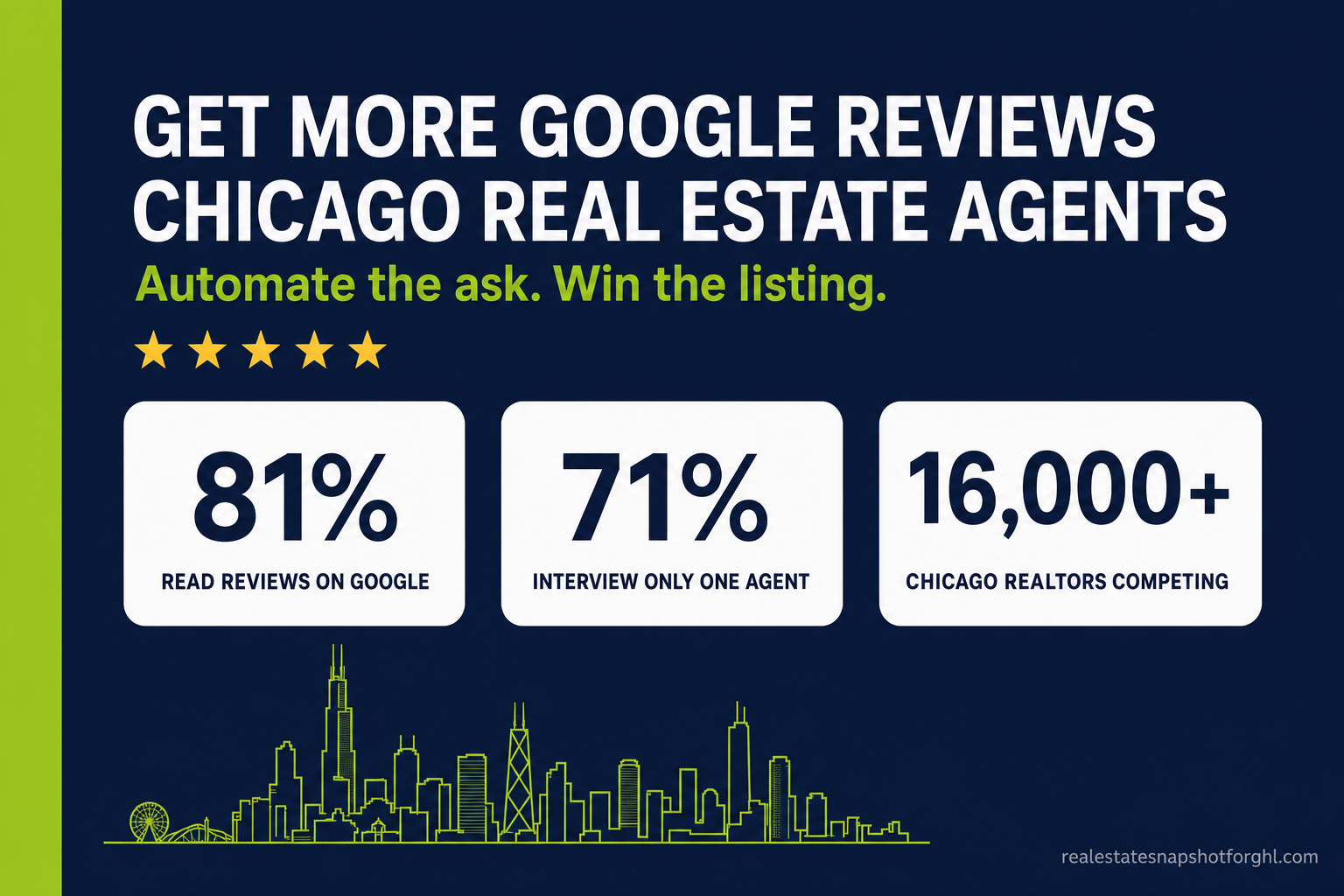
In a city with more than 16,000 members of the Chicago Association of REALTORS® (Chicago Association of REALTORS®), a listing appointment is rarely won on price or a polished pitch alone — it’s won before you ever walk in, on the proof a seller finds when they Google your name. The fastest way for a Chicago real estate agent to get more Google reviews is to stop asking from memory and let an automated sequence ask every closed client at the exact right moment. Do that and your review count compounds while your competitors keep meaning to send that text.
This is a step-by-step playbook for building that system — what to send, when to send it, how to route happy clients to Google while catching unhappy ones privately, and how to wire the whole thing so it runs without you. Every number below is sourced, and the CTA is simple: this is the same review harvesting automation we install inside a real estate agent’s GoHighLevel account.
Table of contents
- Why reviews decide Chicago listings
- Why doing it manually always fails
- The 5-step automated review system
- Manual asking vs. automated harvesting
- Chicago-specific playbook notes
- How we set it up inside GoHighLevel
- FAQ
Why reviews decide Chicago listings
Real estate is a referral-and-reputation business, and the data says so plainly. In NAR’s most recent buyer/seller research, 88% of buyers purchased their home through a real estate agent, and 40% of all buyers — 51% of first-time buyers — found that agent through a referral from a friend, neighbor, or family member (NAR, 2024). A referral gets your name into the conversation. Your Google reviews are what that referred lead reads next, before they decide whether to actually call you.
And the window is unforgiving: 71% of repeat buyers interviewed only one agent before choosing (NAR, 2024). When someone weighs which agent to choose, the factors they rank highest are experience, honesty and trustworthiness, and reputation — and reviews are the public, third-party proof of exactly those things.
Then there’s where that reading actually happens. 81% of consumers use Google to read reviews of local businesses (BrightLocal, 2024) — more than Facebook, Yelp, or any industry site. For a Chicago agent, that makes your Google Business Profile the highest-leverage review asset you own, ahead of even Zillow and Realtor.com (which still matter — you want reviews on all three).
Why doing it manually always fails
Every agent means to ask for the review. Almost none do it consistently — and it’s not a discipline problem, it’s a timing problem. The satisfaction peak is the day of closing and the few days after. That’s exactly when you’re buried in the next three deals, driving to a showing, or catching your breath. Three weeks later, when things finally slow down, the client has moved on emotionally and the ask feels awkward.
The result is the familiar gap: an agent closes 20 transactions in a year and adds three Google reviews, while the team down the street with the same volume adds 40. The difference isn’t charm. It’s that one side asks automatically, at the moment satisfaction is highest, and the other side asks from memory.
The data backs up how much the ask itself moves the needle. The share of consumers who say they always leave a review when asked rose from 12% in 2023 to 19% in 2024, and 69% recall leaving a review after a business prompted them in the past year (BrightLocal, 2024). People are increasingly willing — they just need to be asked, once, at the right time, with a one-tap link.
There’s a freshness angle too. Reviews aren’t a trophy case you fill once — buyers increasingly discount old ones. In BrightLocal’s 2024 survey, one in five consumers (20%) said a review needs to be within the last two weeks to feel relevant, and that recency demand keeps climbing (BrightLocal, 2024). A pile of reviews from two years ago reads as “used to be busy.” A steady trickle of new ones reads as “in demand right now” — and Google’s local algorithm rewards that velocity, with review signals accounting for roughly 16% of local pack ranking factors (Whitespark, 2025). Only automation keeps the trickle going without you.
The 5-step automated review system
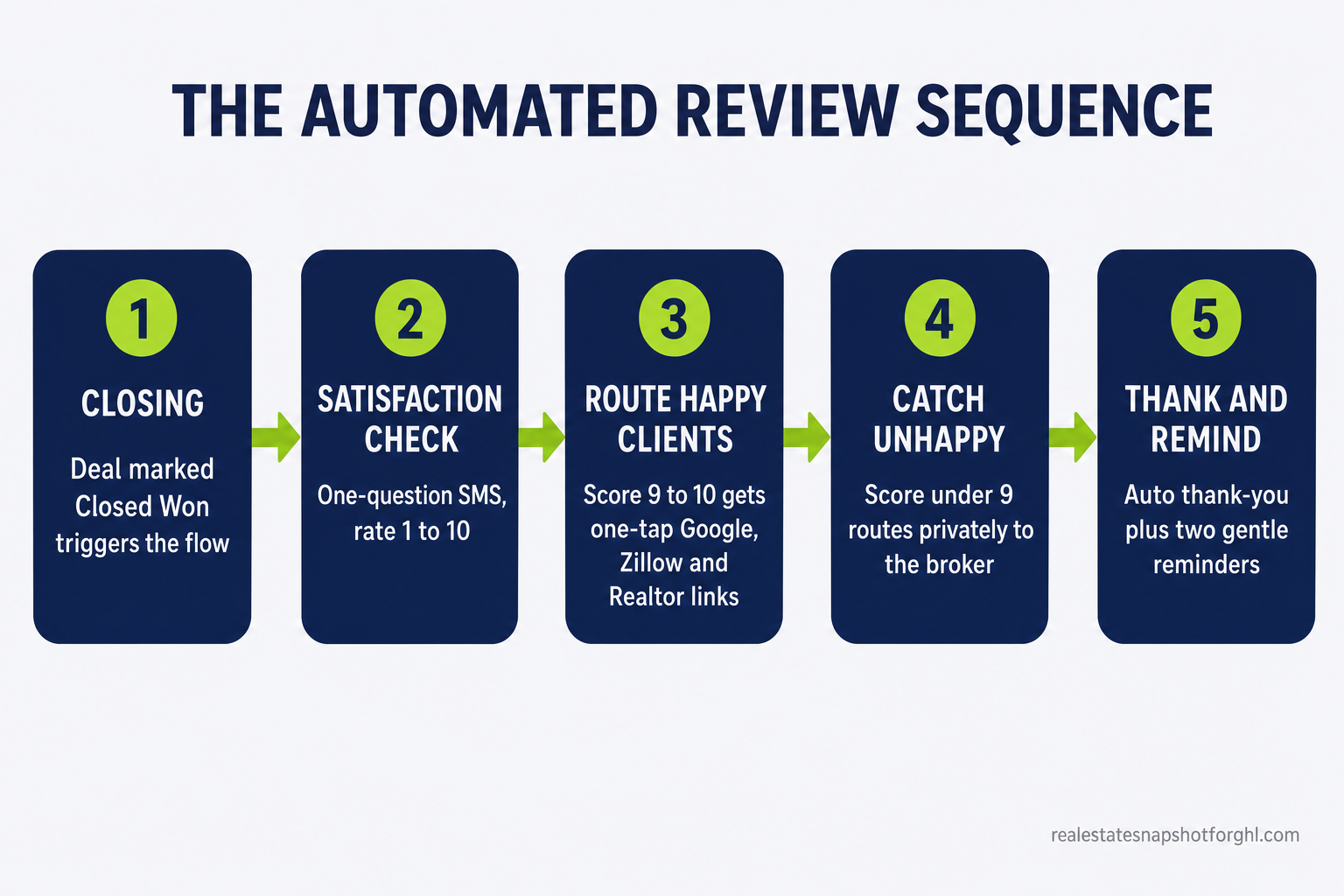
Here’s the exact sequence to build. It runs entirely inside GoHighLevel, fires off your closing, and never asks a client twice by hand.
Step 1 — Trigger off the closing
The whole system hangs on one event: a deal reaching Closed Won. In GoHighLevel that trigger can be a pipeline-stage move, a calendar event tagged “closing,” a manual tag you drop, or a date-based fire off a “close date” custom field (typically 7 days after closing, sometimes 14). Pick one and stay consistent. The point is that no closing can happen without the sequence starting — you remove yourself from the loop entirely.
Step 2 — Send a one-question satisfaction check
Do not lead with “leave me a Google review.” Lead with a genuine, low-friction check-in a week after the dust settles:
“Hi Maria — now that you’re settled into the new place in Logan Square, how would you rate your experience working with me, 1 to 10?”
One question, one tap. This does two jobs: it re-opens a warm conversation, and it segments clients by satisfaction before you ask anything public of them.
Step 3 — Route happy clients straight to Google
Anyone who answers 9 or 10 immediately gets the review request — Google first (your highest-leverage platform), then Zillow, then Realtor.com — each as a one-tap link pre-filled with your name so the client types nothing. Make Google the primary ask; that’s where 81% of the reading happens.
Step 4 — Catch unhappy clients privately
Anyone who scores 8 or below does not get sent to Google. They get a soft, private “What could we have done better?” that routes their feedback straight to you or the broker — never to a public platform. Anything in the low range triggers an immediate personal call. This is the part that protects your rating: you learn about a problem in your inbox instead of on your profile, and you get the chance to make it right.
Step 5 — Thank, then remind
Most happy clients who intend to post don’t do it the first day. The sequence sends two gentle reminders over the following two weeks, then stops. The moment a review is posted, an automatic thank-you goes out and the contact rolls into your long-term sphere-of-influence nurture — because a client happy enough to review is your best future referral source. Pair this with a post-close referral engine and one closing produces a review and a warm referral ask.
Manual asking vs. automated harvesting
The difference isn't effort — it's timing and consistency
| Automated harvesting | Asking manually | |
|---|---|---|
| When the ask happens | Every closing, 7 days out, automatically | Whenever you remember — often never |
| Client friction | One-tap, pre-filled Google/Zillow link | "Search my name and scroll down" |
| Bad experiences | Caught privately before they go public | Discovered when a 2-star appears |
| Freshness / velocity | Steady drip Google rewards | Sporadic, clumpy, easily stale |
| Reminders | Two automatic, then stop | One awkward text, if that |
| Result over 20 closings | Compounding review count | A handful, at best |
Chicago-specific playbook notes
A few local realities make automated reviews especially worth it in Chicago:
The field is crowded. With 16,000+ members in the Chicago Association of REALTORS® (CAR) and roughly 50,000 REALTORS® statewide (Illinois REALTORS®), a referred seller comparing you to two other agents will use review count and recency as the tiebreaker. Being the one with 120 fresh Google reviews instead of 12 is a durable, compounding edge.
Neighborhood-level trust matters. Chicago buyers shop by neighborhood — Lincoln Park, Pilsen, Hyde Park, Logan Square all behave like distinct micro-markets. Reviews that mention the specific area you closed in (“she nailed our Avondale two-flat”) double as hyper-local social proof and reinforce your local SEO for real estate. The automation’s satisfaction message can gently prompt clients to mention the neighborhood.
The stakes per deal are real. With a Chicago median sale price around $375,000 (Redfin, 2026), each listing you win or lose to a better-reviewed competitor is a meaningful commission. A review system that tips even one interview a quarter your way pays for itself many times over.
How we set it up inside GoHighLevel
The review sequence isn’t a standalone gadget — it’s one piece of the Real Estate Snapshot we install in your GoHighLevel account, wired into the rest of your pipeline so a closing automatically becomes a review, a thank-you, and a referral ask.
- We connect your trigger. Whatever marks a deal “closed” in your world — a pipeline stage, a calendar event, a close-date field — becomes the fire point, so nothing depends on you remembering.
- We pre-build the review links. Tracked, one-tap Google, Zillow, and Realtor.com links signed with your name, so clients type nothing and Google gets the priority ask.
- We wire the private catch. Score-based routing sends unhappy clients to you or the broker for a call, never to a public profile.
- We connect it to reviews you already have. Pair harvesting with Google Business Profile reply automation so every new review gets a fast, on-brand response — another local ranking signal.
Prefer to have someone run the whole thing for you? Our hire-a-GHL-VA service operates the automation, monitors the responses, and handles the private follow-ups, so your reputation grows without adding to your plate. Want the broader reputation strategy first? Start with our autopilot reviews playbook and the real estate follow-up sequences that keep every closed client engaged. When you’re ready to see it live, book a demo and we’ll show the sequence route a real 10-out-of-10 client straight to Google.
Frequently asked questions
How do Chicago real estate agents get more Google reviews?
The reliable way is to automate the ask: trigger a short satisfaction check about a week after every closing, route clients who score 9–10 to a one-tap Google review link (Zillow and Realtor.com next), and send two gentle reminders. Asking automatically at the moment satisfaction is highest — instead of from memory weeks later — is what separates agents with 100+ fresh reviews from those with a handful. Since 81% of consumers read reviews on Google (BrightLocal, 2024), Google should be your primary ask.
Is it against Google's policy to route unhappy clients away from a review?
You should never suppress or gate reviews — every client is free to post publicly at any time, and the one-tap links stay available to anyone. What the automation does is decide who gets proactively asked to review based on a private 1–10 satisfaction check, and it routes lower scores to a private conversation first so you can make things right. It never blocks a client from reviewing; it just prioritizes the happiest clients for the public ask and gives you a chance to resolve problems directly.
How many reviews should a Chicago agent aim for?
There's no magic number, but volume and freshness both matter. With 16,000+ REALTORS® in the Chicago Association of REALTORS® (CAR), you're compared side by side — aim to out-review the agents in your neighborhood and, just as importantly, to keep a steady drip of new reviews. Roughly one in five consumers wants reviews from the last two weeks (BrightLocal, 2024), so consistency beats a one-time push.
Which platform matters most — Google, Zillow, or Realtor.com?
Google is the highest-leverage platform because 81% of consumers read reviews there (BrightLocal, 2024) and reviews feed your Google Business Profile's local ranking. Zillow and Realtor.com still matter for buyers deep in a property search, so the automation asks for all three — Google first, then Zillow, then Realtor.com.
How long does it take to set up automated review harvesting?
It's part of the Real Estate Snapshot, which we install in your GoHighLevel account fast — typically live in about a day. We connect your closing trigger, pre-build the tracked review links, wire the private catch for unhappy clients, and turn on the reminder cadence. The quickest way to start is to book a demo and watch it run.
Why not just ask clients in person at closing?
You can and should — but in-person asks are inconsistent because closings are chaotic and satisfaction peaks in the days after, not during the paperwork. The share of consumers who always review when asked rose to 19% in 2024 (BrightLocal), so the ask works — automation just makes sure it actually happens every time, with a one-tap link, instead of relying on a busy agent's memory.
About the author. Priya Rangan is a Listing & Conversion Specialist who cut her teeth on the seller side, turning expired and FSBO leads into signed agreements through patient, multi-touch outreach. She’s obsessed with the full seller journey — from first valuation request to the post-close review ask — and translates it into SMS, email, and AI sequences that feel personal at scale. Priya is a fictional editorial persona created for Real Estate Snapshot.